
Amyelois
Amsel, 1956
navel orangeworm
Species Guides
1- Amyelois transitella(Navel Orangeworm)
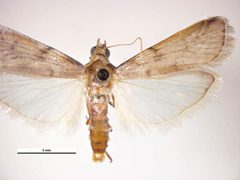
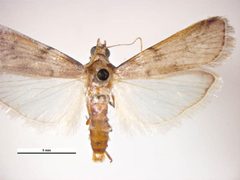
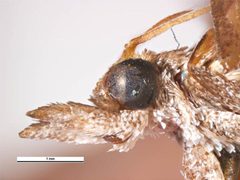
Amyelois is a of snout moths (Pyralidae) containing a single , Amyelois transitella, commonly known as the navel orangeworm. The species is to the tropical Western Hemisphere, including the southern United States, and has become a major agricultural pest in California nut orchards. Its abundance increased substantially during the first half of the 20th century.
Pronunciation
How to pronounce Amyelois: /ˌæm.aɪˈɛ.loʊ.ɪs/
These audio files are automatically generated. While they are not always 100% accurate, they are a good starting point.
Identification
Amyelois transitella can be distinguished from the related Pyralis farinalis by differences in blend composition and reproductive isolation; males of P. farinalis have been observed attempting to mate with female A. transitella, but these copulations do not produce offspring. Specific morphological diagnostic characters for field identification are not provided in available sources.
Images
Appearance
are small with wingspan of 9.7 to 10.9 mm. Individual adults weigh approximately 7 mg. No detailed coloration or pattern description available from sources.
Habitat
Agricultural and orchard systems in southwestern United States and Mexico. Laboratory rearing conditions include temperatures of 25-28°C, 65-75% relative humidity, and 16:8 hour light:dark .
Distribution
Native to southwestern United States and Mexico; first recorded in Arizona in 1899. to the tropical Western Hemisphere. Abundant in California, where increased greatly during the first half of the 20th century. Currently present in North and South America; absent from EU territory but climate suitability models indicate potential for establishment in Southern and Mediterranean areas of Europe if introduced.
Seasonality
are on wing from the end of March to the end of October in California. Mating activity primarily occurs during the last hour of scotophase and first 30 minutes of photophase. Approximately 80% of mating occurs within the first two days after adult .
Host Associations
- Prunus dulcis - larval food sourcealmond
- Pistacia vera - larval food sourcepistachio
- Juglans regia - larval food sourcewalnut
- Ficus carica - larval food sourcefig
- Citrus sinensis - larval food sourcenavel orange (damaged/rotting)
Life Cycle
Complete . are orange-colored and laid on substrate. Larval development occurs on material; in laboratory conditions, larvae develop on dried roasted pistachio at 28±2°C. occurs inside pistachios or on cage surfaces. emerge with protandry (males emerge before females).
Behavior
Female calling involves protrusion between wings with segments perpendicular to body, exposing the , accompanied by continuous . Male courtship includes wing fanning and antennation from short distance. Female acceptance is signaled by lowering the abdomen; rejection by away. Post-copulation, the male rotates 180° into a linear abdomen-to-abdomen position, remaining in this position for over 3 hours on average. Mated females fly significantly longer and farther than unmated females, potentially representing appetitive ranging behavior searching for oviposition cues. Females are monandrous (mate once); males are polygynous with approximately 55% mating once, 40% twice, and 5% three times.
Ecological Role
Major agricultural pest of almond and pistachio in California; also damages walnut and fig crops. Larvae directly feed on nuts, reducing quality and yield. can introduce fungi that produce aflatoxins. Opportunistic colonizer with long- capacity contributing to spread. Target for including -based , postharvest , and applications.
Human Relevance
Significant economic pest of California nut crops. identification has enabled practical applications of in agricultural fields, significantly reducing use. Subject of research for sterile insect technique (SIT) development, though mass-rearing and irradiation currently impair male performance and response. Research on oviposition repellents shows promise for additional management tools.
Similar Taxa
- Pyralis farinalisFemales release very similar , specifically (Z,Z)-11,13-hexadecadienal; males of P. farinalis have been observed attempting to mate with female A. transitella, but these copulations do not produce offspring, indicating reproductive isolation.
More Details
Pheromone research
Walter Leal and colleagues identified the system of A. transitella, leading to practical applications of in agricultural fields.
Sterile insect technique challenges
Mass-reared and irradiated males show substantially reduced capacity and impaired ability to locate and contact sources, presenting challenges for SIT implementation. Female flight capacity appears unaffected by mass-rearing conditions.
Sources and further reading
- BugGuide
- Wikipedia
- GBIF taxonomy match
- iNaturalist taxon
- NCBI Taxonomy
- Catalogue of Life
- Walter Leal Selected to Give ESA Founders' Memorial Award Lecture | Bug Squad
- Congrats to NAI Fellow UC Davis Distinguished Professor Walter Leal | Bug Squad
- Looking for Lygus | Bug Squad
- Amazing Project | Bug Squad
- A Good Day on the UC Davis Campus | Bug Squad
- Why Flight Testing is an Important Step in Sterile Insect Technique
- Sex Pheromone Mediated Behavior of the Navel Orangeworm, Amyelois transitella12
- Sexual behavior of the navel OrangeWorm, Amyelois transitella (Walker) (Lepidoptera: Pyralidae)
- Effect of Female Flight Activity on Reproduction in the Navel Orangeworm (Amyelois transitella)
- Factors Associated with Variation in Cuticular Hydrocarbon Profiles in the Navel Orangeworm, Amyelois transitella (Lepidoptera: Pyralidae)
- Climate suitability analysis in the context of EFSA Pest Risk Assessment. Amyelois transitella, the navel-orange worm, as a case study
- Evaluating Response of Mass-Reared and Irradiated Navel Orangeworm, Amyelois transitella (Lepidoptera: Pyralidae), to Crude Female Pheromone Extract
- An in vivo study of intracytoplasmic membranous structures associated with chronic stunt virus infection in granular hemocytes of Amyelois transitella
- Parasitization of Goniozus legneri (Hymenoptera: Bethylidae) at Increasing Parasite and Host, Amyelois transitella (Lepidoptera: Phycitidae), Densities