
Melanophora roralis
(Linnaeus, 1758)
Smoky-winged Woodlouse Fly, woodlouse fly
Melanophora roralis is a small fly (3–5.5 mm) commonly known as the smoky-winged fly. It is native to the Palaearctic region but has been introduced to the Americas. The is a specialized parasitoid of terrestrial isopods (woodlice), with larvae developing internally and killing the .
Pronunciation
How to pronounce Melanophora roralis: /mɛˌlænoʊˈfɔːrə roʊˈrælis/
These audio files are automatically generated. While they are not always 100% accurate, they are a good starting point.
Identification
Images
Appearance
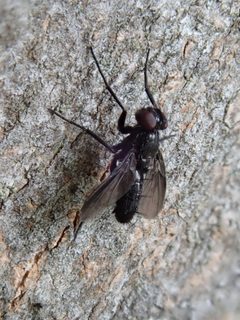
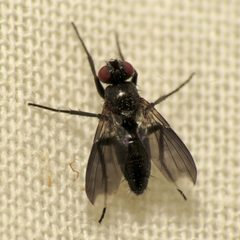
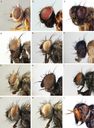
Small black fly measuring 3–5.5 mm in length. are hairy. is shiny. Wings are darkened; females possess a distinctive white patch at the wing tip. Body coloration is uniformly black.
Habitat
Found in old forests, damp areas near shorelines, under bark, under stones, and among vegetation in upper seashore regions. Also occurs in anthropogenic settings including outhouses and gardens. frequently rest on light-colored vertical surfaces such as walls or rocks.
Distribution
Native to the Palaearctic region (excluding northernmost areas) and the Afrotropical region (Cape Verde). Introduced to the Nearctic region (Southern Ontario) and Neotropical region (Chile and Argentina). Present in Britain and Ireland, and on the Azorean islands of Faial, São Miguel, and Terceira. Also recorded from Denmark and Norway.
Seasonality
are active from mid-May to October.
Diet
Larvae are obligatory of woodlice and other terrestrial isopods, feeding internally and killing the . do not require a meal for ovarian maturation.
Host Associations
- Porcellio scaber - primary Well-documented natural
- Cylisticus convexus - laboratory Successfully reared in captivity
- Porcellio dilatatus - laboratory Successfully reared in captivity
- Porcellionides floria - laboratory Successfully reared in captivity
- Porcellionides pruinosus - laboratory Successfully reared in captivity
- Oniscus asellus - Recorded as
- Asopia farinalis - possible larva; record from single source (Séguy 1941) with uncertain validity
- Larinioides cornutus - possible Spider -cocoons; record from older sources with less certainty
Life Cycle
hatch after approximately 7 days. Larvae pass through three instars. The first instar larva attaches to a and penetrates the intersegmental of a recently moulted . Internal feeding continues until the host is killed; the larva then pupates inside the host remains. may take up to 21 days.
Behavior
First instar larvae rest on the end perpendicular to the substrate. When disturbed, they extend anteriorly and move in circular or figure-of-eight motions while searching for a . Locomotion includes somersaulting. Larvae attach to any moving object but only remain on suitable hosts. Females perform wing fluttering during oviposition. Mating occurs without pre-feeding: females are receptive within an hour of , males usually after twelve hours. A mating dance involving wing fluttering is initiated by the female.
Ecological Role
Acts as a regulating of woodlice and other terrestrial isopods. May also target spider -cocoons and larvae, though these associations are less certain.
Human Relevance
No significant direct impact on human health or agriculture. Presence in gardens and outhouses indicates to human-modified environments.
Similar Taxa
- Other RhinophoridaeShare general body plan and lifestyle, but most lack the distinctive white wing-tip patches of female M. roralis and differ in associations.
- Calliphoridae (sensu lato)Historically confused due to taxonomic reclassification; M. roralis was previously placed in Calliphoridae but differs in smaller size, darkened wings, and specialized versus the carrion-feeding habits of most blow flies.
Misconceptions
Formerly classified in Calliphoridae; modern places it in Rhinophoridae based on morphological and molecular evidence.
More Details
Genome
A high-quality assembly of 565.10 Mb has been generated, with 98.9% scaffolded into 6 chromosomal pseudomolecules including the X . The assembly contains 20,321 protein-coding genes.
Oviposition
Females lay in batches of 4–8 in bark cracks contaminated with uropod secretions. Total ranges from 150–450 eggs laid within approximately 6 hours. Females die 1–3 days after oviposition.