
Melanophora
woodlouse flies
Species Guides
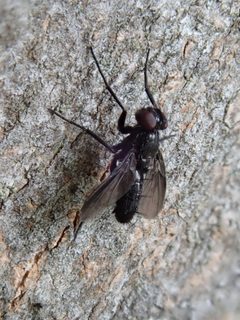
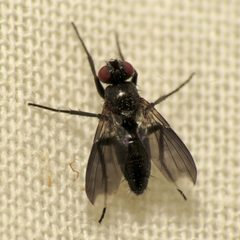
1- Melanophora roralis(Smoky-winged Woodlouse Fly)
Melanophora is a of small flies commonly known as woodlouse flies. are internal parasitoids of terrestrial isopods (woodlice), with larvae developing inside and eventually killing their . The genus has a broad distribution across multiple biogeographic regions, including native Palaearctic and Afrotropical ranges and introduced in the Nearctic and Neotropics. are typically active from spring through autumn and are often observed resting on light-coloured vertical surfaces.
Pronunciation
How to pronounce Melanophora: //ˌmɛləˈnɒfərə//
These audio files are automatically generated. While they are not always 100% accurate, they are a good starting point.
Identification
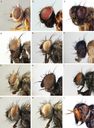
Distinguished from similar calliphorid and rhinophorid flies by the combination of small size (under 6 mm), entirely black body, and conspicuously darkened wings. The 'woodlouse fly' and association with provides additional context. Separation from other Rhinophorinae requires examination of male genitalia and other fine morphological characters.
Images
Habitat
Found in microhabitats associated with woodlice: under bark, stones, and among vegetation in upper seashore regions. frequently rest on light-coloured vertical surfaces such as walls or rocks. Also recorded from outhouses and gardens.
Distribution
Native to the Palaearctic region (excluding northernmost parts) and Afrotropical region (Cape Verde). Introduced to Nearctic and Neotropical regions. Present in Britain and Ireland.
Seasonality
active from May to October in temperate regions.
Host Associations
- Porcelio scaber - internal confirmed
- Cylisticus convexus - internal confirmed
- Porcellio dilatatus - internal confirmed
- Porcellionides floria - internal confirmed
- Porcellionides pruinosus - internal confirmed
- Oniscus asellus - internal confirmed
Life Cycle
Females lay in bark cracks contaminated with secretions, depositing 150–450 eggs in batches of 4–8. Eggs hatch after approximately 7 days. First instar larvae exhibit specialized : resting on their end perpendicular to the substrate, extending anteriorly when disturbed, and moving in circular or figure-eight patterns; capable of somersaulting locomotion. Larvae attach to moving objects but only persist on suitable woodlouse . They penetrate the intersegmental of recently moulted woodlice, feed internally through three larval instars, kill the host, and pupate within the host remains.
Behavior
characteristically rest on light-coloured vertical surfaces including walls and rocks. Females initiate mating with a wing-fluttering display; males join briefly before copulation. Females continue wing fluttering during oviposition. Males typically copulate 12 hours after ; females are ready to mate within one hour without requiring a pre-oviposition meal. First instar larvae exhibit distinctive defensive and -seeking movements including somersaulting and circular motion patterns.
Ecological Role
of woodlice (terrestrial isopods), contributing to regulation of in soil and litter .
Human Relevance
No direct economic or medical significance. Occasionally encountered in gardens and outhouses. of Melanophora roralis sequenced as part of biodiversity initiatives.
Similar Taxa
- Other Rhinophorinae generaShare general body plan and lifestyle; distinguished by wing coloration, size, and genitalic
- Small black Muscidae or FanniidaeSimilar size and coloration; distinguished by darkened wings and association with
More Details
Taxonomic placement
Long classified in Calliphoridae, Melanophora is now placed in Rhinophoridae based on molecular and morphological evidence. The includes at least six described .
Genomic resources
The of Melanophora roralis has been sequenced, comprising 565.10 Mb with 20,321 protein-coding genes, scaffolded into 6 chromosomal pseudomolecules including the X .