
Porcellionides pruinosus
(Brandt, 1833)
Powderblues, powder blue woodlouse
Porcellionides pruinosus is a terrestrial isopod () native to Europe that has achieved global distribution through human-mediated . The is detritivorous and occupies diverse terrestrial from agricultural fields to desert margins. It is suspected to represent a cryptic , with ten currently recognized and significant morphological and reproductive variation documented across . The species carries endosymbionts that can induce feminization of males and , affecting population sex ratios. P. pruinosus has become popular in the pet trade, with numerous color morphs selectively bred.
Pronunciation
How to pronounce Porcellionides pruinosus: //pɔːrˈsɛliənaɪdiːz pruːɪˈnoʊsəs//
These audio files are automatically generated. While they are not always 100% accurate, they are a good starting point.
Identification
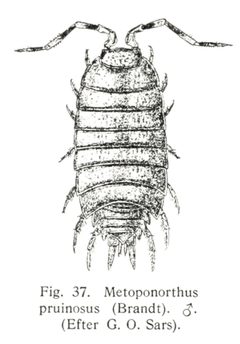
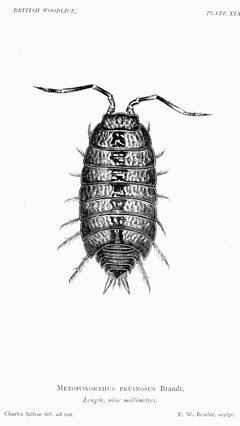
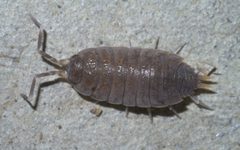
The powdery coating distinguishes P. pruinosus from most other European porcellionid woodlice. The combination of subrectangular cephalon, pale reticulate patterning, and spear-shaped uropods provides diagnostic morphological characters. In regions where it co-occurs with Porcellio , the more oval body shape and distinct pruinosity are useful field characters. Cryptic species within the P. pruinosus complex may require molecular or detailed morphometric analysis for definitive identification.
Images
Habitat
Occupies diverse terrestrial microhabitats including agricultural fields, grasslands, forest edges, urban gardens, and semi-arid environments. In the Negev Desert, observed inside nests and along foraging trails, suggesting use of subterranean refugia. Shows ecological adaptability across Mediterranean, temperate, and semi-arid climatic zones. Agricultural in southern Iraq supported high densities, particularly in spring.
Distribution
distribution; native to Europe with introduced worldwide. Documented from: Tunisia (multiple populations studied phenetically), Greece (Athens), France, Belarus (Gomel region, 2020), southern Iraq (Dhi Qar Province), Negev Desert (Israel), Azores (Faial, Flores, Pico), and widespread in North America as an introduction. The ' broad distribution reflects human-mediated .
Seasonality
Reproductive activity varies by : some show continuous year-round (Tabarka, Korba, Tamerza in Tunisia; Togo; Saint-Cyran, France), others seasonal reproduction (Garat Nâam, Raccada, Sahline, Gafsa, Rdayef, Gabès in Tunisia; Athens, Greece). In southern Iraq, peak population densities occurred in March and April (spring), with lowest densities in winter months. Wild lifespan is 11-14 months; captive individuals may live 2-3 years.
Diet
, feeding on decaying organic matter. Specific dietary components not documented beyond general detritivory.
Life Cycle
Direct development without free-living larval stages. Females carry and developing young (mancae) in a pouch (marsupium) until they are ready to emerge as miniature . Reproductive strategy varies geographically: (multiple broods) in tropical , with potential for in some temperate populations. Growth rates and population structure have been documented in field studies at Garat Nâam, Tunisia.
Behavior
Exhibits , with disaggregation response used as an ecotoxicological endpoint. Shows risk-related behavioral plasticity: artificial light at night disrupts behavioral repeatability, prolongs freezing response to threats, increases shelter-seeking, and reduces . In the Negev Desert, demonstrates trail-following behavior along foraging paths and enters ant nests, possibly using ant cues for orientation. Homing ability demonstrated: displaced individuals can return to trails, with return time increasing with displacement distance.
Ecological Role
Soil contributing to decomposition and nutrient cycling. Potential bioindicator of soil health and stability in disturbed agroecosystems, as suggested by studies in southern Iraq. Serves as a model organism for ecotoxicological research including pharmaceutical , heavy metal , and infochemical disruption assays.
Human Relevance
Widely used as a laboratory model organism for ecotoxicology, reproductive , and - interaction studies. Popular in the pet trade as a feeder organism for reptiles and amphibians, and increasingly as a pet in its own right with selectively bred color morphs commanding high prices. Documented as a associated with human-modified environments.
Similar Taxa
- Porcellio scaberCommon European lacking the distinct coating; more heavily sculptured surface
- Porcellio dilatatusAnother porcellionid with broader body form and different uropod shape
- Armadillidium vulgareConvergent in use but in different (Armadillidiidae); capable of conglobation (rolling into ball) which P. pruinosus cannot perform
More Details
Wolbachia Endosymbiont Interactions
P. pruinosus carries bacteria that can induce feminization of genetic males and , leading to female-biased sex ratios. prevalences are high in many , associated with elevated inbreeding coefficients. However, population genetic diversity may be maintained through multiple paternity and fluctuating population sizes. Multiple Wolbachia strains have been detected, showing -dependent infection patterns across the .
Cryptic Species Complex
P. pruinosus is suspected to comprise multiple cryptic based on significant morphological heterogeneity, reproductive strategy differences (continuous vs. seasonal), and genetic structure. Phenetic analysis of Tunisian and Greek populations revealed geographic clustering rather than reproductive-mode clustering, with Tabarka and Garat Nâam populations being most divergent. Genetic and crossbreeding studies are needed to resolve taxonomic status.
Ant Association
First documented association reported in 2022-2023 with Messor ebeninus harvester ants in the Negev Desert. Isopods occurred at densities up to 60 individuals along 22-meter foraging trails, entered nests, and showed minimal aggression from ants. This commensal or mutualistic relationship may provide thermal , access to food resources, or avoidance.
Sources and further reading
- BugGuide
- Wikipedia
- GBIF taxonomy match
- iNaturalist taxon
- NCBI Taxonomy
- Catalogue of Life
- Ants in the Nest: A Possible Emerging Pressure on Sea Turtles
- Periodical Cicadas, 2024: Entomologists Prepare for the Six-Week Serenade
- A “superb” southwestern Missouri cicada | Beetles In The Bush
- Bug Eric: Wasp Wednesday: Pacific Cicada Killer
- Psychidae | Beetles In The Bush
- Brood's Clues: New Mapping Approach Puts Cicadas in Focus
- Antibiotics effects on the life history traits of Porcellionides pruinosus (Crustacea: Oniscidea)
- Analyse phénétique des populations de Porcellionides pruinosus (Brandt, 1833) (Crustacea, Isopoda, Oniscidea)
- New insights in the Porcellionides pruinosus complex (Isopoda, Oniscidea): biological, behavioural, and morphological approaches
- Prévalences et impact de Wolbachia sur la diversité génétique chez les isopodes terrestres, Armadillidium vulgare et Porcellionides pruinosus
- Iteroparous reproduction, body growth and energy reserves in a tropical population of the isopod, Porcellionides pruinosus
- First record of the terrestrial isopod Porcellionides pruinosus as an ant guest along foraging trails and inside Messor ebeninus nests in the Negev Desert
- Porcellionides pruinosus (Brandt, 1833) – a new woodlouse species (Isopoda: Oniscidea: Porcellionidae) in the fauna of Belarus
- BREEDING BIOLOGY OF THE TERRESTRIAL ISOPOD, PORCELLIONIDES PRUINOSUS (BRANDT, 1833) AT GARAT NÂAM (TUNISIA)
- BIOLOGY,POPULATION STRUCTURE, AND FIELD-GROWTH RATES OF PORCELLIONIDES PRUINOSUS (BRANDT, 1833) (ISOPODA, ONISCIDEA) AT GARATNÂAM (KASSERINE, TUNISIA)
- Disaggregation behavior in the terrestrial isopod Porcellionides pruinosus as a new ecotoxicological endpoint for assessing infochemical disrupting activity
- Wolbachia diversity in the Porcellionides pruinosus complex of species (Crustacea: Oniscidea): evidence for host-dependent patterns of infection
- Artificial light at night alters risk-related behaviors of the ground-dwelling isopod Porcellionides pruinosus
- Feeding behaviour of the terrestrial isopod Porcellionides pruinosus Brandt, 1833 (Crustacea, Isopoda) in response to changes in food quality and contamination
- Morphological Redescription and Monthly Variation in the Population Density of the Terrestrial Isopod Porcellionides pruinosus (Isopoda: Porcellionidae) in Southern Iraq