
Porcellio scaber
Latreille, 1804
Common Rough Woodlouse, Rough Woodlouse
Porcellio scaber is a European with a distribution, now found across North America, South Africa, Australia, and sub-Antarctic islands through human-mediated . It is one of the most abundant and widespread terrestrial isopods in many regions, including the United Kingdom where it is considered one of the 'big five' woodlouse species. The species is notable for its rough, tuberculate and inability to conglobate (roll into a ball), instead relying on tonic immobility and chemical defenses when threatened. Research has documented individual personality traits in this species, expressed through consistent differences in defensive duration.
Pronunciation
How to pronounce Porcellio scaber: //pɔrˈsɛli.oʊ ˈskeɪbər//
These audio files are automatically generated. While they are not always 100% accurate, they are a good starting point.
Identification
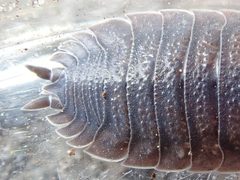
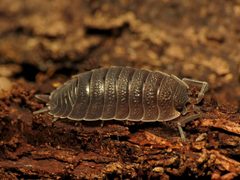
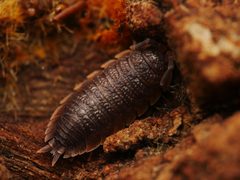
Distinguished from smooth (e.g., Porcellio laevis) by the rough, tuberculate surface. Separated from 'roller' woodlice such as Armadillidium spp. by its inability to conglobate; when disturbed, P. scaber adopts tonic immobility or flees rather than rolling into a ball. Distinguished from Oniscus asellus by less dependence on high humidity and preference for drier microhabitats. The combination of rough , oval non-conglobating body form, and grey coloration with paler surface is diagnostic in most of its range.
Images
Habitat
Occupies a wide variety of damp including forests, gardens, urban green spaces, and coastal areas. Seeks small, narrow spaces to minimize water loss due to permeable lacking waxy . Avoids bright light to prevent desiccation. Uses loose bark of dead or dying trees and flat-lying compact objects as day shelters. Less dependent on high humidity than Oniscus asellus, allowing occupation of somewhat drier microhabitats. Requires moisture for respiration and proper .
Distribution
Native to Central and Western Europe. Introduced and established in North America, South Africa, Australia (where it is the most common woodlouse), and sub-Antarctic Marion Island. Widespread across the United Kingdom as one of the most common woodlice. Distribution expanded globally through human activity.
Diet
feeding primarily on decaying leaf litter and rotting plant matter. Consumes bacteria and fungi associated with decomposition rather than living plant tissue. Uses sensitive olfactory receptors to detect microbial activity and locate food. Has been observed engaging in (consumption of fecal material).
Life Cycle
Females carry 25–90 fertilized in a fluid-filled pouch (marsupium) for approximately 40–50 days until hatching. Young reach reproductive maturity after approximately 3 months. life expectancy approximately 2 years. Size categories correlate with age: small individuals <7 mm, medium 7–12 mm, large >12 mm. (molting) occurs periodically; new epicuticle forms at least 21 hours before moulting, with new chitinous differentiating into exocuticle and endocuticle approximately 5 hours after moulting.
Behavior
Exhibits activity patterns correlated with air humidity regulation. Activity serves to balance water uptake and : animals accumulate water in moist shelters, then move to drier areas to transpire excess, with activity periods lasting approximately one hour for most individuals. Shows hygrokinesis (high activity in dry air, motionless in saturated air) and hygrophobotactic (movement toward moist air). Demonstrates turn alternation during klinokinesis, with alternating left-right turns averaging to straight-line movement for efficient escape. When threatened, adopts tonic immobility (death feigning/) with body contraction, legs folded ventrally, and folded or extended backwards; duration of immobility varies individually and consistently, indicating personality traits ('bold' vs. 'shy' individuals). Main defenses are escape running, sticking to surfaces, and chemical secretions rather than tonic immobility. Shows strong thigmotaxis (preference for contact with surfaces). Lives in large . to environments occurs within approximately 10 minutes, reducing sensitivity to repeated stimuli.
Ecological Role
Decomposer contributing to nutrient cycling through consumption of decaying plant matter and associated microorganisms. Prey item for various including shrews, , toads, spiders, and some birds. Serves as potential for associated organisms, though specific phoretic relationships remain unconfirmed.
Human Relevance
Used in bioactive terrarium and vivarium systems for reptile and amphibian keeping, where they contribute to waste decomposition and soil health. Cultivated in captivity for unusual color morphs. Subject of extensive behavioral research, including studies that inspired the 'Porcellio scaber algorithm' for constrained optimization problems. Common in gardens and urban environments where it contributes to decomposition of organic matter.
Similar Taxa
- Armadillidium spp.These 'roller' woodlice can conglobate into a ball for defense, unlike P. scaber which adopts tonic immobility; also have smoother
- Porcellio laevisSmooth with relatively smooth, less tuberculate compared to the rough surface of P. scaber
- Oniscus asellusCommon European with smoother appearance and higher dependence on humid conditions than P. scaber
More Details
Personality research
First terrestrial isopod in which individual personality traits were scientifically documented, with consistent individual differences in tonic immobility duration established through repeated testing over three weeks.
Water balance physiology
Activity patterns function as active water-balance regulation, moving between high-humidity shelters and lower-humidity areas; can absorb water through from saturated air, with uptake increasing with temperature up to 15–20°C.
Color anomalies
Bright blue individuals, though striking, result from iridovirus and do not represent natural genetic color variation.
Sources and further reading
- BugGuide
- Wikipedia
- GBIF taxonomy match
- iNaturalist taxon
- NCBI Taxonomy
- Catalogue of Life
- Bohart Museum Open House on 'Many Legged Wonders': How Many Legs Does an Isopod Have? | Bug Squad
- Uncategorized | Blog - Part 11
- The bold and the shy one: Could woodlice have personalities? | Blog
- Isopoda | Blog
- Ecdysis in the isopod Porcellio Scaber (Latreille).
- Some observations of correcting behaviour in woodlice (Porcellio scaber)
- Personality affects defensive behaviour of Porcellio scaber (Isopoda, Oniscidea)
- Figure 3 from: Tuf IH, Drábková L, Šipoš J (2015) Personality affects defensive behaviour of Porcellio scaber (Isopoda, Oniscidea). In: Taiti S, Hornung E, Štrus J, Bouchon D (Eds) Trends in Terrestrial Isopod Biology. ZooKeys 515: 159–171. https://doi.org/10.3897/zookeys.515.9429
- The adaptive significance of coprophagous behaviour in the terrestrial isopod Porcellio scaber
- Caenorhabditis elegans nematodes are not attracted to the terrestrial isopod Porcellio scaber
- Architecture of microtubule cytoskeleton in the hindgut cells of Porcellio scaber
- The Humidity Reactions of the Wood-Louse,Porcellio Scaber(Latreille)
- Bacteria associated with the hepatopancreas of the woodlice Oniscus asellusand Porcellio scaber(Crustacea, Isopoda)
- The Ecological Significance of Activity Patterns in the Woodlouse Porcellio Scaber Latr. (Isopoda)