
Porcellio laevis
Latreille, 1804
swift woodlouse, smooth slater
Porcellio laevis is a large terrestrial isopod distinguished by its smooth surface and rapid escape response when disturbed. Native to North Africa, it has achieved distribution through human-mediated transport and now occurs across Europe, the Americas, Australia, and Pacific islands. The exhibits direct development with and juveniles brooded in a fluid-filled marsupium, representing extensive parental care among terrestrial arthropods. It is widely kept in captivity due to ease of maintenance and the availability of selectively bred color morphs.
Pronunciation
How to pronounce Porcellio laevis: //pɔrˈkɛl.i.oʊ ˈlæ.vɪs//
These audio files are automatically generated. While they are not always 100% accurate, they are a good starting point.
Identification
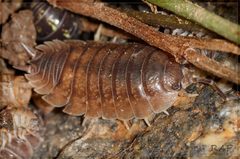
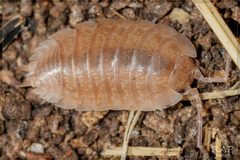
Distinguished from other Porcellio by the smooth, non-tuberculate surface—most such as P. scaber have rough or sculptured tergites. The combination of large size (to 20 mm), smooth , and rapid locomotion when disturbed separates it from similar isopods. Male spear-shaped uropods are diagnostic for sex determination. In Australia, the 'smooth slater' reflects this key character.
Images
Appearance
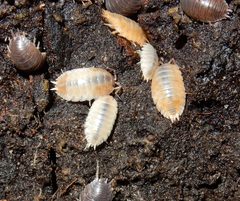
Large-bodied reaching up to 20 mm in length. surface notably smooth and , lacking the rough common in . Males possess distinctive long, spear-shaped uropods. Coloration variable in wild ; selectively bred morphs exhibit diverse patterns including dalmatian, orange, and other variants. Body form typical of Porcellionidae: oval, somewhat flattened, with seven pairs of legs.
Habitat
Found in moist microhabitats under rocks, fallen logs, and decaying wood in damp areas. In agricultural and urban settings, occurs in compost piles, stable manure, garden debris, and heaps. Requires high humidity for respiration and molting. Rarely encountered in dry conditions.
Distribution
distribution following human introduction. Native to North Africa; first recorded in Britain in the 13th century. Introduced to Australia (including Norfolk Island and Lord Howe Island), North and South America, Western Asia, Japan, and Pacific islands. Present in the Azores (Faial, Pico, São Miguel) and Galápagos Islands.
Diet
Opportunistic consuming dead plant material including leaves, moss, lichens, and rotting wood; also feeds on animal waste. Laboratory studies demonstrate attraction to phenylethylamine and variable responses to organic compounds, with acids and aldehydes generally repellent.
Life Cycle
Direct development without free-living larval stages. and juveniles develop within a pouch (marsupium) filled with maternal fluid, eliminating need for external water source during early development. Juveniles released at first stage. Females under long-day (16:8 ) at 20°C begin after approximately 50 days and may produce up to four successive broods; constant darkness delays reproduction to ~136 days with single brood.
Behavior
Exhibits rapid, erratic escape locomotion when disturbed, capable of quick bursts of speed—hence 'swift '. Uses turn alternation (sequential left-right turning) during movement, which reduces random circling and promotes linear progression; this behavior is robust and not significantly modulated by chemical cues. Does not conglobate (roll into ball).
Ecological Role
Contributes to nutrient cycling through decomposition of organic matter and animal waste, releasing nutrients into soil. Serves as prey for birds, reptiles, and small mammals. Heavy metal accumulation capability suggests potential for bioremediation applications.
Human Relevance
Widely maintained in terrariums as a bioactive 'cleanup crew' for reptile and amphibian enclosures, consuming and uneaten food. Popular in the pet trade due to simple care requirements and rapid colony establishment. Selectively bred for diverse color morphs. Used as a model organism in behavioral, toxicological, and ecotoxicological research due to sensitivity to environmental changes.
Similar Taxa
- Porcellio scaberRough with tuberculate surface; P. laevis is smooth and generally larger
- Armadillidium vulgarePill capable of conglobation (rolling into ball); P. laevis cannot conglobate and has different body proportions
- Porcellio dilatatusOverlapping distribution but differs in body shape and uropod structure
More Details
Chemosensory responses
Laboratory studies demonstrate differentiated behavioral reactions to organic substances: phenylethylamine elicits strong attraction (index 12.71), while formic acid, 2-ethoxyethanol, and benzaldehyde produce strong repellency (indices 0.04–0.19).
Reproductive plasticity
and male presence influence reproductive timing; long days accelerate onset and increase number, while male presence further reduces lag time in females.
Sources and further reading
- BugGuide
- Wikipedia
- GBIF taxonomy match
- iNaturalist taxon
- NCBI Taxonomy
- Catalogue of Life
- Bohart Museum Open House on 'Many Legged Wonders': How Many Legs Does an Isopod Have? | Bug Squad
- Fly got eye! | Beetles In The Bush
- Isopoda | Blog
- One-shot Wednesday: The “other” hibiscus jewel beetle | Beetles In The Bush
- These Beetles Withstand Cyanide Blasts to Eat Millipedes
- Collecting in Australia’s remote McIlwraith range | Beetles In The Bush
- Do predator cues influence turn alternation behavior in terrestrial isopods Porcellio laevis Latreille and Armadillidium vulgare Latreille?
- Locomotor activity of Porcellio laevis (Isopoda, Porcellionidae) under the influence of organic substances
- Photoperiod and male-presence effects on the onset of reproduction of Porcellio laevis (Oniscidea)
- The distribution of phosphomonoesterases in the digestive gut of Porcellio laevis latreille (Porcellionidae, Isopoda)
- The energetics of reproduction and parental care in the terrestrial isopod Porcellio laevis
- Effect of Vermicompost and Isopod (Porcellio laevis) Fertilizers on The Emergence and Seedling Quality of Lettuce (Lactuca sativa var. capitata cv. Wismar)
- Changes in life history characteristics of Porcellio laevis (Isopoda: Oniscidea) along a cadmium pollution gradient in Sfax (Central Tunisia)
- The relationship between behavioural responses to temperature and genotype at a PGI locus in the terrestrial isopod Porcellio laevis
- The effect of high lead concentrations on the mortality, mass and behaviour ofPorcellio LaevisLatr. (Crustacea, Isopoda) in laboratory tests
- Lower Toxicity of the Essential Oils With Repellent Potential Compared to Diethyltoluamide and Cypermethrin on Porcellio laevis.