
Porcellio
Latreille, 1804
woodlice
Species Guides
4- Porcellio dilatatus(Giant Canyon Woodlouse)
- Porcellio laevis(swift woodlouse)
- Porcellio scaber(Common Rough Woodlouse)
- Porcellio spinicornis(Brickwork Woodlouse)
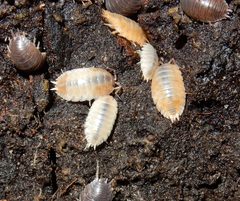
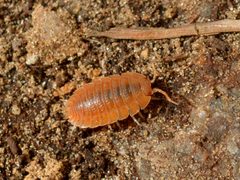
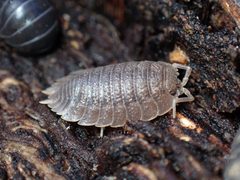
Porcellio is a large of terrestrial isopods (woodlice) in the Porcellionidae, containing approximately 191 described with a near- distribution. The genus includes the well-studied common rough (Porcellio scaber), which has served as a model organism for research on behavioral , personality traits in , and physiological processes such as . Most species were described by 1950, though new species continue to be discovered. Members of this genus cannot conglobate (roll into a ball), distinguishing them from pill bugs in related genera.
Pronunciation
How to pronounce Porcellio: /pɔɹˈsɛlioʊ/
These audio files are automatically generated. While they are not always 100% accurate, they are a good starting point.
Identification
Distinguished from conglobating woodlice (pill bugs) such as Armadillidium by the inability to roll into a ball and the visible extension of uropods beyond the body margin. Separated from other non-conglobating in Porcellionidae by combinations of body shape, uropod structure, and details of the and . -level identification requires examination of male genitalia (pleopods), detailed body proportions, and surface texture of the .
Images
Habitat
Terrestrial environments requiring moisture for respiration and molting. Found in leaf litter, under stones, decaying wood, compost heaps, and soil crevices. Some occupy more specialized including coastal areas, caves, and pre-desert . Moisture availability is a critical limiting factor.
Distribution
Essentially worldwide distribution across temperate and subtropical regions. Records from Europe, North America, North Africa, Asia, and Australia. Some have been introduced widely through human activity.
Diet
feeding on decaying plant material. (consumption of fecal pellets) has been documented in P. scaber as an adaptive , likely serving to recover nutrients from incompletely digested material.
Life Cycle
Development includes marsupial ( pouch) stage where embryos develop, followed by postmarsupial manca stages that gradually acquire features. Molting occurs in two phases: half shed first, then half approximately two days later. This biphasic is characteristic of the .
Behavior
Exhibits death-feigning (tonic immobility) as a defensive response to disturbance; duration varies individually and contextually. Studies of P. scaber demonstrate consistent individual differences in defensive over time, interpreted as personality traits ('bold' vs. 'shy' individuals). to stimuli occurs rapidly (within 10 minutes). Righting behavior when flipped onto back involves coordinated leg movements. Pre- and post-ecdysis behaviors include shelter-seeking and reduced activity during the vulnerable soft-bodied period.
Ecological Role
Decomposer contributing to nutrient cycling in terrestrial . Serves as prey for various and small vertebrates. Some function as part of 'cleanup crews' in bioactive terrarium systems.
Human Relevance
Some used in bioactive terrariums and vivariums for waste decomposition and soil health. Occasionally considered minor pests in gardens and greenhouses. Subject of extensive scientific research, particularly P. scaber as a model for and physiology.
Similar Taxa
- ArmadillidiumAlso common terrestrial isopods, but conglobate (roll into ball) and have uropods that do not extend visibly beyond body margin
- OniscusSimilar non-conglobating woodlice; distinguished by body proportions and details of and uropod structure
- TrachelipusOverlapping distribution and ; requires examination of pleopod structure and shape for separation
More Details
Research significance
Porcellio scaber has emerged as an important model organism for studying personality in , demonstrating that consistent individual behavioral differences are not restricted to vertebrates or large-brained animals.
Fossil record
Two fossil (P. cyclocephalus and P. notatus) are known from Baltic amber, though their placement in Porcellio is considered doubtful due to brief original descriptions.
Sources and further reading
- BugGuide
- Wikipedia
- GBIF taxonomy match
- iNaturalist taxon
- NCBI Taxonomy
- Catalogue of Life
- Bohart Museum Open House on 'Many Legged Wonders': How Many Legs Does an Isopod Have? | Bug Squad
- Uncategorized | Blog - Part 11
- The bold and the shy one: Could woodlice have personalities? | Blog
- Ecdysis in the isopod Porcellio Scaber (Latreille).
- Reproduction saisonnière de Porcellio variabilis Lucas, 1846
- Some observations of correcting behaviour in woodlice (Porcellio scaber)
- Personality affects defensive behaviour of Porcellio scaber (Isopoda, Oniscidea)
- Behavioral and Reproductive Strategies of Porcellio Species (Oniscidea) in Tunisian Pre-Desert Ecosystems
- Figure 10 from: Montesanto G, Pizzo G, Caruso D, Lombardo B (2012) The postmarsupial development of Porcellio siculoccidentalis, with some data on reproductive biology (Crustacea, Isopoda, Oniscidea). ZooKeys 176: 87-101. https://doi.org/10.3897/zookeys.176.2369
- Figure 8 from: Montesanto G, Pizzo G, Caruso D, Lombardo B (2012) The postmarsupial development of Porcellio siculoccidentalis, with some data on reproductive biology (Crustacea, Isopoda, Oniscidea). ZooKeys 176: 87-101. https://doi.org/10.3897/zookeys.176.2369
- The adaptive significance of coprophagous behaviour in the terrestrial isopod Porcellio scaber
- Figure 3 from: Tuf IH, Drábková L, Šipoš J (2015) Personality affects defensive behaviour of Porcellio scaber (Isopoda, Oniscidea). In: Taiti S, Hornung E, Štrus J, Bouchon D (Eds) Trends in Terrestrial Isopod Biology. ZooKeys 515: 159–171. https://doi.org/10.3897/zookeys.515.9429
- Bacteria associated with the hepatopancreas of the woodlice Oniscus asellusand Porcellio scaber(Crustacea, Isopoda)
- Caenorhabditis elegans nematodes are not attracted to the terrestrial isopod Porcellio scaber