
Trachelipus
Budde-Lund, 1908
Species Guides
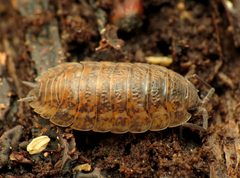
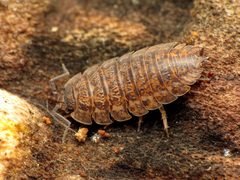
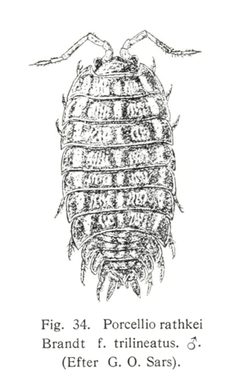
1- Trachelipus rathkii(Rathke's Woodlouse)
Trachelipus is a of terrestrial woodlice in the Trachelipodidae, comprising multiple distributed across Central and Eastern Europe. The genus includes common species such as T. nodulosus, one of the most frequent terrestrial isopods in Hungary, as well as T. rathkii, T. squamuliger, T. vespertilio, and T. trilobatus. Species within this genus occupy diverse ranging from open grasslands to woodlands, with documented adaptations to extreme temperature fluctuations in exposed environments.
Pronunciation
How to pronounce Trachelipus: /trəˈkɛlɪpəs/
These audio files are automatically generated. While they are not always 100% accurate, they are a good starting point.
Images
Habitat
within this occupy diverse terrestrial . T. nodulosus has been documented in open, treeless vegetation including dry sandy grasslands, wind-blown dune slacks, south-exposed dry limestone rocky grasslands, vineyards, pastures, planted spruce forests, secondary hawthorn scrub, and Robinia pseudoacacia forests. T. squamuliger occurs in both woodland sites and pastures. The genus shows to habitats with extreme temperature fluctuations, particularly in open, treeless environments.
Distribution
Central and Eastern European distribution. T. nodulosus: Germany, Poland, Czech Republic, Slovakia, Austria, Slovenia, Croatia, Serbia, Romania, Bulgaria, and Hungary (widespread and common). T. vespertilio: originally described from Croatia, rediscovered in Slovenia. T. trilobatus: Romania (western Timiş-Cerna Corridor and expanded range). T. rathkii: southwestern Ohio, USA. GBIF records additionally indicate presence in Denmark, Norway, Sweden, and Vermont, USA.
Seasonality
Surface activity peaks in July and August for T. nodulosus. Gravid females observed from April to November, with highest proportion in July-August.
Diet
T. nodulosus has been observed feeding on fallen leaves of Populus alba (white poplar), with food consumption stabilizing at 1.57% of body weight daily after initial growth period.
Host Associations
- Caenorhabditis remanei - T. rathkii serves as for developmentally arrested dauer larvae; associations found on inner surfaces of plates and appendages; experimental persisted at least five days
- Plagiorhynchus cylindraceus - intermediate T. squamuliger serves as intermediate for this acanthocephalan of passerine birds; 4.0–9.3% in woodland ; new host record for this parasite
Life Cycle
T. nodulosus: intensive growth until approximately 60 days of age, then growth rate slows. Gravid females produce 14–40 offspring depending on body size, up to 32–75 offspring under favorable weather conditions. Some two-year-old females can become gravid twice in one year under favorable conditions. Sex ratio in pitfall traps: 75% female. size fluctuates annually depending on microclimatic factors, primarily precipitation during reproductive period.
Behavior
Aggregated pattern due to heterogeneity and seasonal climatic changes. T. nodulosus exhibits surface activity peaking in summer months. T. rathkii shows association with through specific behavioral responses (nictating and climbing) that facilitate experimental .
Ecological Role
Macrodecomposer in terrestrial . T. nodulosus is a component of isopod in certain open , comprising 75% of isopod individuals in some grassland . Serves as intermediate for acanthocephalan , linking terrestrial and avian .
Similar Taxa
- Porcellio scaberT. nodulosus differs in respiratory physiology: lower intensity respiration that is less influenced by external temperature, an to open versus the more temperature-sensitive respiration of P. scaber
- Porcellio spinicornisT. rathkii is distinguished by documented association with Caenorhabditis remanei; P. spinicornis intermingled with infested T. rathkii populations but showed no associations, suggesting differential susceptibility or use
- Armadillidium vulgareT. squamuliger co-occurs as for Plagiorhynchus cylindraceus but shows higher (4.0–9.3% vs. single individual in A. vulgare), indicating differential patterns
More Details
Physiological adaptation
T. nodulosus exhibits respiratory to open, treeless : respiration is of lower intensity and less influenced by external temperature compared to congeneric or confamilial , allowing survival in environments with extreme temperature fluctuations.
Taxonomic history
T. vespertilio was known only from a single female collected in Croatia in the nineteenth century until its rediscovery in Slovenia more than a century later, with the first description of male providing additional diagnostic characters.
Sources and further reading
- BugGuide
- Wikipedia
- GBIF taxonomy match
- iNaturalist taxon
- NCBI Taxonomy
- Catalogue of Life
- The ecobiology of Trachelipus rathkei (Isopoda)
- Magyarország szárazföldi ászkarákfaunája (Isopoda: Oniscidea): Trachelipus nodulosus (C. L. Koch, 1838)
- Natural and experimental associations of Caenorhabditis remanei with Trachelipus rathkii and other terrestrial isopods
- New distributional records for the species Trachelipus trilobatus (Stein, 1859) (Isopoda: Oniscidea, Trachelipodidae) in Romania
- New records of Trachelipus vespertilio (Budde-Lund, 1896) (Isopoda, Oniscidea) with a description of the male
- Occurrence of cystacanths of Plagiorhynchus cylindraceus (Acanthocephala) in the terrestrial isopods Trachelipus squamuliger and Armadillidium vulgare (Oniscidea) in Bulgaria