
Armadillidium vulgare
(Latreille, 1804)
common pill-bug, common pill woodlouse, roly-poly, potato bug, doodle bug, carpenter
Armadillidium vulgare is a terrestrial isopod native to Mediterranean Europe that has become one of the most widespread globally through human-mediated . It is the most extensively studied terrestrial isopod and serves as a model organism for research on mitochondrial evolution, desiccation resistance, and conglobation . The species exhibits remarkable morphological plasticity, including numerous color morphs maintained through selective breeding in the pet trade.
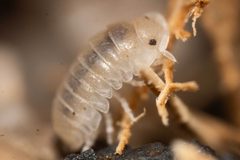
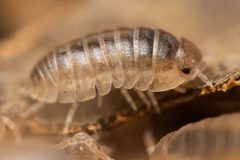
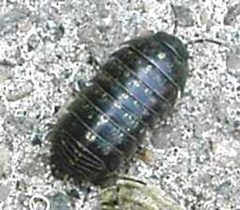
Pronunciation
How to pronounce Armadillidium vulgare: /ˌɑːrməˌdɪˈlɪdiəm vʌlˈɡɛəri/
These audio files are automatically generated. While they are not always 100% accurate, they are a good starting point.
Identification
Distinguished from congeneric Armadillidium nasatum and A. depressum by forming a complete sphere without gaps when conglobated; the latter two species leave visible gaps. Differs from pill millipedes (Glomeris marginata and relatives) by having only seven leg pairs (14 legs total) versus millipedes' numerous leg pairs, and by the distinct thoracic segmentation visible when unrolled. The unstalked and with dense bristles are additional distinguishing features.
Images
Appearance
range 8.5–18 mm in length with an oval, highly convex body capable of complete conglobation (rolling into a ball). The consists of protective plates typically dark grey to brown with faint cream or yellow spotting, though albino and other color morphs occur. The 40 μm-thick contains , hardened proteins, and calcium carbonate in four layers. Two pigment control coloration: ommochrome (black) and pteridine (yellow). The bears unstalked with single photoreceptors and with dense sensory bristles. Seven thoracic segments each bear one pair of legs; females carry in a marsupium on segments 2–5. The bears white, spongiform pleopods for and two tail appendages (uropods) for water transport.
Habitat
Requires humid microhabitats to prevent desiccation; thrives under rocks, logs, and leaf litter in forests, gardens, and coastal areas. Shows greater drought than many but restricted to calcareous soils or coastal . In winter, avoids exposed shores for areas near unfrozen water where soil remains workable. Anthropophilic, utilizing cardboard and other human waste materials.
Distribution
Native to Mediterranean Europe; introduced and naturalized worldwide including North America (where may reach 10,000 individuals/m² in California coastal grasslands), Madagascar, Australia, and South Africa. Now among the most abundant in California coastal grassland .
Seasonality
Active year-round in suitable microhabitats, with dormancy induced below 0°C. Foraging activity peaks at night when temperatures are lower and humidity higher. occurs primarily during warmer months with females capable of up to 3 per season.
Diet
Primarily detritivorous, feeding on decomposing plant litter; also consumes seeds (), living plant matter, dead animal remains, fungi, and . Fungal consumption contributes to carbon cycling by reducing fungal decomposition rates and associated CO₂ release.
Life Cycle
Direct development without larval stage; lecithotrophic (-nourished) develop in female's marsupium for 3–4 weeks post-hatching. Juveniles emerge as miniature , molting within 24 hours to develop the seventh body segment, then again after two weeks for final leg pair. Adults on approximately 29-day cycles, with 2-day vulnerability period while new calcifies. Lifespan up to 3 years. Females produce up to 40 young per , with 3 broods possible per season; sperm storage allows up to 12 months between mating and .
Behavior
Exhibits conglobation (defensive rolling) in response to tactile stimuli or vibrations, protecting soft surfaces with the thick . Death-feigning observed under extreme stress. Negative and positive thigmotaxis (preference for contact/crevices) often conflict, with thigmotaxis sometimes overriding temperature preferences even in dangerous heat. reduces desiccation risk and synchronizes female receptivity for mating. foraging pattern with increased sheltering during dry conditions.
Ecological Role
Human Relevance
Popular in pet trade with selective breeding for color morphs; the "Punta Cana" morph remains taxonomically disputed (A. sordidum versus A. vulgare variant). Laboratory model for mitochondrial studies (unusually large 42 kb partially linear mtDNA). Generally considered a benign household presence, non-venomous and non-pathogenic, though sometimes dismissed as a pest.
Similar Taxa
- Armadillidium nasatumCongeneric distinguishable by gap left when rolling into ball
- Armadillidium depressumCongeneric distinguishable by gap left when rolling into ball
- Glomeris marginataPill with superficially similar conglobation ; distinguished by numerous leg pairs and different segmentation pattern