
Armadillidium nasatum
Budde-Lund, 1885
Nosy Pill Woodlouse
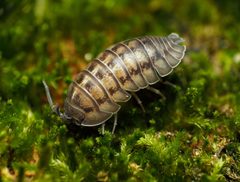
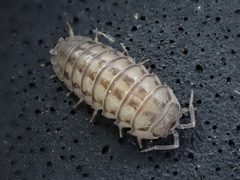
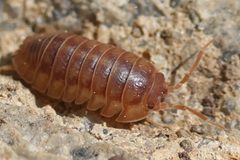
Armadillidium nasatum is a large native to Western Europe, particularly Britain, that has been introduced to North America and other regions. It reaches up to 21 mm in length and is distinguished from by a rectangular protrusion ("nose") at the apex of the and a rounded tail tip with incurved sides. Unlike some relatives, it does not form a complete ball when enrolled. The species exhibits tendencies and prefers drier than most woodlice.
Pronunciation
How to pronounce Armadillidium nasatum: /ˌɑːr.mə.dɪˈlɪd.i.əm næˈseɪ.təm/
These audio files are automatically generated. While they are not always 100% accurate, they are a good starting point.
Identification
Distinguished from Armadillidium vulgare by the prominent rectangular "nose" protrusion at the apex and the rounded, incurved tail () tip; A. vulgare has a smaller, flat tail. Unlike A. depressum, does not form a complete ball when enrolled. Dark grey coloration similar to A. vulgare; pale longitudinal stripes occasionally present but variable and non-diagnostic.
Images
Habitat
Occupies drier microhabitats than most woodlice. ; frequently found in non-inhabited areas including railway lines and industrial waste ground. Shelters under stones and wood.
Distribution
Native to Western Europe, particularly Britain (patches in southern England, sporadic in Ireland). Introduced to North America and other parts of Europe.
Behavior
Exhibits and shelter-seeking responses when exposed to fluorescent and ultraviolet light; demonstrates negative /photophobia in laboratory conditions.
Human Relevance
associated with human-modified environments; introduced beyond native range.
Similar Taxa
- Armadillidium vulgareSimilar dark grey coloration and general appearance, but distinguished by lack of "nose" protrusion and flat (not rounded/incurved) tail tip
- Armadillidium depressumAlso does not form complete ball when enrolled, but lacks the distinctive "nose" and has different tail
Sources and further reading
- BugGuide
- Wikipedia
- GBIF taxonomy match
- iNaturalist taxon
- NCBI Taxonomy
- Catalogue of Life
- Bohart Museum Open House on 'Many Legged Wonders': How Many Legs Does an Isopod Have? | Bug Squad
- ID Challenge #18 | Beetles In The Bush
- Eumastacidae | Beetles In The Bush
- Aggregation and sheltering behavior of Armadillidium vulgare and Armadillidium nasatum (Isopoda: Armadillidiidae) exposed to fluorescent and ultraviolet light