
Porcellio dilatatus
Brandt, 1831
Giant Canyon Woodlouse, Giant canyon isopod
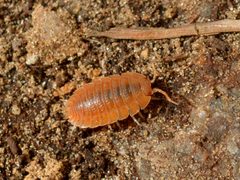
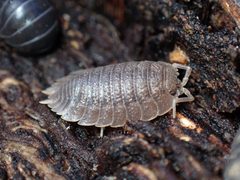
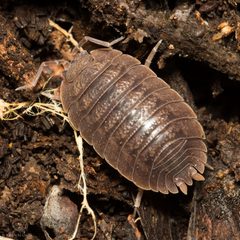
Porcellio dilatatus is a medium-sized terrestrial isopod () native to Europe, now introduced to North America. reach approximately 15 mm in length. The is characterized by brown coloration with longitudinal striping. It is a saprophagous that feeds primarily on decaying plant matter. The species has been widely used as a model organism in ecotoxicology research and has demonstrated significant biotechnological potential through its gut microbiome, which harbors diverse lignocellulosic -degrading bacteria. It is considered a minor pest in horticultural settings, occasionally found in greenhouses and seed boxes.
Pronunciation
How to pronounce Porcellio dilatatus: /pɔrˈsɛl.li.o dɪl.əˈteɪ.təs/
These audio files are automatically generated. While they are not always 100% accurate, they are a good starting point.
Images
Habitat
Found in upper soil layers and surface leaf litter in terrestrial environments. Collection records include cellulosic -rich with pinewood and eucalyptus debris, including forest areas and gardens. Successfully established in greenhouses, seed boxes, and flower pots where moisture and organic matter are available.
Distribution
Native to Europe, with widespread distribution across the continent. Introduced to North America from Western Europe. Specific collection localities include Portugal (National Forest of Choupal, Garden of University of Coimbra, Mértola region, Cabeço-de-Vide region), and records from the Azores (Faial, Pico, São Miguel).
Diet
Saprophagous, feeding on decaying organic matter, primarily of plant origin. Documented feeding on alder leaves and lettuce (Lactuca sativa) in natural settings. Gut microbiome analysis confirms capacity for lignocellulosic degradation, including cellulose, hemicellulose, and lignin.
Life Cycle
Undergoes periodic molting () with biphasic and ecdysis. Pre- individuals accumulate sternal CaCO3 deposits. Active water vapor absorption enables volume expansion during molting, with progressive mass increase from 5 days pre-molt until ecdysis, followed by 3–4 days of post-molt mass loss.
Behavior
Exhibits death feigning (tonic immobility) as defensive response to external stimuli. Demonstrates to environmental conditions within 10 minutes, reducing sensitivity to repeated stimuli.
Ecological Role
Keystone in terrestrial , contributing to organic matter cycling through substrate fragmentation and promotion of microbial decomposition. Gut microbiome serves as natural enrichment source for lignocellulosic -degrading bacteria, with potential for biotechnological applications in biofuel and biomaterial production.
Human Relevance
Considered a minor house and greenhouse pest in horticultural settings. Widely used as a model organism in ecotoxicology research for evaluating toxic effects of environmental pollutants, particularly heavy metals such as cadmium. Source of lignocellulosic -degrading bacteria and with biotechnological applications. Occasionally sold in the pet trade for bioactive terrarium systems.
Sources and further reading
- BugGuide
- Wikipedia
- GBIF taxonomy match
- iNaturalist taxon
- NCBI Taxonomy
- Catalogue of Life
- Bohart Museum Open House on 'Many Legged Wonders': How Many Legs Does an Isopod Have? | Bug Squad
- Uncategorized | Blog - Part 11
- The bold and the shy one: Could woodlice have personalities? | Blog
- isopods | Blog
- Isolation of lignocellulosic biomass-degrading bacteria from Porcellio dilatatus gut-enriched cultures
- Effects on survival and reproduction of Porcellio dilatatus exposed to different Cd species
- Guts Bacterial Communities of Porcellio dilatatus: Symbionts Predominance, Functional Significance and Putative Biotechnological Potential
- Water vapor absorption allows for volume expansion during molting in Armadillidium vulgare and Porcellio dilatatus (Crustacea, Isopoda, Oniscidea)
- The influence of metal speciation on the bioavailability and sub-cellular distribution of cadmium to the terrestrial isopod, Porcellio dilatatus
- Boric acid as a reference substance in avoidance behaviour tests with Porcellio dilatatus (Crustacea: Isopoda)
- Does subcellular distribution in plants dictate the trophic bioavailability of cadmium to Porcellio dilatatus (crustacea, isopoda)?