
Porcellionidae
Porcellionid Woodlice
Genus Guides
4- Acaeroplastes
- Porcellio(woodlice)
- Porcellionides(woodlice)
- Proporcellio
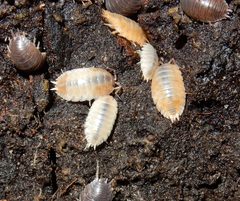
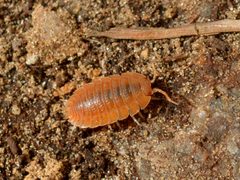
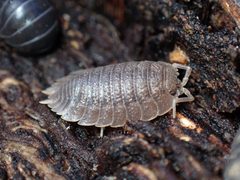
Porcellionidae is a of terrestrial isopods (woodlice) containing approximately 530 across 19 , distributed on every continent except Antarctica. Members are distinguished by flattened, spear-shaped uropods that extend beyond the terminal exoskeletal plate and slightly flared epimera on the thoracic . Unlike members of Armadillidiidae, porcellionids cannot roll into a defensive ball.
Pronunciation
How to pronounce Porcellionidae: /pɔːrˌsɛliˈoʊnɪˌdiː/
These audio files are automatically generated. While they are not always 100% accurate, they are a good starting point.
Identification
Distinguished from Armadillidiidae by inability to roll into a ball. Separated from other non-conglobating isopod by the combination of spear-shaped, flattened uropods extending beyond the pleotelson and slightly flared epimera. Porcellionides pruinosus specifically identified by subrectangular cephalon and pale reticulate patterning.
Images
Habitat
Terrestrial; found in soil and surface litter of agricultural , mesic temperate regions, and semi-arid environments. varies seasonally, with highest densities typically in spring and autumn, lowest in summer and winter months.
Distribution
distribution on every continent except Antarctica. Documented in Europe (Denmark, Norway, Sweden, Belarus), Middle East (Iraq, Israel, Negev Desert), and North America (Vermont, USA).
Seasonality
Activity and seasonal in temperate regions. In Iraq, peak densities occur in March–April (spring); lowest densities in winter. Two reproductive seasons reported for some populations: February–August and September–January. In India, copulation occurs during spring and monsoon seasons.
Diet
; feeds on decaying organic matter. Phosphomonoesterase present in hepatopancreas and gut tissues indicate biochemical for digestion of plant material and detritus.
Life Cycle
Direct development without larval stages. Four biological stages: , Manca (post-hatching stage with reduced appendages), , and Mature. Female carries 2–70 eggs in pouch (marsupium). Early period from through third moult is most vulnerable stage; humidity critical for survival. Lifespan approximately 12–18 months with nine to ten moults; body length increases with each moult. Females produce one or two broods per year.
Behavior
Exhibits differentiated locomotor responses to organic chemical cues. Repellent responses to acids (formic, lactic, oleic), aldehydes (benzaldehyde, formaldehyde, glutaraldehyde), and certain alcohols/esters. Attractant response to amines (phenylethylamine) and some phenolic derivatives. Activity patterns sensitive to environmental humidity.
Ecological Role
Key role in organic matter decomposition and nutrient cycling in soils. Serves as bioindicator of soil health and stability in disturbed agroecosystems. High sensitivity to environmental changes makes useful for ecotoxicological assessment.
Human Relevance
Used as model organism in behavioral and toxicological research due to ecological importance and chemosensory sensitivity. Potential for development of environmentally friendly control methods in agricultural settings. Presence indicates soil function.
Similar Taxa
- ArmadillidiidaeAlso terrestrial isopods, but distinguished by ability to conglobate (roll into ball); porcellionids cannot roll into ball and have spear-shaped rather than rod-like uropods.
More Details
Chemosensory biology
Porcellio laevis demonstrates highly differentiated behavioral reactions to organic substances depending on chemical class and functional group, with acids and aldehydes generally repellent and amines attractant. This chemosensory complexity supports use as sensitive bioindicator for environmental monitoring.
Sources and further reading
- BugGuide
- Wikipedia
- GBIF taxonomy match
- iNaturalist taxon
- NCBI Taxonomy
- Life cycle ofPorcellio laevis (Latreille) (Isopoda, porcellionidae)
- The distribution of phosphomonoesterases in the digestive gut of Porcellio laevis latreille (Porcellionidae, Isopoda)
- Locomotor activity of Porcellio laevis (Isopoda, Porcellionidae) under the influence of organic substances
- Porcellionides pruinosus (Brandt, 1833) – a new woodlouse species (Isopoda: Oniscidea: Porcellionidae) in the fauna of Belarus
- Growth and reproduction in a rare desert isopod:Porcellio barroisi(Oniscidea; Porcellionidae) from the Central Negev Mountains
- A study of some Biological Aspects of Procellio scaber(Isopoda : porcellionidae) Latrellile 1804In Al-jadriyia region /Baghdad-Iraq
- A study of some Biological Aspects of Procellio scaber(Isopoda : porcellionidae) Latrellile 1804In Al-jadriyia region /Baghdad-Iraq
- Life history patterns of terrestrial isopods from mesic habitats in the temperate region of Northern Israel (Isopoda:Porcellionidae, Armadillidae)
- Morphological Redescription and Monthly Variation in the Population Density of the Terrestrial Isopod Porcellionides pruinosus (Isopoda: Porcellionidae) in Southern Iraq