
Armadillidae
Brandt in Brandt & Ratzeburg, 1831
Tropical Pill Woodlice, Pill Bugs
Genus Guides
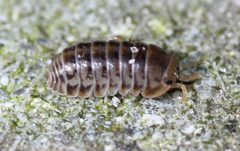
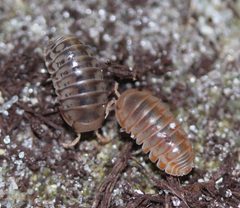
3Armadillidae is the largest of terrestrial isopods (woodlice), comprising approximately 80 and 700 . Members are characterized by their ability to enroll into a complete sphere (conglobation), a defensive that distinguishes them from most other woodlice families. The family exhibits a strongly convex body form adapted for this rolling behavior, with fully enclosed within the sphere when enrolled—a key difference from the superficially similar family Armadillidiidae. Armadillids occupy diverse across tropical and subtropical regions worldwide, with some species adapted to arid environments and others to cave systems.
Pronunciation
How to pronounce Armadillidae: //ˌɑːr.məˈdɪlɪdiː//
These audio files are automatically generated. While they are not always 100% accurate, they are a good starting point.
Identification
Distinguished from Armadillidiidae by complete enclosure during conglobation. Distinguished from non-conglobating by ability to form perfect sphere. Some secondarily lost conglobation through reduction of inner coxal plate ; males of such species cannot enroll. Cave species identifiable by reduction, pigment loss, and appendage elongation.
Images
Habitat
Forests, savannas, and arid regions; some in deserts with physiological adaptations to heat and low productivity. Multiple independent cave-dwelling lineages exist, including troglobitic species in Colombia (Diploexochus troglobius) and Vietnam (Dryadillo longiantenna).
Distribution
Native to Afrotropics, Asia, Australia, Neotropics, and Mediterranean Europe. Few native in North America north of Mexico; some introduced elsewhere. Specific documented localities include Southwest Desert Province of North America (Venezillo arizonicus), Colombian Caribbean, New Caledonia, Flores (Indonesia), Myanmar, Seychelles, Izu Islands (Japan), and karstic islands in North Vietnam.
Behavior
Defensive conglobation (rolling into sphere) is primary ; some have secondarily lost this ability. Mating in studied species (Venezillo evergladensis) involves male antennal tapping of female, female assuming receptive posture with body lowered and uropods spread, and male mounting with sperm transfer via copulatory stylets on pleopods 1–2.
Human Relevance
Some collected for pet trade, with at least some Merulanella species considered endangered due to this pressure yet not formally listed by IUCN. Introduced established in some regions outside native range.
Similar Taxa
- ArmadillidiidaeAlso conglobate into sphere, but remain partially exposed when enrolled rather than fully enclosed; most familiar 'pill bugs' in temperate regions belong to this , not Armadillidae.
Misconceptions
The 'pill bugs' is often applied indiscriminately to both Armadillidae and Armadillidiidae; these are distinct with different geographic distributions and morphological details. Most temperate 'pill bugs' encountered by casual observers are Armadillidiidae, not Armadillidae.
More Details
Taxonomic History
erected by Johann Friedrich von Brandt in 1831. Karl Wilhelm Verhoeff described nearly 25% of currently recognized (17 of ~80). Most armadillid are not monophyletic, indicating substantial revisionary work remains.
Physiological Adaptations
Desert-adapted Venezillo arizonicus shows critical thermal maximum of 43°C, 1.6–2.6°C higher than mesic ; possesses efficient pleopodal lungs enabling metabolic regulation in hypoxia down to 2% O₂; metabolic rate markedly lower than mesic relatives (1.5 vs. 4–6 μl min⁻¹ g⁻¹ at 25°C).
Sources and further reading
- BugGuide
- Wikipedia
- GBIF taxonomy match
- iNaturalist taxon
- NCBI Taxonomy
- Catalogue of Life
- Mating Behavior of the Terrestrial Isopod, Venezillo evergladensis (Oniscoidea, Armadillidae)
- The physiology of Venezillo arizonicus (Isopoda, Armadillidae): metabolism and thermal tolerance
- Facing the taxonomic impediment — a reassessment of Merulanella Verhoeff, 1926 (Oniscidea, Armadillidae) through historical specimens
- <em>Dryadillo longiantenna </em>sp. nov., a new species of cave-dwelling terrestrial isopods (Oniscidea, Armadillidae) from a karstic island in Quang Ninh province, North Vietnam
- Life history patterns of terrestrial isopods from mesic habitats in the temperate region of Northern Israel (Isopoda:Porcellionidae, Armadillidae)
- From surface to caves: new species of Diploexochus Brandt, 1833 (Oniscidea, Armadillidae) from Colombia, with the description of the first troglobitic species
- Distribution pattern of Armadillidae species (Crustacea: Isopoda: Oniscidea) on the Izu Islands, Japan
- Species of the genus Laureola (Isopoda, Armadillidae), with an identification key to world species.