
Oniscus asellus
Linnaeus, 1758
common woodlouse, common shiny woodlouse, European sowbug
Oniscus asellus is a large terrestrial isopod native to Western and Northern Europe, and one of the most widespread in the British Isles. It reaches up to 16 mm in length and inhabits diverse moist environments, including rotting wood, gardens, and human structures. The species exhibits biphasic moulting, consuming its shed , and has been documented to fragment weathered polystyrene plastic into microplastics. Two are recognized: the widespread O. a. asellus and the smaller, more colorful O. a. occidentalis in western France and southeastern Britain.
Pronunciation
How to pronounce Oniscus asellus: //oʊˈnɪskəs əˈsɛləs//
These audio files are automatically generated. While they are not always 100% accurate, they are a good starting point.
Identification
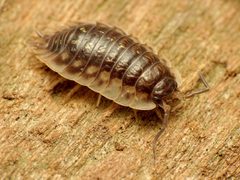
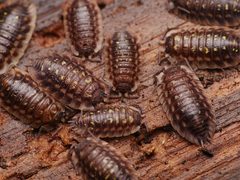
Distinguished from Porcellio scaber by smoother (juveniles may be confused due to rough bumps), shiny rather than matte appearance, and inability to roll completely into a ball. Three-segmented antennal and wide with lateral lobes on are -level diagnostic features. Pale calcium patches often visible. O. a. occidentalis distinguished by smaller size, more vivid coloration, and slightly different body shape; found only in western France and southeastern Britain.
Images
Habitat
Requires moist conditions; found under rotting wood, rocks, leaf litter, and in soil crevices. Occupies diverse including woodlands, grasslands, scrub, road verges, cliff , quarries, gardens, greenhouses, walls, and building interiors. Especially prevalent in decaying wood, allowing of calcium-poor environments like moorlands. Avoids dry habitats.
Distribution
Native to Western and Northern Europe from Portugal to Sweden, east to Ukraine, including British Isles, Azores, and Madeira. Widespread throughout British Isles, recorded in every vice-county of England, Scotland, Wales, and Ireland. Introduced to Americas, predominantly in Mexico and United States (east of Mississippi River, west of Rocky Mountains). Less common in Mediterranean Basin.
Seasonality
Active year-round in suitable microhabitats; may seek deeper shelter during cold or dry periods. Specific seasonal patterns not documented.
Diet
feeding on decaying plant matter, particularly rotting wood and leaf litter. In laboratory conditions, has been observed to fragment and consume weathered polystyrene foam, preferring plastic previously exposed to soil suspension over pristine or UV-weathered material.
Life Cycle
Development through direct development (no larval stages); young resemble miniature . Biphasic moulting cycle with 15 distinguishable stages: half of body moults before half. Calcium stored in deposits during premoult for post- hardening. Shed typically consumed. involves growth, formation, nurse development, and formation. Females possess two tube-shaped ovaries running much of body length; males have two three-lobed .
Behavior
surface activity with daytime sheltering under cover objects. Locomotory altered by heavy metal exposure, including reduced activity time, decreased distance traveled, and disrupted turning patterns. Aggregates in moist microhabitats. Consumes own shed after moulting.
Ecological Role
Decomposer contributing to breakdown of plant detritus, particularly woody material. Bioindicator for heavy metal pollution; accumulates lead, , zinc, and cadmium in hepatopancreas, with documented concentrations among highest recorded in animal soft tissues. May contribute to microplastic in soil through fragmentation of weathered plastic debris.
Human Relevance
Frequently encountered in gardens and buildings; generally considered harmless. Used in scientific research on moulting physiology, heavy metal bioaccumulation, , and microplastic fragmentation. Occasionally referenced as edible with flavor compared to crab or shrimp. O. a. occidentalis classified as Near Threatened in Britain due to fragmentation and hybridization with O. a. asellus.
Similar Taxa
- Porcellio scaberRougher, matte ; does not possess shiny appearance of O. asellus. O. asellus with rough bumps may be misidentified as P. scaber.
- Armadillidium vulgareCan roll completely into ball (conglobation); O. asellus cannot.
More Details
Subspecies
Two recognized: O. a. asellus (widespread) and O. a. occidentalis (western France, southeastern Britain). The latter described 1994, smaller, more colorful, slightly different body shape; capable of interbreeding with O. a. asellus producing hybrids.
Plastic Fragmentation
Laboratory study demonstrated ability to fragment weathered polystyrene foam into microplastic particles within 24 hours; showed strong preference for polystyrene previously exposed to soil suspension over pristine or UV-weathered material.
Heavy Metal Accumulation
Hepatopancreas accumulates exceptionally high levels of lead, , zinc, and cadmium from contaminated environments; concentrations among highest recorded in animal soft tissues. Woodlice from contaminated sites show enlarged hepatopancreata and altered locomotory .
Sources and further reading
- BugGuide
- Wikipedia
- GBIF taxonomy match
- iNaturalist taxon
- NCBI Taxonomy
- Catalogue of Life
- Study Examines Insects' Role in Plastic Pollution
- isopod with plastic - Entomology Today
- Oniscus asellus Archives - Entomology Today
- Come one, come all to explore the Insect Petting Zoo: Maryland Day, Saturday April 29, 2023 — Bug of the Week
- Come one, come all to explore the Insect Petting Zoo: Maryland Day, Saturday April 26, 2025 — Bug of the Week
- COME ONE, COME ALL TO EXPLORE THE INSECT PETTING ZOO: MARYLAND DAY, SATURDAY APRIL 27, 2024 — Bug of the Week
- Oogenesis in oniscus asellus
- Microorganisms associated with the hindgut of Oniscus asellus (Crustacea, Isopoda)
- The Effect of Different Foods, Substrates, Moisture, and Temperatures on the Behavior in Oniscus asellus
- Neurosecretory action potentials recorded extracellularly from a neurohemal region associated with the Y-organ in the terrestrial isopod,Oniscus asellus
- Ultrastructure and distribution of identified neurosecretory terminals in the sinus gland of the terrestrial isopod Oniscus asellus
- Altered locomotory behavior in woodlice (Oniscus asellus (L.)) collected at a polluted site
- Stages of the intermoult cycle in the terrestrial isopod Oniscus asellus and their relation to biphasic cuticle secretion