
Cylisticus convexus
(De Geer, 1778)
Curly Woodlouse
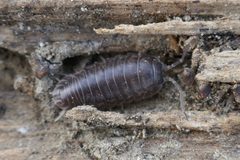
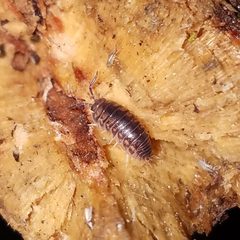
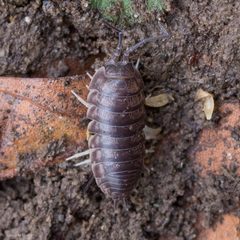
Cylisticus convexus, commonly known as the curly , is a small terrestrial isopod first described by Charles De Geer in 1778. Native to Europe and Asia, it has been introduced to North Africa, North America, and South America. The is notable for its ability to conglobate (roll into a ball) while retaining protruding and uropods, and for possessing five pairs of pleopodal lungs—features that distinguish it from similar pillbugs.
Pronunciation
How to pronounce Cylisticus convexus: /sɪˈlɪstɪkəs kənˈvɛksəs/
These audio files are automatically generated. While they are not always 100% accurate, they are a good starting point.
Identification
Distinguished from Armadillidium spp. and Eluma caelata by its long pointed uropods (versus truncated 'square' uropods in those ) and five pairs of pleopodal lungs (versus two pairs in Armadillidium and Eluma). When conglobated, and uropods remain protruding, unlike the complete enclosure seen in some other pillbugs. The nearly square, obliquely outward-directed lateral lobes of the cephalon and specific antennal proportions provide additional diagnostic characters.
Images
Appearance
Elongated, convex body reaching 9.0 mm in males and 10.0 mm in females. Cephalon bears nearly square lateral lobes directed obliquely outward. composed of 22 . with fifth peduncular article longer than the two-articled ; and flagellar articles nearly equal in length. with molar penicil consisting of numerous setae arising from a single stem. two-lobed with both lobes bearing setules; inner lobe larger than outer lobe with scattered spines. Long, pointed uropods remain protruding when conglobated.
Habitat
Terrestrial; found in soil, particularly the top layer (0–10 cm depth) of sandy loam soils. Occurs in ground-level near buildings in temperate regions, and in tropical forest soils in introduced ranges. Shows very poor vertical , rarely found below 30 cm depth; highest densities occur at 1–5 cm beneath the surface. Prefers moist environments with slightly acidic soil and high organic carbon content. Seeks in cracks of rocks and bark during unfavorable conditions.
Distribution
Native to Europe and Asia. Introduced to North Africa, North America, and South America. Documented in the Western Ghats of India (Mekkarai, Kottavasal, Achenkovil localities in Tamil Nadu and Kerala).
Seasonality
varies seasonally in tropical regions: highest during post-monsoon (38.24±2.83 individuals per unit area), moderate during monsoon (31.04±3.63), and lowest during pre-monsoon (17.87±2.69). activity pattern.
Diet
; feeds on dead wood, leaf litter, and organic matter. Involved in organic matter decomposition and humus formation.
Behavior
. Capable of conglobation (rolling into a defensive ball), though and uropods remain protruding. Exhibits very poor vertical in soil compared to other soil arthropods such as collembolans. Aestivates in cracks of rocks and bark during unfavorable conditions.
Ecological Role
Soil decomposer contributing to organic matter breakdown, humus formation, and soil aggregate production through litter destruction activities.
Similar Taxa
- Armadillidium spp.Similar conglobating pillbugs, but distinguished by truncated 'square' uropods and only two pairs of pleopodal lungs versus five in Cylisticus convexus.
- Eluma caelataAnother conglobating with truncated uropods and two pairs of pleopodal lungs, differing from C. convexus in these key morphological features.
More Details
Taxonomic history
Originally described as Oniscus convexus by Charles De Geer in 1778; later transferred to Cylisticus.
Research significance
Used as a model organism in studies of soil and seasonal in tropical environments.