
Larinioides cornutus
(Clerck, 1757)
furrow spider, furrow orb spider, foliate spider
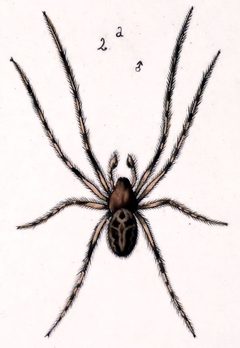
Larinioides cornutus is a Holarctic orb-weaver spider (Araneidae) commonly known as the furrow spider or foliate spider. Females reach 6–14 mm body length, males 5–9 mm, with leg spans of 18–35 mm. The constructs orb webs in moist near water, hiding in silken retreats during daytime and emerging at night to repair webs and occupy the hub. It exhibits distinctive antipredator including (death feigning), with circadian modulation of defensive responses.
Pronunciation
How to pronounce Larinioides cornutus: /ˌlærɪniˈɔɪdiːz kɔːrˈnuːtəs/
These audio files are automatically generated. While they are not always 100% accurate, they are a good starting point.
Identification
Distinguished from by combination of: (1) arrow-shaped markings on and pointing toward , (2) moist preference near water, (3) silken retreat with bottom opening camouflaged with plant and animal debris. Similar L. sclopetarius (Bridge Orbweaver) prefers manmade structures and drier situations; L. patagiatus lacks and differs in habitat association. L. folium, if valid, occurs in dry habitats. arrangement (row of six with pair above) typical of Larinioides , not diagnostic to species level.
Images
Habitat
Moist environments near water: tall grasses, reeds, bridges, posts, damp rough grassland, and meadows. Webs constructed between grass blades or in low shrubbery. Retreat sites positioned high in adjacent vegetation.
Distribution
Holarctic: North America, Europe, Russia (European to Far East), Middle East (Turkey, Israel, Iran), Caucasus, China, Korea, and Japan. In United Kingdom: widespread in England and Wales, scattered in Scotland, records from most Irish counties. In North America: present across northern regions with records from maritime provinces through Great Lakes and Pacific Northwest.
Seasonality
Active year-round; does not hibernate. Exhibits cycle of seasonal cold resistance: supercooling point drops from −8°C in summer to −20°C in winter. Mating occurs in autumn and spring; female produces 3–5 yellow sacs during summer.
Life Cycle
stage: yellow egg sacs produced by female, quantity 3–5 per summer. spiders construct webs and occupy hub more frequently during daytime than mature individuals. Development includes cycle without winter . Males typically die after mating, often consumed by female.
Behavior
activity pattern: hides in silken retreat during day, emerges at night to repair or reconstruct web, then occupies hub hanging -down. Retreat constructed with bottom opening and camouflaged using plant and animal matter. Web rebuilt each evening. Exhibits (death feigning) as antipredator defense; duration modulated by octopamine (shortens) and serotonin (lengthens). Antipredator responsiveness shows , reduced at night compared to day. Males detect female via ; copulation occurs within female-constructed silk cocoon.
Ecological Role
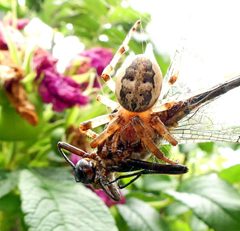
of flying insects captured in orb webs; may concentrate near outdoor lights where insect prey aggregate. Serves as prey for spider wasps including Agenioideus humilis.
Human Relevance
Bites cause mild pain, numbness, and swelling; rarely nausea and dizziness. Not considered medically significant. Subject of neuroethological research on biogenic amine modulation of . sequenced as reference for arachnid .
Similar Taxa
- Larinioides sclopetariusFormerly confused with L. cornutus; prefers manmade structures (bridges, buildings) and drier situations versus moist natural of L. cornutus.
- Larinioides patagiatusMorphologically similar but lacks ; distinguished by preferences and geographic patterns.
- Larinioides foliumPossibly distinct occurring in dry , contrasting with moisture-dependent of L. cornutus.
Misconceptions
Common misconception that spiders cannot hear due to lack of ears; L. cornutus detects sound via macrosetate and hairs on legs.
More Details
Neuroethology
First spider in which biogenic amine effects on specific antipredator were directly demonstrated. Octopamine and serotonin have opposite effects on duration, providing model for studying behavioral modulation in arachnids.
Genomic resources
Chromosomally complete assembly available from female specimen collected in Oxfordshire, UK. Assembly contains two haplotypes (~2.3 Gb each), with haplotype 1 scaffolded into 13 chromosomal pseudomolecules including X1 and X2 . Mitochondrial genome assembled at 14.6 kb.
Sources and further reading
- BugGuide
- Wikipedia
- GBIF taxonomy match
- iNaturalist taxon
- NCBI Taxonomy
- Catalogue of Life
- Bug Eric: One Night, One House, Seventeen Spider Species
- Bug Eric: Spider Wasp, Agenioideus humilis, Caught on Video
- For horny beetles, size does matter: Forked Fungus Beetle, Bolitotherus cornutus — Bug of the Week
- How a cool creepy insect warms up: Eastern Dobsonfly, Corydalus cornutus — Bug of the Week
- Bug Eric: Bridge Orbweaver (Gray Cross Spider)
- Evidence of circadian rhythm in antipredator behaviour in the orb-weaving spider Larinioides cornutus
- Octopamine and serotonin have opposite effects on antipredator behavior in the orb-weaving spider, Larinioides cornutus
- The genome sequence of the furrow orbweaver, Larinioides cornutus (Clerck, 1757).