
Agenioideus humilis
(Cresson, 1867)
Spider Wasp
Agenioideus humilis is a small spider wasp in the Pompilidae that hunts orbweaver spiders (Araneidae) as prey for its larvae. Females paralyze spiders with their sting, then transport them to nest burrows where a single is laid on the immobilized . The ranges across most of the United States but is considered scarce throughout its distribution. It favors woodland with sandy soil and has been observed nesting in both excavated burrows and pre-existing cavities such as rock crevices and building cracks.
Pronunciation
How to pronounce Agenioideus humilis: //ˌædʒəniˈɔɪdiəs ˈhjuːmɪlɪs//
These audio files are automatically generated. While they are not always 100% accurate, they are a good starting point.
Identification
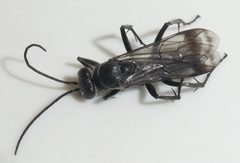
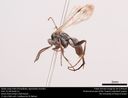
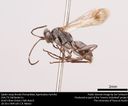
Distinguished from other spider wasps by the combination of small size, dull black coloration, and the white spot on the hind tibia. The wing pattern—clear with dark edges and a broad dark band on the forewing—provides additional diagnostic characters. Males are notably smaller and differently proportioned than females. The lacks the bright coloration or metallic sheen seen in many larger pompilids such as tarantula hawks (Pepsis spp.).
Images
Appearance
Small, dull black with clear wings bearing dark edges and a broad dark band on the forewing. Females measure 5.5–10.5 mm in body length (averaging 8 mm); males are smaller at 4–9.5 mm (averaging 6.5 mm). Both sexes display a distinctive white spot dorsally near the base of the tibia on the hind leg. Males have a substantially smaller and different body type than females.
Habitat
Woodland with sandy soil; mixed coniferous forest with understory shrubs including oak and chokecherry. Nesting occurs in sandy substrates, including soil excavations and pre-existing cavities in rocks or building walls.
Distribution
United States, excluding the northern Rocky Mountains, northern Great Plains, most of Minnesota, Wisconsin, and northern Michigan. Nowhere common; scarce in collections throughout range.
Diet
do not appear to feed on flower nectar or honeydew, unlike most adult spider wasps. Larvae are that feed on paralyzed orbweaver spiders.
Host Associations
- Araneidae - preyOrbweaver spiders including Acacesia hamata, Larinioides cornutus, and Araneus pegnia
Life Cycle
Female paralyzes a single spider with her sting, transports it to a nest site, and excavates a burrow or uses a pre-existing cavity. A single is laid on the spider, the entrance is concealed with soil scraped and compacted using abdominal blows, and the female departs to repeat the process. Larva develops by feeding on the paralyzed .
Behavior
Females hunt actively, dragging paralyzed spiders to nest sites even when disturbed. Nesting involves rapid digging with soil ejected between the legs. Males have been observed loitering near nesting females, possibly seeking mating opportunities. The maintains grip on prey during transport and will continue descent even when startled.
Ecological Role
Human Relevance
Minimal direct interaction with humans. Nesting in building cracks may bring it into occasional proximity with human structures. Not known to sting humans unless handled. Of interest to entomologists due to scarcity in collections and specialized hunting .
Similar Taxa
- Agenioideus nigricornisAustralian that hunts cobweb weavers (Theridiidae) including the dangerous Redback Spider (Latrodectus hasselti); differs in geographic range and prey
- Pepsis spp.Larger, brightly colored tarantula hawks with metallic blue-black bodies and orange wings; differ dramatically in size, coloration, and prey (tarantulas and large spiders)
- Tastiotenia festivaAnother small spider wasp with circumstantial record as potential of widow spiders; differs in restricted southwestern U.S. range and less well-documented
More Details
Nesting observations
A female observed in Colorado Springs in 2015 demonstrated flexible nesting : after transporting a paralyzed orbweaver down a building exterior, she initially groomed, then relocated to a pre-started burrow at the building base and excavated at high speed with sand ejected between legs.
Male behavior
Males have been observed loitering near active nesting females, suggesting mate-locating centered on female activity rather than territorial defense or lekking.
Sources and further reading
- BugGuide
- GBIF taxonomy match
- iNaturalist taxon
- NCBI Taxonomy
- Catalogue of Life
- Bug Eric: Spider Wasp, Agenioideus humilis, Caught on Video
- Bug Eric: Tiny Wasp Hero Slays Redback Spiders in Australia
- Ivy bees and rare carder bees in a warming world - Buglife Blog - Buglife
- Twig tethered to a twig | Beetles In The Bush
- Researchers Develop Genome Map for Mojave Poppy Bee
- Bare ground experiments to help save rare bees and wasps - Buglife Blog - Buglife