
Agenioideus
Ashmead, 1902
spider wasps
Species Guides
2- Agenioideus birkmanni
- Agenioideus humilis(Spider Wasp)
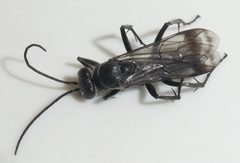
Agenioideus is a of spider wasps in the Pompilidae, Pompilinae. The genus contains approximately 30 described distributed across Europe, Asia, North America, South America, and Australia. Species are generally small, with females of A. humilis measuring 5.5–10.5 mm and males 4–9.5 mm. The genus gained notable attention when A. nigricornis was documented as the first pompilid known to parasitize the highly venomous redback spider (Latrodectus hasselti) in Australia.


Pronunciation
How to pronounce Agenioideus: //ˌædʒɪˌnɪoʊˈaɪdiːəs//
These audio files are automatically generated. While they are not always 100% accurate, they are a good starting point.
Identification
Distinguished from other Pompilinae by the combination of small size, dull black coloration with white hind tibial spot, and wing venation pattern with dark marginal banding. Males recognized by smaller size and slender body form compared to females. In Australia, A. nigricornis and A. expulsus can be separated by diagnostic characters provided in systematic revisions. Japanese distinguished by structural features of the genitalia and wing characteristics.
Images
Habitat
Woodland with sandy soil preferred by at least some . A. humilis recorded from mixed conifer forest with Gambel's Oak, chokecherry, and shrub understory. Nesting occurs in sandy substrates, pre-existing cavities, cracks in rocks, and building walls.
Distribution
Europe (21 recorded ), eastward to Japan, North America, South America, and Australia. In North America, A. humilis ranges across the continental United States except the northern Rockies, northern Great Plains, most of Minnesota, Wisconsin, and northern Michigan. Australian species occur across southern Australia. Japanese species distributed across the archipelago with some extending to Korea, China, and Taiwan.
Seasonality
active during warmer months. A. humilis observed nesting in late June in Colorado. Specific seasonal patterns vary by region and .
Host Associations
- Orbweavers (Araneidae) - preyA. humilis: Acacesia hamata, Larinioides cornutus, Araneus pegnia
- Redback spider (Latrodectus hasselti) - preyA. nigricornis: first record of any pompilid utilizing this ; documented at multiple locations across southern Australia
Life Cycle
Females paralyze spiders with their sting and transport them to nest sites. Single prey item provisioned per nest. laid on paralyzed spider. Larva develops by consuming the living but immobilized . Nest sealed with soil compacted by abdominal blows. Multiple nests constructed sequentially by individual females.
Behavior
Females hunt spiders, paralyze them with venomous sting, and drag prey to nest sites using a zig-zag locomotion pattern. Prey transport observed down vertical surfaces including rockwork and building exteriors. Nesting includes rapid excavation of burrows in sand, with soil ejected between legs and behind the body. Nest closure involves scraping soil over entrance and compacting with abdominal impacts. Males observed near active nesting females, possibly mate-guarding or seeking mating opportunities. Females maintain grip on prey even when disturbed.
Ecological Role
Specialized of spiders, acting as regulators. A. nigricornis provides of the medically significant redback spider in Australia. Contributes to nutrient cycling through burrowing activities in sandy soils.
Human Relevance
A. nigricornis recognized for on the dangerous redback spider, a medically significant pest in Australia. Potential value as agent for widow spiders. Generally too small to pose defensive threat to humans. Rare in collections, suggesting limited human encounter frequency.
Similar Taxa
- Other Pompilinae generaAgenioideus distinguished by small size, white hind tibial spot, and wing banding pattern; many related lack the distinctive tibial marking or have different wing pigmentation
- Tastiotenia festivaAnother small spider wasp suggested as potential of widow spiders in southwestern North America; differs in distribution and records
- Chalybion californicum (Blue Mud Dauber)Well-documented of widow spiders but belongs to Sphecidae, not Pompilidae; differs in nesting (mud nests vs. soil burrows) and prey handling
More Details
Discovery of redback spider predation
The relationship between A. nigricornis and Latrodectus hasselti was first discovered in 2012, initiated by observation from a nine-year-old boy in Beaconsfield, Western Australia. Despite A. nigricornis being known to science since 1775 (described from specimens collected by Captain James Cook in 1768), its host remained unknown until this citizen science observation.
Collection rarity
A. humilis described as scarce in collections throughout its North American range, suggesting either genuine rarity, cryptic habits, or under-collection due to small size.
Sources and further reading
- BugGuide
- Wikipedia
- GBIF taxonomy match
- iNaturalist taxon
- NCBI Taxonomy
- Catalogue of Life
- Bug Eric: Spider Wasp, Agenioideus humilis, Caught on Video
- Bug Eric: Tiny Wasp Hero Slays Redback Spiders in Australia
- Systematic studies on the Pompilidae occurring in Japan: Genus Agenioideus Ashmead (Hymenoptera), supplement
- Systematics of AustralianAgenioideusAshmead (Hymenoptera: Pompilidae) with the first record of a spider wasp parasitizingLatrodectus hasseltiThorell (redback spider)