
Acacesia hamata
(Hentz, 1847)
Difoliate Orbweaver
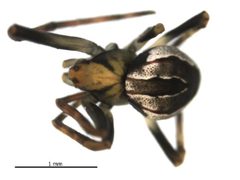
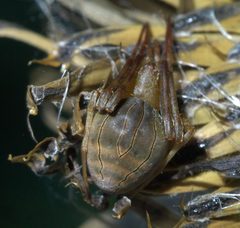
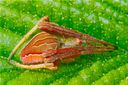
Acacesia hamata, commonly known as the Difoliate Orbweaver, is a small orb-weaving spider in the Araneidae. It is the only of its found north of Mexico, with a distribution ranging from the eastern United States south to Argentina. The species is recognized by its distinctive abdominal pattern featuring a dagger-like mark within a wedge-shaped folium. It builds vertical orb webs at night and removes them before dawn, typically in grassy or shrubby near forest edges.
Pronunciation
How to pronounce Acacesia hamata: //ˌækəˈseɪʃə ˈhæmətə//
These audio files are automatically generated. While they are not always 100% accurate, they are a good starting point.
Identification
The Difoliate Orbweaver can be distinguished from other small Araneidae by the distinctive two-part abdominal pattern: a wedge-shaped outer folium with wavy borders containing an inner dagger-like cardiac mark. The Acacesia is distinguished from related orb-weaver genera by genitalic characters. Within its range, it is the only of Acacesia north of Mexico, eliminating confusion with . It may be confused with other small greenish orb-weavers such as some Araniella or Mangora species, but these lack the characteristic double folium pattern.
Images
Appearance
Small orb-weaver with distinctive abdominal pattern. Mature females measure 4.7–9.1 mm in body length, males 3.6–5 mm. Basic coloration varies from greenish gray to brown on legs and , gray to green on . The abdomen displays a characteristic pattern: a roughly triangular or wedge-shaped folium with wavy borders containing a dagger-like (cardiac) mark, giving rise to the 'Difoliate' (two foliums). Resting spiders often adopt a hunched posture with legs drawn in.
Habitat
Occurs in open grassy including prairies, meadows, fields, and forest edges (). Has been found on blades of tall grass in glades and by sweeping grasses in open fields. One reference lists it from bushes and shaded woods. Webs are constructed 3–4 feet (approximately 1 meter) above ground in shrubs.
Distribution
Eastern North America from New England south to Florida and west to Illinois and Texas; southward through Central and South America to Argentina. The only of Acacesia normally found in the United States. GBIF records indicate presence in Colombia (Antioquia, Cundinamarca, Magdalena, Valle del Cauca), Venezuela, and the United States.
Seasonality
Active in summer months. Mature individuals are found in early to mid-summer.
Host Associations
- Agenioideus humilis - preyParalyzed and used as larval food by this spider wasp
Life Cycle
Details of reproductive and sac remain unknown. Spiderlings and developmental stages have not been described in detail.
Behavior
web-builder that constructs vertical orb webs 20–25 cm across at night and removes them before daybreak. When startled by bright light, females can deconstruct their web in under 60 seconds by strategically cutting support lines and consuming the silk as they roll it up. may be locally dense. Prey consists of flying insects captured in the orb web.
Ecological Role
of flying insects; serves as prey for spider wasps including Agenioideus humilis. Contributes to diversity in grassland and forest-edge .
Human Relevance
Documented prey item for spider wasp Agenioideus humilis, which has been studied for its hunting and nesting . Subject of interest for arachnologists due to its distinctive appearance and poorly known .
Similar Taxa
- Araniella spp.Similar small greenish orb-weavers, but lack the distinctive double folium abdominal pattern
- Mangora spp.Small orb-weavers with somewhat similar body form, but different abdominal markings and web structure
- Other Acacesia speciesFive other occur from Mexico to Argentina; distinguished by genitalic characters and geographic range
More Details
Web construction behavior
Unlike many orb-weavers that maintain webs throughout the day, A. hamata builds its web anew each night and actively removes it before dawn. This may reduce risk or dew damage.
Taxonomic history
Originally described as Epeira hamata by Hentz in 1847. The Acacesia was revised by Glueck in 1994, who recognized six ranging from the United States to Argentina.
Research gaps
Significant aspects of the of this remain unknown, including reproductive , sac , and specific prey preferences. The species represents an opportunity for citizen science contributions to arachnology.
Sources and further reading
- BugGuide
- Wikipedia
- GBIF taxonomy match
- iNaturalist taxon
- NCBI Taxonomy
- Catalogue of Life
- Bug Eric: Spider Sunday: Difoliate Orbweaver
- Bug Eric: Spider Wasp, Agenioideus humilis, Caught on Video
- Where siblings mingle: Ellipsoptera marginata vs. E. hamata | Beetles In The Bush
- Tiger Beetle Nocturnal Perching | Beetles In The Bush
- (My) Introduction to Florida Tiger Beetles | Beetles In The Bush