
Acacesia
Simon, 1895
Species Guides
1- Acacesia hamata(Difoliate Orbweaver)
Acacesia is a of orb-weaver spiders ( Araneidae) containing six with predominantly neotropical distribution. The genus was established by Eugène Simon in 1895. Most species are known only from museum specimens, with A. hamata being the only species documented in the United States and the only one with substantial natural history information available. Close relatives include the genera Ocrepeira and Cyclosa.
Pronunciation
How to pronounce Acacesia: //ˌækəˈsiːʒə//
These audio files are automatically generated. While they are not always 100% accurate, they are a good starting point.
Identification
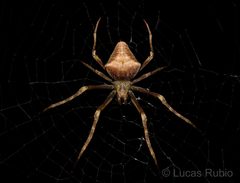
The dagger-shaped mark outlined in black, enclosed within a triangular folium with parallel rows of orange-brown dots on each side, distinguishes Acacesia from other small orb-weaver . For A. hamata specifically, the 'two foliums' pattern (difoliate) gives the 'Difoliate Orbweaver.' Size is small to medium for orb-weavers (under 10 mm).
Images
Appearance
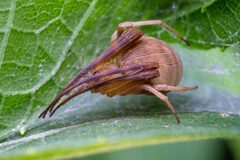
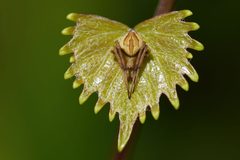
Spiders in this display a distinctive abdominal pattern: a dagger-shaped mark outlined in black, surrounded by a triangular folium. Parallel rows of orange-brown dots flank the dagger on each side. Females measure 4.3–8 mm in body length; males are smaller at 3.6–6.5 mm. In A. hamata specifically, the basic coloration varies from greenish-gray to brown on legs and , with gray to green on the .
Habitat
A. hamata occupies grassland edges, glades, and open fields, often found on tall grasses. It has also been recorded from bushes and shaded woodlands. The spider builds its web in shrubs approximately one meter above ground. Other in the are poorly known but presumably occupy similar vegetation-associated in their neotropical range.
Distribution
The ranges from South America through Mexico. A. hamata extends into the United States, occurring from New England south to Florida and west to Illinois and Texas.
Seasonality
Mature individuals of A. hamata appear in early to mid-summer. web-building activity occurs at night, with webs removed before daybreak.
Behavior
A. hamata constructs vertical orb webs 20–25 cm in diameter, built at night and actively dismantled before dawn. When startled by bright light, females can deconstruct the web in under sixty seconds by cutting support lines and consuming the silk as it rolls up. This may function as avoidance or reduce detection by predators.
Ecological Role
As an orb-weaver, Acacesia functions as a of flying insects. A. hamata serves as documented prey for the spider wasp Agenioideus humilis, which paralyzes and provisions nests with these spiders.
Human Relevance
No significant economic or medical importance. The distinctive appearance of A. hamata makes it of interest to naturalists and arachnologists. The highlights gaps in basic natural history knowledge for many tropical arthropods.
Similar Taxa
More Details
Taxonomic knowledge gaps
Five of six Acacesia are known only from museum specimens. A. hamata is the only species with substantial field observations and behavioral documentation, creating a significant imbalance in ecological understanding across the .