
Cyclosa
Menge, 1866
Trashline Orbweavers
Species Guides
4- Cyclosa caroli
- Cyclosa conica(Conical Trashline Orbweaver)
- Cyclosa turbinata(Humped Trashline Orbweaver)
- Cyclosa walckenaeri(Walckenaer's Trashline Orbweaver)
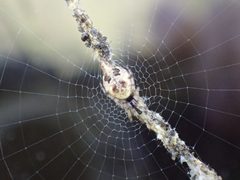
Cyclosa is a of orb-weaver spiders commonly known as trashline orbweavers, first described by Anton Menge in 1866. These spiders are distinguished by their unique web decorations consisting of linear arrangements of prey remains, debris, and sometimes sacs arranged vertically through the web center. The name derives from Greek 'to move in a circle,' referencing their spiral web construction. Most downward in their webs, though some face upward. The genus contains approximately 178 species distributed worldwide.
Pronunciation
How to pronounce Cyclosa: /sɪˈkloʊsə/
These audio files are automatically generated. While they are not always 100% accurate, they are a good starting point.
Identification
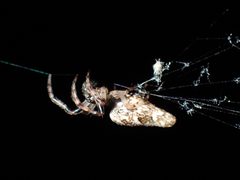
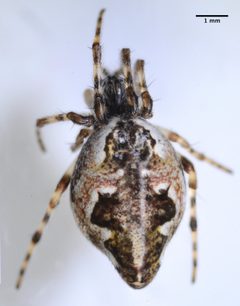
Cyclosa are identified by their small size (females 5-8 mm, males smaller), cryptic coloration resembling bird droppings, and distinctive abdominal projections. In North America, C. conica lacks abdominal humps and measures 5.3-7.5 mm, while C. turbinata has paired humps on the top. Both species often display conical or spatulate projections at the rear of the abdomen. The linear trashline decoration through the web center is diagnostic for the .
Images
Habitat
Open woodlands, shrubs in gardens and yards, typically at or above level. Some occupy specific microhabitats: C. mulmeinensis in Thai rice agroecosystems, Allocyclosa bifurca (related ) in prickly pear cacti in southern Texas and Florida.
Distribution
Worldwide distribution. In North America, five occur north of Mexico, with C. conica and C. turbinata widespread across the continent. Records from Denmark, Norway, Sweden, Vermont (USA), and other locations globally.
Seasonality
reach maturity in spring. Some with in June-July and September-October (e.g., C. onoi).
Diet
capturing flying insects in orb webs. Prey capture success varies among coexisting based on web parameters: C. octotuberculata uses thick silk with large adhesive droplets; C. argenteoalba constructs dense mesh webs at open sites; C. sedeculata has thinner silk with reduced prey retention.
Life Cycle
Mature males abandon web-building and wander seeking mates. Females construct up to five sacs hidden on twigs or beneath foliage. In some , spiderlings hatch and disperse independently.
Behavior
Constructs characteristic 'trashline' —vertical linear decorations of debris, prey remains, and shed through web center where the spider sits, providing camouflage against bird and hymenopteran . Some tropical (e.g., C. longicauda in Peru) build complex non-linear stabilimenta resembling larger spider silhouettes as visual mimicry. Web relocation varies: C. argenteoalba relocates frequently and constructs smaller initial webs at new sites; C. octotuberculata shows stronger site tenacity and maintains web size after relocation. Some species upward in webs rather than downward.
Ecological Role
of flying insects. Webs serve as passive environmental collectors and of fungal diversity, with documented associations with Alternaria, Aspergillus, Cladosporium, Fusarium, Penicillium, and Talaromyces in agroecosystems. for spider ectoparasitoids including Reclinervellus nielseni (Ichneumonidae) and Baeus (Scelionidae). Subject to kleptoparasitism by Argyrodes species in colonial webs.
Human Relevance
Not dangerously venomous to humans. Occasionally considered nuisance when webs built near human structures; webs may be unsightly but spiders pose minimal risk. Serve as indicators of agricultural health through associated fungal .
Similar Taxa
- AllocyclosaAlso called trashline orbweavers and constructs similar debris decorations; differs in geographic distribution (southern USA only for A. bifurca) and female reproductive ( external genitalia, potentially parthenogenic)
- UloborusBoth are small orb-weavers, but Uloborus lacks venom glands, uses cribellate (hackled) rather than sticky silk, and constructs horizontal orbs with different patterns; also has distinctive feathered front legs
- ArgiopeBoth construct orb webs with , but Argiope builds larger webs with zigzag or cross-shaped silk bands rather than detritus lines, and lacks the trashline camouflage strategy
Sources and further reading
- BugGuide
- Wikipedia
- GBIF taxonomy match
- iNaturalist taxon
- NCBI Taxonomy
- Catalogue of Life
- Cyclosa sp. "trash line" orb weaver spider - Entomology Today
- Bug Eric: Spider Sunday: Trashline Orb Weavers
- Orbs, Tangles, and Sheets: Spider Web Styles Linked to Anti-Predator Adaptations
- Bug Eric: June 2012
- Bug Eric: One Night, One House, Seventeen Spider Species
- Bug Eric: Spider Sunday: Featherlegged Orb-weavers
- Life history characteristics of a rare spider Cyclosa onoi.
- Testing the Functions of Detritus Stabilimenta in Webs of Cyclosa fililineata and Cyclosa morretes (Araneae: Araneidae): Do They Attract Prey or Reduce the Risk of Predation?
- Predator perception of detritus and eggsac decorations spun by orb-web spiders Cyclosa octotuberculata: Do they function to camouflage the spiders?
- Difference in Web Construction Behavior at Newly Occupied Web Sites Between Two Cyclosa Species
- Evaluation of manipulative effects by an ichneumonid spider-ectoparasitoid larva upon an orb-weaving spider host (Araneidae: Cyclosa argenteoalba) by means of surgical removal and transplantation
- Factors affecting the difference in foraging success in three co‐existing Cyclosa Spiders
- A NEW SPECIES OF BAEUS (HYMENOPTERA: SCELIONIDAE) FROM BRAZIL, PARASITOID OF CYCLOSA MORRETES (ARANEAE: ARANEIDAE)
- Cyclosa omonaga (Araneae: Araneidae), an Alternative Host of the Spider Ectoparasitoid Reclinervellus nielseni (Hymenoptera: Ichneumonidae), with Notes on Behavioural Manipulation
- Spider webs as reservoirs of culturable fungal diversity: evidence from orb-weaving Cyclosa mulmeinensis spider in Thai rice agroecosystems
- Life‐history variation in closely related generalist predators living in the same habitat: a case study with three Cyclosa spiders
- Diel patterns of foraging aggression and antipredator behaviour in the trashline orb-weaving spider, Cyclosa turbinata
- The host becomes dinner: possible use of Cyclosa as a nuptial gift by Argyrodes in a colonial web
- The timing of female genital mutilation and the role of contralateral palpal insertions in the spider Cyclosa argenteoalba
- Spider webs as reservoirs of culturable fungal diversity: evidence from orb-weaving Cyclosa mulmeinensis spider in Thai rice agroecosystems
- Cyclosa Menge, 1866 (Araneidae) Orb-Weavers Build Stabilimenta That Resemble Larger Spiders.