
Uloborus
Latreille, 1806
Feather-legged Spiders, Featherlegged Orb-weavers, Hackled Band Orb-weavers
Species Guides
3- Uloborus campestratus(Featherlegged Orb-weaver)
- Uloborus diversus(hackled orb-weaver)
- Uloborus glomosus(Featherlegged Orbweaver)
Uloborus is a of cribellate orb-weaving spiders in the Uloboridae, comprising approximately 72 described . These small spiders (3–6 mm body length) are unique among orb-weavers in lacking venom glands entirely, instead relying on constriction and digestive to subdue prey. They construct small horizontal orb-webs with hackled, non-sticky silk produced by a specialized cribellum organ, often incorporating a —a thickened linear or zigzag silk band at the web hub. The genus is predominantly tropical and subtropical in distribution, with only a few species extending into temperate North America and Europe.


Pronunciation
How to pronounce Uloborus: /ˌjuːləˈbɔːrəs/
These audio files are automatically generated. While they are not always 100% accurate, they are a good starting point.
Identification
Distinguished from other orb-weaving by the combination of: (1) cribellate silk production (visible as woolly, non-sticky capture threads rather than glue droplets), (2) complete absence of venom glands, and (3) often prominent feather-like setal tufts on the tibiae of the first legs. The web structure aids identification: small horizontal orbs with a thickened (linear, zigzag, or auxiliary spiral) at the hub. From the related genus Hyptiotes (triangle spiders), Uloborus differs in constructing complete orb webs rather than triangular sector webs. From ecribellate orb-weavers such as Argiope and Cyclosa, Uloborus differs in having hackled rather than sticky capture silk and lacking venom glands.
Images
Habitat
Occurs in diverse outdoor situations including gardens, greenhouses, the mouths of culverts, and vegetation near water. Webs are typically built in relatively sheltered locations. In tropical and subtropical regions, found in a wide variety of terrestrial ; in temperate zones, restricted to suitable microhabitats.
Distribution
Predominantly tropical and subtropical worldwide. In North America, five occur collectively across the entire United States and southern Canada. Few species extend into northern Europe (records from Denmark, Norway, Sweden). Specific documented locations include Parque Nacional Natural Serranía de Chiribiquete (Colombia).
Diet
Preys on a variety of flying insects. Lacks venom glands; kills prey through constriction by extensive silk wrapping combined with application of digestive poured onto the prey. The wrapped silk becomes transparent after absorbing enzymes.
Life Cycle
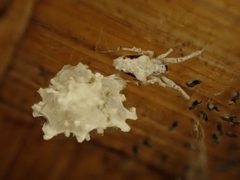
Females construct small, flattened, papery sacs, usually positioned near the web periphery; multiple egg sacs may be arranged in a row. Spiderlings hatch and build orb webs immediately upon , but webs differ structurally from webs: they have additional and retain the auxiliary spiral at the hub. This difference occurs because spiderlings are born without functional cribella and calamistra. After the second , the spiderling develops these structures and can construct the characteristic 'normal' cribellate web.
Behavior
Constructs small horizontal orb-webs with cribellate silk, often incorporating a of variable shape (commonly a linear band). When approaching prey, the spider forcefully tugs the web using legs I and II to locate and further entangle the victim. The spider hangs from legs I and II while using legs IV to throw silk onto the prey, facing away from the prey during wrapping. Prey subjugation involves extensive wrapping followed by application of digestive . Web-building is a prolonged process: the tangled spiral is drawn slowly through the cribellum and fluffed with the calamistrum, taking hours to complete.
Ecological Role
of flying insects; contributes to insect in where abundant. The cribellate silk, while non-sticky, effectively captures prey through physical entanglement, representing an alternative evolutionary solution to prey capture compared to the viscid silk of ecribellate orb-weavers.
Human Relevance
Occasionally encountered in gardens and greenhouses. Non-venomous and harmless to humans due to complete absence of venom glands. May incidentally capture butterflies in exhibits, incapacitating them without killing them outright. Serves as a research model for studying orb-web evolution and neurobiology of web-building (e.g., Uloborus diversus).
Similar Taxa
- HyptiotesAlso in Uloboridae and lacks venom glands, but constructs triangular sector webs rather than complete orbs, and lacks the prominent feather-legged appearance of some Uloborus
- ArgiopeEcribellate orb-weaver that constructs webs with , but uses sticky viscid silk rather than hackled cribellate silk, possesses venom glands, and is generally much larger
- CyclosaEcribellate orb-weaver with -like web decorations, but uses adhesive capture silk, has venom glands, and often incorporates debris into the web center
More Details
Evolutionary significance of orb-web building
Uloborus has contributed to scientific understanding of orb-web evolution. The convergent hypothesis proposed that orb webs evolved independently in cribellate and ecribellate lineages, but molecular analysis of silk proteins now supports a single origin of the orb web with subsequent diversification.
Neurobiological research model
Uloborus diversus has been established as a model organism for studying the neural basis of complex innate , with the first three-dimensional immunofluorescence brain atlas for any spider created for this .
Male rarity
Males of some appear to be rarely encountered; for Uloborus glomosus, one arachnologist noted never having observed a male despite extensive field experience.