
Hyptiotes
Walckenaer, 1837
Triangle Web Spiders, Triangle Spiders
Species Guides
3- Hyptiotes cavatus(triangle weaver)
- Hyptiotes gertschi(Gertsch's Triangleweaver)
- Hyptiotes puebla(triangle spider)
Hyptiotes is a of small cribellate spiders in the Uloboridae, commonly known as triangle web spiders. These arachnids are distinguished by their unique triangular webs— orb webs consisting of four connected to a single anchor thread. They are notable as the only spiders in North America that lack venom glands, relying instead on specialized silk to capture and subdue prey. females measure 3-4 mm, while males are 2-3 mm. Four occur in North America, with three primarily western and one eastern species (H. cavatus).
Pronunciation
How to pronounce Hyptiotes: //haɪpˈti.oʊtiːz//
These audio files are automatically generated. While they are not always 100% accurate, they are a good starting point.
Identification
The triangular web shape is diagnostic—unlike the circular orb webs of most orb-weavers, Hyptiotes constructs only a triangular sector. The combination of tiny size, cribellate silk (visible as fuzzy, non-sticky threads), and the spider's habit of sitting at the web's apex holding the anchor thread taut further distinguishes this . The lack of venom glands, unique among North American spiders, cannot be observed directly but is a key biological characteristic. Distinguished from related Uloborus by web geometry: Uloborus builds more complete, though reduced, orb webs rather than simple triangles.
Images
Appearance
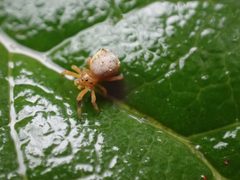
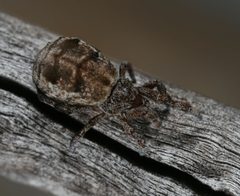
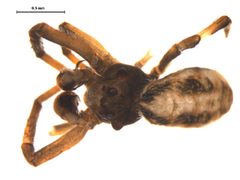
Very small spiders with females 3-4 mm and males 2-3 mm in length. as broad as long, weakly convex above, highest and broadest at the second row. narrowed and rounded anteriorly, widely rounded posteriorly. Eight eyes in two unequal transverse rows: row procurved from front, nearly straight dorsally, with small eyes close together and widely separated lateral eyes; row much wider, recurved, with large median eyes as widely separated as anterior lateral eyes. broad and sloping. Sternum triangular, longer than wide, truncated and widest anteriorly, tapering evenly to blunt point between slightly separated posterior . sub-oval and moderately to strongly arched in females, more slender in males. Anterior much larger than posterior pair. Legs short and stout; female legs without spines except few on , male legs longer with and lateral spines. Calamistrum occupies most of flattened fourth metatarsus length, consisting of single series of curved bristles.
Habitat
Vegetation in open areas including goldenrods, asters, and ornamental trees. Webs constructed between leaves on plants, on twigs of trees and shrubs, on bridges and other structures, typically at waist height.
Distribution
North America with four : three primarily western in distribution, one eastern species (Hyptiotes cavatus). Records also from northern Europe (Denmark, Norway, Sweden).
Diet
Flying insects that collide with the web; specific prey types not documented.
Life Cycle
-sac flattened, mottled brown, attached to surface of twig. Developmental details otherwise unknown.
Behavior
Constructs triangular orb web with four connected to single anchor thread. Spider sits at web vertex holding anchor thread taut with tension maintained by coiled silk. When prey impacts web, spider instantly releases anchor thread, causing web to rebound and further entangle prey. Spider then wraps prey in specialized wrapping silk. Related Uloborus observed to spend approximately 10 minutes wrapping even small prey in extensive silk. Web construction involves drawing tangled silk spans through cribellum slowly, then 'ratting' with calamistrum; spiral construction takes hours.
Ecological Role
of small flying insects; prey capture method represents unique evolutionary solution to web-building in reduced spaces.
Human Relevance
Non-venomous and harmless to humans due to complete absence of venom glands. Too small to be conspicuous; occasionally encountered by naturalists and arachnologists.
Similar Taxa
- UloborusAlso in Uloboridae with cribellate silk and reduced orb webs, but constructs more complete orb webs rather than simple triangular sectors; web geometry is the primary distinguishing feature
More Details
Cribellate Silk
Cribellate spiders possess an additional spinning organ, the cribellum, adjacent to normal . The cribellum produces specialized silk that is 'fluffed up' using the calamistrum (comb-like organ on hind legs). The capture silk is not sticky but tangled, apparently equally effective as adhesive droplets at trapping prey.
Venom Absence
Uloboridae, including Hyptiotes, are the only spiders in North America that completely lack venom glands. Prey subjugation relies entirely on extensive silk wrapping and possibly enzymatic digestion after immobilization.