
Larinioides
Caporiacco, 1934
Furrow Spiders, Bridge Orbweavers, Gray Cross Spiders
Species Guides
3- Larinioides cornutus(furrow spider)
- Larinioides patagiatus(Ornamental Orbweaver)
- Larinioides sclopetarius(bridge-spider)
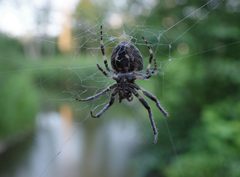
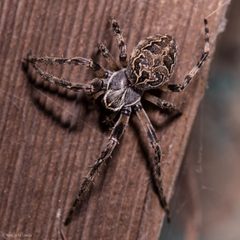
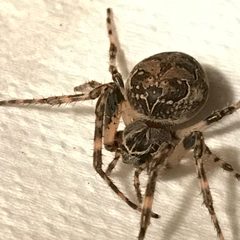
Larinioides is a of orb-weaving spiders in the Araneidae, first described by Lodovico di Caporiacco in 1934. The genus name derives from the related genus Larinia, meaning 'like Larinia.' These spiders are primarily found in temperate regions of the northern hemisphere and are commonly known as furrow spiders or bridge orbweavers due to their tendency to construct webs on manmade structures near water. The genus contains seven recognized , including the widely distributed L. cornutus, L. patagiatus, and L. sclopetarius. Larinioides spiders build new orb webs nightly, consuming them each morning before rebuilding.
Pronunciation
How to pronounce Larinioides: //ˌlɛrɪniˈɔɪdiːz//
These audio files are automatically generated. While they are not always 100% accurate, they are a good starting point.
Images
Habitat
Larinioides spiders are strongly associated with aquatic and riparian environments, frequently constructing webs on bridges, docks, and other manmade structures near water where emerging aquatic insects provide abundant prey. They also occur in dry-mesic upland deciduous forests and around outdoor lights where insect prey concentrates. The shows particular affinity for temperate climates across the northern hemisphere.
Distribution
Temperate regions of the northern hemisphere including North America, Europe, Asia (Russia, China, Korea, Japan, Central Asia), Turkey, Israel, Caucasus, Iran, and Mongolia. Specific distributions vary: L. cornutus and L. patagiatus are transcontinental across North America and Eurasia; L. sclopetarius is native to Europe and Asia with introduced in North America; L. chabarovi and L. jalimovi are restricted to Russia and Korea; L. ixobolus ranges from Western Europe to Central Asia; L. suspicax occurs from Europe through North Africa to Central Asia.
Diet
Feeds on flying insects captured in orb webs. Prey includes emerging aquatic insects such as and mayflies when webs are positioned near water, and various insects attracted to outdoor lighting.
Life Cycle
Mature females measure 8–14 mm in body length, males 6–8 mm. Males can be distinguished by enlarged . Spiders construct new orb webs nightly and consume them the following morning, then rebuild the next evening. specimens are more likely to occupy the web hub during daylight hours than mature individuals.
Behavior
web-building activity with spiders typically occupying the hub of the web at night, hanging -down. During daylight, spiders retreat to a shelter at the web periphery. Individual differences in boldness have been documented, measured by latency to resume movement following aversive stimuli; bolder individuals exhibit higher rates. Exhibits (death feigning) as an antipredator , with duration modulated by octopamine (shortening effect) and serotonin (lengthening effect). Antipredator behavior shows patterns.
Human Relevance
Commonly encountered spiders on bridges and buildings, generally considered harmless to humans. Serve as prey for spider wasps including Agenioideus humilis and Caliadurgus hyalinatus. L. sclopetarius has been used as a model organism in studies of effects on web-building .
Similar Taxa
- LariniaRelated from which Larinioides derives its name; both are araneid orb-weavers but differ in morphological details and preferences
- AraneusBoth are araneid orb-weavers with similar web architecture; Larinioides distinguished by association with bridges and water, and specific abdominal patterning
- NeosconaAnother araneid with similar orb-web construction; Larinioides typically show more pronounced association with artificial structures near water
More Details
Taxonomic History
The underwent revision in 2014 (Zootaxa 3894: 61-82), resulting in taxonomic changes including the recognition of L. sericatus as distinct from L. sclopetarius, though some sources continue to list these as synonyms. Records of L. sclopetarius from Asia have been reassigned to L. jalimovi.
Research Significance
Larinioides cornutus and L. patagiatus have been subjects of behavioral physiology research, including studies on individual differences in boldness, neurochemical modulation of antipredator , and in defensive responses. L. sclopetarius has been used in toxicological studies of effects on web geometry and construction behavior using the Witt and Peters spider test.
Sources and further reading
- BugGuide
- Wikipedia
- GBIF taxonomy match
- iNaturalist taxon
- NCBI Taxonomy
- Catalogue of Life
- Bug Eric: Bridge Orbweaver (Gray Cross Spider)
- Bug Eric: One Night, One House, Seventeen Spider Species
- Bug Eric: Spider Wasp, Agenioideus humilis, Caught on Video
- Bug Eric: Wasp Wednesday: Caliadurgus hyalinatus
- BitB Bits: April 2023 | Beetles In The Bush
- Evidence of circadian rhythm in antipredator behaviour in the orb-weaving spider Larinioides cornutus
- Octopamine and serotonin have opposite effects on antipredator behavior in the orb-weaving spider, Larinioides cornutus
- Individual differences in boldness positively correlate with heart rate in orb-weaving spiders of genus Larinioides
- Effects of selected pesticides on web building behaviour of Larinioides sclopetarius (Clerck) (Araneae, Araneidae)
- The genome sequence of the furrow orbweaver, Larinioides cornutus (Clerck, 1757).