
Larinia
Simon, 1874
Grass Orb-web Spiders
Species Guides
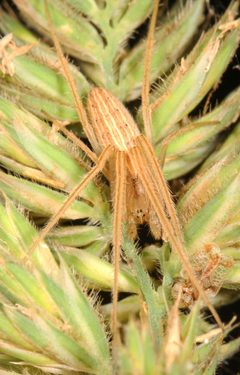
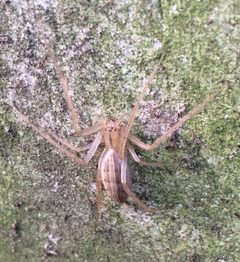
2Larinia is a of orb-weaving spiders ( Araneidae) comprising 69 as of 2026. These medium-sized spiders are characterized by their elongated, straw-coloured bodies and association with grassland . They construct loosely woven orb-webs in vegetation, typically at heights matching surrounding plants. The genus has a distribution with species documented across multiple continents including Asia, Africa, Europe, the Americas, and Australia.
Pronunciation
How to pronounce Larinia: /lɑːˈrɪniə/
These audio files are automatically generated. While they are not always 100% accurate, they are a good starting point.
Identification
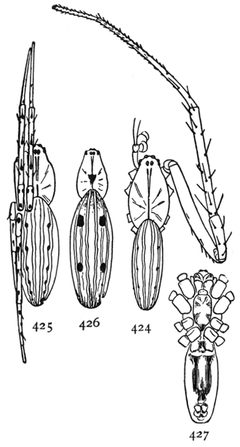
Distinguished from similar orb-weaver by the combination of elongated body form, straw coloration, and specific arrangement. May be confused with Kilima decens, but Larinia shows lines with slight curves. Female features a slender scape with rigid basal attachment that often breaks. Accurate identification to level requires examination of genitalic structures.
Images
Habitat
Grassland including natural grasslands, meadows, and agricultural fields such as rice paddies. Webs constructed in vegetation, typically at heights equal to surrounding plant growth. Australian (L. sexta, L. tumulus) favour spinifex (Triodia spp.) grassland. Wetland documented for some species (L. elegans in Slovakia).
Distribution
with documented occurrence across six continents: Asia (Pakistan, type localities), Africa (Algeria, Maghreb region), Europe (Slovakia, Czechia, North Macedonia), North America, South America (subtropical and tropical regions, Brazil), and Australia (Western Australia including Barrow Island).
Seasonality
Activity patterns vary by and region. In Pakistani rice fields, L. chloris shows reduced abundance in August, increased activity in September (reproductive stage), and peak abundance in late October (crop ripening stage). web-building activity concentrated at dusk.
Diet
of insects; documented prey includes orders Diptera, Hemiptera, Coleoptera, and Lepidoptera. Prey composition varies significantly with seasonality and crop growth stages.
Life Cycle
in web-building behaviour: females construct orb-webs while males do not build webs. In studied , 75% of webs built by , 25% by young females. Reproductive activity peaks during specific crop growth stages in agricultural .
Behavior
activity pattern; constructs new orb-webs daily at dusk and consumes webs in morning. Web construction time approximately 45 minutes. 'Sit and wait' predatory strategy, occupying hub position after web completion. When at rest, stretches body and legs along grass blades for . Not easily observed; typically collected using sweep nets. Web architecture shows plasticity in response to seasonal dynamics and biotic factors including vegetation height.
Ecological Role
of flying and plant-dwelling insects in grassland and agricultural . In rice agro-ecosystems, preys on economically important agricultural pest groups (Diptera, Hemiptera, Coleoptera, Lepidoptera) with potential to reduce pest below . Suggested biocontrol agent value for in rice .
Human Relevance
Potential utility as agent in agricultural systems, particularly rice production. Not known to pose medical or nuisance significance to humans.
Similar Taxa
- Kilima decensSimilar elongated body form and grassland association; distinguished by line patterns (Larinia shows slight curves in median lines)
More Details
Taxonomic history
Lariniaria and Lipocrea synonymized with Larinia in 2025, increasing count to 69 as of January 2026.
Web architecture variation
Web parameters including number of spirals, number of , capture area, average mesh height, and distribution of radii (upper, lower, left, right) show significant variation across trapping months and correlate with spider body size ( length) and vegetation height.
Sources and further reading
- BugGuide
- Wikipedia
- GBIF taxonomy match
- iNaturalist taxon
- NCBI Taxonomy
- Catalogue of Life
- Distribution of the genus Larinia in the Maghreb, with the first record of Larinia chloris in Algeria (Araneae: Araneidae)
- Web architecture, behavior, and predatory potential of Larinia chloris from rice fields (Araneae: Araneidae)
- Two new species of orb-weaving spiders of the genus Larinia (Araneae, Araneidae) in meridional Brazil
- Two new species in the orb-weaving spider genus Larinia Simon, 1874 (Araneae, Araneidae) from Western Australia
- Two rare wetland spider species new to Slovakia: Larinia elegans Spassky, 1939 and Tetragnatha reimoseri (Roșca, 1939) (Araneae, Araneidae, Tetragnathidae)
- New records of Larinia elegans (Araneae: Araneidae) from Czechia and North Macedonia with remarks on its ecology