
Larinioides sclopetarius
(Clerck, 1757)
bridge-spider, gray cross spider, grey cross spider, bridge orbweaver
Larinioides sclopetarius is a relatively large orb-weaving spider in the Araneidae with Holarctic distribution. Native to Europe, it has been introduced to North America and is strongly associated with human-made structures, particularly bridges, where it builds webs near artificial light sources over water. The exhibits pronounced in body mass and leg proportions, with males maturing faster and earlier than females. It is notable for its high in urban environments, where light-attracted insect prey supports of up to 100 individuals per square meter in optimal feeding locations.
Pronunciation
How to pronounce Larinioides sclopetarius: /ˌlære.niˈɔɪ.diːz ˌskloʊpəˈtɛəriəs/
These audio files are automatically generated. While they are not always 100% accurate, they are a good starting point.
Identification
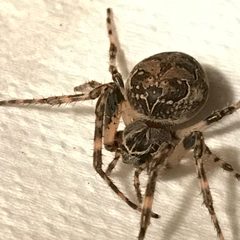
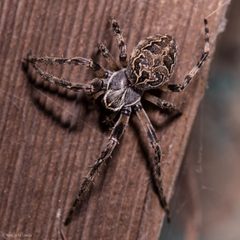
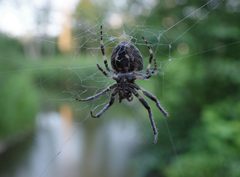
Distinguished from Larinioides patagiatus and L. cornutus by presence of white hairs forming silhouette and dark abdominal markings. L. cornutus occupies different (vegetation, not steel structures) despite similar male . L. patagiatus lacks and differs in markings. Web shape diagnostic: circular orb web (not elliptical), becoming increasingly asymmetrical with spider age and weight—lower capture area expands while upper contracts. on bridges and steel structures near water and artificial light are habitat signatures.
Images
Habitat
Strongly associated with human-made structures, especially bridges, over water. Frequently found on steel objects; seldom observed on vegetation. Optimal sites combine artificial light sources, water proximity, and structural supports for web attachment. Urban environments support dense due to light-attracted insect prey. In North America, most common near buildings in Great Lakes states. In Europe, found near water bodies with artificial lighting. Can colonize boats and boathouses, facilitating spread to islands.
Distribution
Holarctic distribution. Native to Europe, ranging from Mediterranean Coast to Finland. Introduced to North America, now established across much of USA and southern Canada. Most abundant in Great Lakes states but recorded from maritime provinces to British Columbia, south to Virginia, Kentucky, and isolated records in California, Oklahoma, Utah. In Europe, widespread including Central Europe, coastal areas, Åland Islands. Asian records previously attributed to this now assigned to L. jalimovi.
Seasonality
Activity pattern . Males most abundant during summer; females active until November in Central Europe. spiders may mature at any point during year, but greatest concentration of mature individuals in late summer. Prey capture highest in summer months, declining in spring and fall.
Diet
forager. constitute up to 94% of diet; small flies generally . Prey size ranges 1.2–6.8 mm. Feeding tightly coupled to artificial light sources, which attract insect prey. Males may exhibit kleptoparasitism, inhabiting female webs and stealing prey.
Life Cycle
Lifespan approximately 1.5 years under optimal conditions. Development independent of seasons; maturation can occur year-round. Males exhibit protandry, maturing up to one month earlier than females and growing faster despite having fewer instars. Females grow slower with more instars, ultimately achieving greater mass. Females produce up to 15 sacs, indicating above-average reproductive capacity for the group. Spiderlings from mothers consuming males observed to spin webs sooner than those from insect-fed mothers.
Behavior
: hides in retreat at web periphery during day, occupies hub at night; juveniles more likely to occupy hub during day than . Positions toward wind direction when resting, reorienting when wind shifts—possibly to reduce dislodgement risk. Territorial: females defend webs from intruders; aggression intensifies at high densities. Web-shaking contests occur between individuals sharing web. Males more aggressive than females; assortative mating by aggression level observed. Ballooning (aerial via silk threads) used to colonize new areas, notably observed in high-rise buildings in Chicago. High exploratory activity in unfamiliar environments may facilitate urban .
Ecological Role
of small flying insects, particularly and other Diptera. near water may influence emergent aquatic insect . Serves as prey for spider-hunting wasps including Trypoxylon attenuatum (in Europe) and Agenioideus humilis (in North America). parasitized by phorid fly Phalacrotophora epeirae.
Human Relevance
Beneficial: controls of nuisance insects including . Webs on bridges, buildings, and boats may require removal for aesthetic or practical reasons—one restaurant boat owner reported daily web removal needed to avoid deterring customers. ballooning events in urban areas (notably Chicago high-rises) cause public alarm despite being harmless natural . Bites rare even in dense ; venom effects range from mosquito-bite to honeybee-sting intensity, usually superficial and self-healing. Bites typically occur only when webs are directly threatened.
Similar Taxa
- Larinioides cornutusSimilar male led to past synonymy proposals; distinguished by preference (vegetation vs. steel structures) and lack of white -silhouette hairs
- Larinioides patagiatusVery similar appearance; distinguished by specific marking patterns and lack of
- Zygiella x-notataCo-occurs in urban environments; L. sclopetarius shows higher exploratory activity, broader intermolt period range, and different web geometry
More Details
Web architecture
Mean mesh height ~2 mm; unlike many orb-weavers, mesh height does not correlate with prey size, possibly due to low prey diversity. Web asymmetry increases with spider age and weight: lower region larger than upper, hypothesized to improve prey accessibility. Spiders in high-prey areas construct webs with larger capture areas—opposite trend to some other where satiation reduces web size.
Anti-adhesive physiology
Secretes anti-adhesive compounds preventing leg adhesion to capture threads; mechanism of development and secretion unknown. Active carbonic anhydrase detected in most silk gland types, suggesting pH gradients may exist beyond major ampullate gland.
Silk gland complexity
Seven silk gland types identified (major ampullate, minor ampullate, flagelliform, aggregate, piriform, tubuliform, two aciniform types). Most glands composed of multiple distinct columnar epithelial types in zones, indicating sequential secretory product addition and layered fiber structure.
Sexual cannibalism
Females may consume males when resources scarce. Lipid-rich insect diets more efficient energetically than protein-rich male diets, but does not affect sac mass or clutch size. Spiderling survival may improve with maternal lipid-rich diet when food scarce. Males function as last-resort prey.
Pesticide sensitivity
Sublethal effects documented: deltamethrin most disruptive to web geometry (28% area reduction, 17% reduction, 36% angle regularity reduction); diazinon also affects web structure; pirimicarb and dicofol relatively benign at tested doses.
Sources and further reading
- BugGuide
- Wikipedia
- GBIF taxonomy match
- iNaturalist taxon
- NCBI Taxonomy
- Catalogue of Life
- Bug Eric: Bridge Orbweaver (Gray Cross Spider)
- Bug Eric: One Night, One House, Seventeen Spider Species
- Bug Eric: Spider Wasp, Agenioideus humilis, Caught on Video
- Effects of selected pesticides on web building behaviour of Larinioides sclopetarius (Clerck) (Araneae, Araneidae)
- Regionalization of cell types in silk glands of Larinioides sclopetarius suggest that spider silk fibers are complex layered structures.