
Caliadurgus
Pate, 1946
Species Guides
1- Caliadurgus fasciatellus(Blotchwing Spider Wasp)
Caliadurgus is a of medium-sized spider wasps in the Pompilidae, Pepsinae. The genus was established by Pate in 1946 as a replacement for the preoccupied name Calicurgus. These are known for hunting orb-weaving spiders (Araneidae) and long-jawed orb weavers (Tetragnathidae) to provision nests for their larvae. The genus has a Holarctic and Neotropical distribution, with recorded across North America, Europe, and South America.
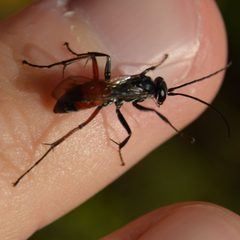
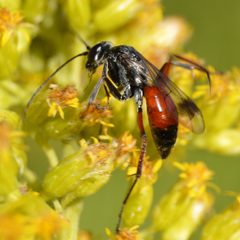
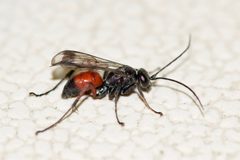
Pronunciation
How to pronounce Caliadurgus: //ˌkæliəˈdɜːrɡəs//
These audio files are automatically generated. While they are not always 100% accurate, they are a good starting point.
Identification
Caliadurgus hyalinatus is not easily confused with other North American spider wasps due to its combination of clear wings with dark forewing spots, bicolored , and toothed hind tibia. The can be distinguished from related genera by its taxonomic placement in Pepsinae and its specific prey associations with Araneidae and Tetragnathidae spiders.
Images
Habitat
Described as having a catholic choice, indicating broad for varied environments. Nests are excavated in sandy soil with burrows placed in crotches of vegetation near the ground.
Distribution
Holarctic and Neotropical distribution. Records from North America (eastern U.S. and adjacent Canada west to Washington, the Dakotas, and Kansas, south to Georgia and Louisiana with sparse records in Texas, New Mexico, and Arizona), Europe, and South America (including Argentina with subandine records). Additional distribution records from Denmark, Norway, and Sweden.
Seasonality
active in late season; observation records from October in New Jersey suggest autumn activity in temperate regions.
Diet
females hunt spiders exclusively; C. hyalinatus has been documented preying on orb-weavers including Acanthepeira stellata, Larinoides patagiatus, Eustala anastera, Araneus marmoreus, and Neoscona . The as a whole prefers spiders of Araneidae and Tetragnathidae.
Host Associations
- Araneidae - preyOrb-weaving spiders; individuals preferred by C. hyalinatus due to size constraints
- Tetragnathidae - preyLong-jawed orb weavers
Life Cycle
Females sting spiders into paralysis, grasp them at the base of a leg, and transport them to nest sites. Burrows are excavated in sandy soil, taking approximately thirty minutes, with tunnels diagonal and about 4 cm long, terminating in a 1 cm about 4 cm below the surface. The spider is placed side down with a single attached. The entrance is then filled in.
Behavior
Females walk forward while holding prey in front of them; they may climb vertical objects and fly or glide to transport prey with minimal effort. Prey are immobilized by stinging before transport. Nest construction is rapid in suitable substrates.
Ecological Role
of spiders, specifically targeting orb-weaving ; contributes to of Araneidae and Tetragnathidae. Acts as a agent for spider in various .
Human Relevance
Documented in entomological literature including Fabre's observational studies and modern systematic works. Of interest to entomologists studying spider wasp and prey selection. No significant negative or positive economic impact documented.
Similar Taxa
- PriocnemisFormer confusion between Caliadurgus hyalinatus and Priocnemis hyalinata due to historical misidentification of ; now separated based on distinct taxonomic status
Misconceptions
The name was originally thought to share type with the replaced name Calicurgus due to mistaken identity of fasciatellus and hyalinata as the same species; later research clarified these as distinct , though ICZN Article 67.8 maintains the original type species designation for nomenclatural purposes.
More Details
Taxonomic history
The replacement name Caliadurgus was proposed by Pate in 1946 for Calicurgus Lepeletier, 1845, which was preoccupied. Pate selected Sphex hyalinata as type , while Kohl had selected Pompilus fasciatellus for Calicurgus. These were later determined to be distinct species: Caliadurgus fasciatellus and Priocnemis hyalinata.
Selected species
Nine recognized: C. cinereus, C. fasciatellus, C. gayii, C. maculatellus, C. modestus, C. ochraceus, C. sigillipes, C. subandinus, and C. ussuriensis.