
Oobius
Trjapitzin, 1963
Species Guides
1- Oobius agrili(Oob)
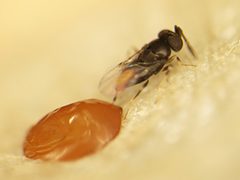
Oobius is a of parasitic non-stinging in the Encyrtidae (Hymenoptera: Chalcidoidea). are specialized of wood-boring beetles, particularly in the family Buprestidae (jewel beetles) and Cerambycidae (longhorn beetles). The genus has gained significant attention due to the use of O. agrili as a agent against the emerald ash borer (Agrilus planipennis) in North America. Oobius species are small, morphologically cryptic wasps that are often distinguished by subtle differences in antennal structure and tarsomere count. Several species exhibit parthenogenetic and undergo to synchronize their with availability.
Pronunciation
How to pronounce Oobius: /ˈoʊ.bi.əs/
These audio files are automatically generated. While they are not always 100% accurate, they are a good starting point.
Images
Distribution
of Oobius are distributed across the Holarctic region, with documented occurrences in North America (USA, Canada), northeastern Asia (China, Russian Far East, Japan, Korea), and Europe (Spain, Portugal). Specific distribution varies by species: O. agrili is native to China and has been introduced to North America; O. primorskyensis occurs in the Russian Far East and South Korea; O. rudnevi is found in southwestern Europe (Spain, Portugal) and potentially eastern Europe; O. depressus and other Nearctic species occur in the USA (Michigan, California).
Seasonality
activity is generally synchronized with oviposition periods. Oobius agrili exhibits seasonal voltinism with multiple per year (F0, F1, F2) in North America, with adult typically occurring from late spring through summer. Oobius rudnevi adults fly from May to July in southwestern Spain. induction and termination are -dependent, with critical day length varying across latitudes. Some show phenotypes while others are predominantly with obligate winter diapause.
Host Associations
- Agrilus planipennis - Emerald ash borer; primary for O. agrili
- Agrilus fleischeri - Poplar borer; for O. saimaensis and O. fleischeri
- Cerambyx cerdo - Great capricorn ; for O. rudnevi
- Cerambyx welensii - Oak longhorn beetle; for O. rudnevi
- Agrilus spp. - Various jewel beetle ; for multiple Oobius species
Life Cycle
Oobius are solitary or gregarious endoparasitoids that develop within . Females locate host eggs deposited under bark or in crevices and deposit their own eggs inside. Larvae consume the host egg contents, with development rates influenced by temperature and . Most species exhibit as larvae or to overwinter, with synchronized to host egg availability the following season. Some show plasticity in voltinism, with both and phenotypes present. Sex ratios are typically female-biased, and some species are parthenogenetic.
Behavior
females actively search bark surfaces for , using visual and chemical cues. Oviposition involves insertion of eggs directly into host eggs through the . Oobius agrili demonstrates phenological synchrony with emerald ash borer oviposition, with F0 adults emerging 2–5 days before host oviposition begins and F1 adults most synchronized with peak host oviposition. capacity allows of new host patches, with documented spread up to 3.8 km from release sites. Photoperiodic cues regulate induction and termination, enabling to different climatic regimes.
Ecological Role
Oobius function as specialized natural enemies of wood-boring beetles, potentially regulating in native . As introduced agents, they contribute to suppression of pests such as emerald ash borer. In oak forests, O. rudnevi parasitizes both protected (Cerambyx cerdo) and pest (C. welensii) longhorn beetles, creating complex conservation conflicts. rates in natural settings range from 1.5% to 93% depending on host , characteristics, and establishment.
Human Relevance
Oobius agrili is widely deployed as a agent against emerald ash borer in North America, with over 2.5 million individuals released across multiple states and provinces. Establishment success has been documented at most release sites, with rates averaging 16–21% in established . Oobius primorskyensis is under evaluation for release to complement O. agrili in cooler climates due to better phenological synchronization with oviposition. The represents a model system for studying cryptic , , and host- synchrony in .
Sources and further reading
- BugGuide
- Wikipedia
- GBIF taxonomy match
- iNaturalist taxon
- NCBI Taxonomy
- Catalogue of Life
- Encyrtid Holdings | Entomology Research Museum
- Publications | Entomology Research Museum
- Parasitoids to the rescue - Emerald Ash Borer, Agrillus plenipennis, and its assassins Oobius agrili, Tetrastichus planipennisi, and Spathius agrili — Bug of the Week
- Oobius-depressus - Entomology Today
- A New Parasitoid Wasp from Russia May Help the Fight Against Emerald Ash Borer
- Emerald Ash Borer: Study Offers Mixed Signals on Drivers of Effective Biological Control
- Preliminary results on the taxonomy and molecular phylogenetics ofOobius(Hymenoptera: Encyrtidae), parasitoids of wood-boring Coleoptera
- A Phenology Model for Simulating Oobius agrili (Hymenoptera: Encyrtidae) Seasonal Voltinism and Synchrony With Emerald Ash Borer Oviposition
- Two new species of Oobius (Hymenoptera: Encyrtidae) and their phylogenetic relationship with other congeners from northeastern Asia
- Postrelease assessment of Oobius agrili (Hymenoptera: Encyrtidae) establishment and persistence in Michigan and the Northeastern United States
- Monitoring the impact of introduced emerald ash borer parasitoids: factors affecting Oobius agrili dispersal and parasitization of sentinel host eggs
- Primer registro en la Península Ibérica de Oobius rudnevi (Nowicki, 1928) (Hymenoptera: Encyrtidae), un parasitoide oófago poco conocido de Cerambyx sp. (Coleoptera: Cerambycidae)
- Ecology of Oobius rudnevi, egg parasitoid of Cerambyx cerdo and Cerambyx welensii in oak forests
- Photoperiodic modulation of diapause induction and termination in Oobius agrili Zhang and Huang (Hymenoptera: Encyrtidae), an egg parasitoid of the invasive emerald ash borer
- Host and oak species impact clutch and adult size of Oobius rudnevi, the only known egg parasitoid of Cerambyx beetles
- Field parasitism and host specificity of Oobius primorskyensis (Hymenoptera: Encyrtidae), an egg parasitoid of the emerald ash borer (Coleoptera: Buprestidae) in the Russian Far East
- Figures 25–32 from: Triapitsyn SV, Petrice TR, Gates MW, Bauer LS (2015) Two new species of Oobius Trjapitzin (Hymenoptera, Encyrtidae) egg parasitoids of Agrilus spp. (Coleoptera, Buprestidae) from the USA, including a key and taxonomic notes on other congeneric Nearctic taxa. ZooKeys 498: 29-50. https://doi.org/10.3897/zookeys.498.9357
- Figures 17–24 from: Triapitsyn SV, Petrice TR, Gates MW, Bauer LS (2015) Two new species of Oobius Trjapitzin (Hymenoptera, Encyrtidae) egg parasitoids of Agrilus spp. (Coleoptera, Buprestidae) from the USA, including a key and taxonomic notes on other congeneric Nearctic taxa. ZooKeys 498: 29-50. https://doi.org/10.3897/zookeys.498.9357
- Figures 9–16 from: Triapitsyn SV, Petrice TR, Gates MW, Bauer LS (2015) Two new species of Oobius Trjapitzin (Hymenoptera, Encyrtidae) egg parasitoids of Agrilus spp. (Coleoptera, Buprestidae) from the USA, including a key and taxonomic notes on other congeneric Nearctic taxa. ZooKeys 498: 29-50. https://doi.org/10.3897/zookeys.498.9357
- Figures 1–8 from: Triapitsyn SV, Petrice TR, Gates MW, Bauer LS (2015) Two new species of Oobius Trjapitzin (Hymenoptera, Encyrtidae) egg parasitoids of Agrilus spp. (Coleoptera, Buprestidae) from the USA, including a key and taxonomic notes on other congeneric Nearctic taxa. ZooKeys 498: 29-50. https://doi.org/10.3897/zookeys.498.9357
- Figures 33–35 from: Triapitsyn SV, Petrice TR, Gates MW, Bauer LS (2015) Two new species of Oobius Trjapitzin (Hymenoptera, Encyrtidae) egg parasitoids of Agrilus spp. (Coleoptera, Buprestidae) from the USA, including a key and taxonomic notes on other congeneric Nearctic taxa. ZooKeys 498: 29-50. https://doi.org/10.3897/zookeys.498.9357