
Spathius
Nees, 1818
Species Guides
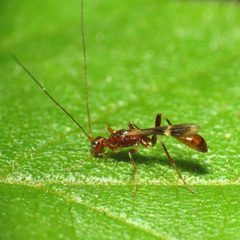
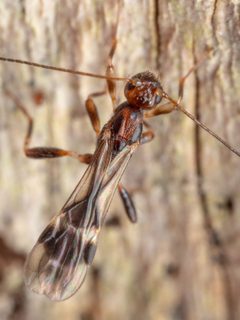
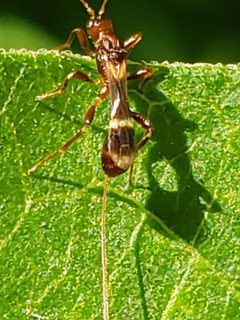
1Spathius is a of doryctine wasps in the Braconidae. within this genus are larval of wood-boring beetles, with several species introduced to North America as agents for the emerald ash borer (Agrilus planipennis). The genus includes both native and introduced species that exhibit -specific relationships with their hosts.
Pronunciation
How to pronounce Spathius: //ˈspeɪθiəs//
These audio files are automatically generated. While they are not always 100% accurate, they are a good starting point.
Images
Habitat
Forests and woodlands containing trees; specifically associated with ash trees (Fraxinus spp.) infested by wood-boring beetles. Some inhabit concealed galleries within dry timber and wood products.
Distribution
Widespread across the Palaearctic, Oriental, and Nearctic regions. Native range includes northeastern China, the Russian Far East, and India. Several have been introduced to North America (United States and Canada) for purposes.
Diet
Larvae are ectoparasitoids of wood-boring larvae. Documented include emerald ash borer (Agrilus planipennis), Hylurgopinus rufipes, and various bostrichid beetles including Heterobostrychus aequalis, Dinoderus brevis, Dinoderus minutus, and Dinoderus ocellaris.
Host Associations
- Agrilus planipennis - emerald ash borer; primary target for introductions
- Hylurgopinus rufipes -
- Heterobostrychus aequalis - lesser auger beetle; intercepted in wood packaging material
- Dinoderus brevis -
- Dinoderus minutus -
- Dinoderus ocellaris -
- Coraebus cavifrons -
- Pempherulus affinis - laboratory
- Hypolixus truncatulus - laboratory
Life Cycle
Idiobiont ectoparasitoid development. Females drill through bark using a long ovipositor to reach larvae concealed in wood, then deposit on or near the host. Larvae feed externally on the host, consuming tissue before pupating within the host gallery. Some exhibit long-lived preimaginal stages capable of surviving extended periods within dry wood.
Behavior
Females use volatile chemical cues from -infested trees to locate hosts. Ovipositor length varies among , determining the maximum bark thickness through which hosts can be reached. Spathius galinae possesses an ovipositor approximately twice as long as that of Tetrastichus planipennisi, enabling of larger diameter trees. Females deposit clutches of approximately 20 on host larvae.
Ecological Role
agent of wood-boring beetles. As ectoparasitoids, they reduce of pest beetles that damage forest and urban trees. Some may compete with native where ranges overlap.
Human Relevance
Used in programs to manage emerald ash borer, an pest that has killed millions of ash trees in North America. Spathius galinae has shown particular promise, with rates reaching 49% and successful establishment in wild within two years of release. do not sting humans.
Similar Taxa
- Tetrastichus planipennisiBoth are larval of emerald ash borer used in ; distinguished by shorter ovipositor in Tetrastichus (1.5–2.5 mm vs. longer in Spathius), endoparasitoid development in Tetrastichus versus ectoparasitoid in Spathius, and different timing
- Oobius agriliBoth are introduced of emerald ash borer; Oobius is an parasitoid with much smaller size and different stage targeted
- Phasgonophora sulcataNative North American of wood-boring beetles; shows opposing response to ash compared to introduced Spathius galinae, with negatively associated with high ash density
Sources and further reading
- BugGuide
- Wikipedia
- GBIF taxonomy match
- iNaturalist taxon
- NCBI Taxonomy
- Catalogue of Life
- Parasitoids to the rescue - Emerald Ash Borer, Agrillus plenipennis, and its assassins Oobius agrili, Tetrastichus planipennisi, and Spathius agrili — Bug of the Week
- Spathius galinae - Entomology Today
- A Promising New Parasitoid Drills Down on Emerald Ash Borers
- parasitized emerald ash borer - Entomology Today
- USDA to Release Russian Wasps Against the Emerald Ash Borer
- Emerald Ash Borer: Study Offers Mixed Signals on Drivers of Effective Biological Control
- Responses of two parasitoids, the exotic Spathius agrili Yang and the native Spathius floridanus Ashmead, to volatile cues associated with the emerald ash borer, Agrilus planipennis Fairmaire
- ACCIDENTAL INTRODUCTION IN ITALY OF THE PARASITOID SPATHIUS VULNIFICUS WILKINSON (HYMENOPTERA BRACONIDAE DORYCTINAE)
- Five new Species of Spathius (Hym. Bracon.)
- Differences in Early Season Emergence and Reproductive Activity Between Spathius agrili (Hymenoptera: Braconidae) and Spathius galinae, Larval Parasitoids of the Invasive Emerald Ash Borer (Coleoptera: Buprestidae)
- Host specificity of Spathius agrili Yang (Hymenoptera: Braconidae), an important parasitoid of the emerald ash borer
- Evaluation of the host specificity of Spathius galinae (Hymenoptera: Braconidae), a larval parasitoid of the emerald ash borer (Coleoptera: Buprestidae) in Northeast Asia
- Biology of the Two Parasitoid Wasps, Atanycolus initiator(FABRICIUS)and Spathius brevicaudis RATZEBURG(Hymenoptera:Braconidae), on Subcortical Beetles in Japanese Pine Trees
- Interactions between Spathius agrili (Hymenoptera: Braconidae) and Tetrastichus planipennisi (Hymenoptera: Eulophidae), larval parasitoids of Agrilus planipennis (Coleoptera: Buprestidae)
- Cold tolerance of Chinese emerald ash borer parasitoids: Spathius agrili Yang (Hymenoptera: Braconidae), Tetrastichus planipennisi Yang (Hymenoptera: Eulophidae), and Oobius agrili Zhang and Huang (Hymenoptera: Encyrtidae)
- Effects of host size on the sex ratio, clutch size, and size of adult Spathius agrili, an ectoparasitoid of emerald ash borer
- Figure 8 from: Cao LM, van Achterberg C, Tang YL, Yang Z-Q, Wang XY, Cao TW (2020) Redescriptions of two parasitoids, Metapelma beijingense Yang (Hymenoptera, Eupelmidae) and Spathius ochus Nixon (Hymenoptera, Braconidae), parasitizing Coraebus cavifrons Descarpentries & Villiers (Coleoptera, Buprestidae) in China with keys to genera or species groups. ZooKeys 926: 53-72. https://doi.org/10.3897/zookeys.926.48688
- Landing Surface Color Preferences of Spathius agrili (Hymenoptera: Braconidae), a Parasitoid of Emerald Ash Borer, Agrilus planipennis (Coleoptera: Buprestidae)
- Host-seeking behavior and parasitism by Spathius agrili Yang (Hymenoptera: Braconidae), a parasitoid of the emerald ash borer