
Phasgonophora sulcata
Westwood, 1832
Phasgonophora sulcata is a native North American chalcidid and solitary endoparasitoid of woodboring beetles in the Agrilus. It has adopted the emerald ash borer (Agrilus planipennis) as a novel and is under investigation as a agent. occurs 20–24 days after host emergence at 21°C, with females emerging 5–6 days before males. Field rates range from 12% to 34%, with activity concentrated in ash trees below 360 cm height.
Pronunciation
How to pronounce Phasgonophora sulcata: //fæzˈɡɒnəˌfɔːrə sʌlˈkɑːtə//
These audio files are automatically generated. While they are not always 100% accurate, they are a good starting point.
Identification
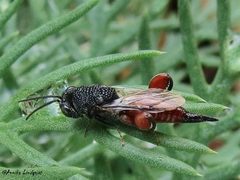
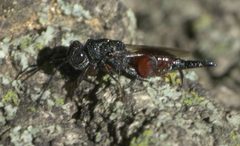
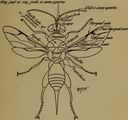
As a chalcidid , P. sulcata possesses the -diagnostic enlarged hind with serrate or toothed inner margins. Specific distinguishing features from other chalcidids require microscopic examination. Females can be distinguished from males by their larger size and earlier timing. The is most readily identified by its association with Agrilus in ash trees.
Images
Habitat
Distribution
Native to North America. Documented from Ontario, Canada; Wisconsin; Michigan; and multiple U.S. states including Arizona, California, Connecticut, Delaware, and District of Columbia.
Seasonality
first observed in early June, with peak capture in late June. Activity corresponds with of Agrilus planipennis.
Host Associations
- Agrilus planipennis Fairmaire (emerald ash borer) - endoparasitoidnovel adoption; primary target for
- Agrilus bilineatus (twolined chestnut borer) - endoparasitoidnative association documented in Wisconsin
- Other Agrilus species - endoparasitoid in Buprestidae
Life Cycle
Solitary endoparasitoid developing within larvae. 20.2–23.9 days after host emergence at 21°C. Females emerge 5.4–5.8 days before males. Mean adult longevity 23.8 days (males) and 28.9 days (females) at 21°C. Potential averages 55.7 per female at emergence, decreasing with age.
Behavior
Males orient toward females in assays, indicating female-produced volatile mediate courtship. Four consistent pre-copulatory observed. capacity increases with temperature and decreases with age; activity unaffected by age or body size. No relationship between walking activity and flight capacity.
Ecological Role
Important source of mortality for Agrilus planipennis . May compete with introduced such as Spathius galinae in areas of high ash , as P. sulcata decreases where ash density increases while S. galinae shows the opposite pattern.
Human Relevance
Investigated as a native agent for emerald ash borer. Mass rearing considered challenging. Recommended for release as pupae near EAB-infested ash trees to improve efficacy. Putative may be useful for detection and retention of in programs.
Similar Taxa
- Spathius galinaeBoth are of emerald ash borer, but S. galinae is an introduced from Asia. P. sulcata shows negative association with ash while S. galinae shows positive association. S. galinae is in Braconidae, not Chalcididae.
- Tetrastichus planipennisiBoth attack emerald ash borer, but T. planipennisi is an introduced eupelmid with different and smaller size.
- Other ChalcididaeRequire microscopic examination for identification; P. sulcata distinguished by associations and geographic distribution.
More Details
Sex ratio and emergence
Females represent 61.8–67.0% of emerging , creating a female-biased sex ratio.
Height limitation
restricted to ash trees below 360 cm; no parasitism observed above this height, possibly due to microclimate differences or accessibility constraints.
Competition with introduced parasitoids
May compete with introduced Spathius galinae for , with opposing responses to ash suggesting partitioning or competitive interaction.
Sources and further reading
- BugGuide
- Wikipedia
- GBIF taxonomy match
- iNaturalist taxon
- NCBI Taxonomy
- Catalogue of Life
- Emerald Ash Borer: Study Offers Mixed Signals on Drivers of Effective Biological Control
- Oecanthidae | Beetles In The Bush
- Bug Eric: Rough Stink Bugs
- Factors influencing the dispersal of a native parasitoid, Phasgonophora sulcata, attacking the emerald ash borer: implications for biological control
- Courtship sequence and evidence of volatile pheromones inPhasgonophora sulcata(Hymenoptera: Chalcididae), a North American parasitoid of the invasiveAgrilus planipennis(Coleoptera: Buprestidae)
- Observations on the life-history traits of the North American parasitoidPhasgonophora sulcataWestwood (Hymenoptera: Chalcididae) attackingAgrilus planipennis(Coleoptera: Buprestidae) in Ontario, Canada
- Observations of the Biology of <i>Phasgonophora Sulcata</i> (Hymenoptera: Chalcididae), a Larval Parasitoid of the Twolined Chestnut Borer, <i>Agrilus Bilineatus</i> (Coleoptera: Buprestidae), in Wisconsin