
Phasgonophora
Westwood, 1832
Species Guides
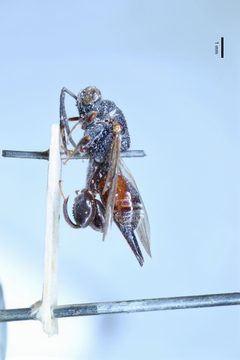
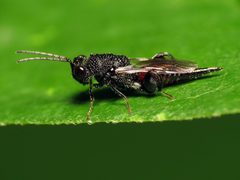
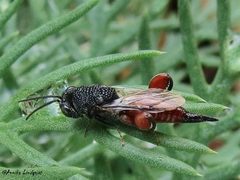
3Phasgonophora is a of chalcidid wasps in the Chalcididae, with at least two described : Phasgonophora sulcata and Phasgonophora rugithorax. Members of this genus are solitary endoparasitoids of woodboring larvae. Phasgonophora sulcata, the better-studied species, is native to North America and has been documented attacking Agrilus planipennis (emerald ash borer) as a novel , as well as Agrilus bilineatus (twolined chestnut borer). The genus has gained attention for its potential role in of forest pests.
Pronunciation
How to pronounce Phasgonophora: /ˌfæzɡəˈnɒfərə/
These audio files are automatically generated. While they are not always 100% accurate, they are a good starting point.
Images
Habitat
Associated with forests containing trees for woodboring beetles; specifically documented in ash trees (Fraxinus spp.) infested with emerald ash borer. Phasgonophora sulcata has been observed in ash trees below 360 cm height, with no parasitism detected above this height.
Distribution
North America; documented in Ontario, Canada, Michigan, and Wisconsin, USA. GBIF records indicate presence in South America (SA), though specific localities are not detailed in available sources.
Seasonality
of Phasgonophora sulcata first observed in the field in early June, with peak capture occurring in late June. Adult occurs approximately 20.2–23.9 days after emergence at 21°C.
Host Associations
- Agrilus planipennis - Novel ; solitary endoparasitoid of larvae
- Agrilus bilineatus - Native ; larval
Life Cycle
Solitary endoparasitoid development. protogynous: females emerge approximately 5.4–5.8 days before males. At 21°C, adult longevity averages 23.8 days for males and 28.9 days for females. Mean potential at emergence: 55.7 per female, with fecundity declining in older individuals.
Behavior
Males orient toward females in assays, suggesting courtship is mediated by female-produced volatile . Four consistent pre-copulatory observed in mating pairs. capacity increases with temperature and decreases with age; activity is independent of flight capacity and unaffected by age or body size.
Ecological Role
Native agent providing mortality for of woodboring beetles, particularly Agrilus planipennis. rates on emerald ash borer have ranged from 11.7% to 34.4% at studied sites. Shows negative association with ash —parasitism rates decrease where ash is abundant, contrasting with that show positive .
Human Relevance
Evaluated for of emerald ash borer in North America. Mass rearing considered challenging. Recommended release strategy involves placing pupae near EAB-infested ash trees. Putative may have utility for detection and monitoring.
Similar Taxa
- Spathius galinae also attacking emerald ash borer; differs in showing positive association with ash (higher where ash is abundant), whereas Phasgonophora sulcata shows negative association. Spathius galinae is in Braconidae, not Chalcididae.
- Tetrastichus planipennisi of emerald ash borer; differs in being an ectoparasitoid gregarious ( Eulophidae), whereas Phasgonophora sulcata is a solitary endoparasitoid.
- Oobius agrili of emerald ash borer; differs in attacking rather than larvae, and in Encyrtidae.
Sources and further reading
- BugGuide
- Wikipedia
- GBIF taxonomy match
- iNaturalist taxon
- NCBI Taxonomy
- Catalogue of Life
- Emerald Ash Borer: Study Offers Mixed Signals on Drivers of Effective Biological Control
- ash density and parasitism - Entomology Today
- Factors influencing the dispersal of a native parasitoid, Phasgonophora sulcata, attacking the emerald ash borer: implications for biological control
- Courtship sequence and evidence of volatile pheromones inPhasgonophora sulcata(Hymenoptera: Chalcididae), a North American parasitoid of the invasiveAgrilus planipennis(Coleoptera: Buprestidae)
- Observations on the life-history traits of the North American parasitoidPhasgonophora sulcataWestwood (Hymenoptera: Chalcididae) attackingAgrilus planipennis(Coleoptera: Buprestidae) in Ontario, Canada
- Observations of the Biology of <i>Phasgonophora Sulcata</i> (Hymenoptera: Chalcididae), a Larval Parasitoid of the Twolined Chestnut Borer, <i>Agrilus Bilineatus</i> (Coleoptera: Buprestidae), in Wisconsin