
Agrilus bilineatus
(Weber, 1801)
two-lined chestnut borer, twolined chestnut borer
Agrilus bilineatus is a metallic wood-boring beetle native to eastern North America that attacks oak trees (Quercus spp.) and chestnut (Castanea spp.). Unlike most Agrilus that develop in dead twigs and branches, it is a trunk borer of living trees and represents a significant forest pest. emerge from June through September with peak activity in late June to July. The species has been introduced to Turkey, where it poses an emerging threat to European oak and chestnut species.
Pronunciation
How to pronounce Agrilus bilineatus: //ˈæɡrɪləs ˌbaɪlɪˈneɪətəs//
These audio files are automatically generated. While they are not always 100% accurate, they are a good starting point.
Identification
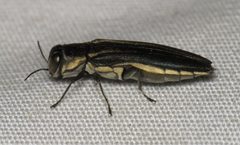
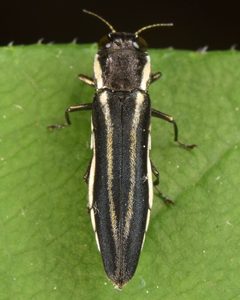
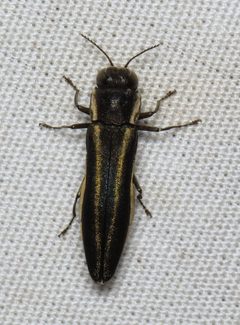
are metallic beetles with two pale longitudinal stripes running the length of the dark , giving the its . The overall body is somewhat flattened and elongated, typical of the . Larvae are white, legless, and C-shaped with enlarged thoracic segments, creating winding galleries in the phloem and outer sapwood that are visible beneath the bark. The species can be distinguished from other Agrilus by its association with oaks and chestnuts combined with the distinctive paired elytral stripes.
Images
Habitat
Oak-dominated forests and woodlands; primarily attacks stressed or weakened trees, particularly those on dry sites, suffering from drought, defoliation, or other physiological stress. The colonizes the trunks and main branches of living trees rather than dead twigs.
Distribution
Native to eastern North America; present throughout the eastern deciduous forest region from Canada (Manitoba, New Brunswick) through the United States. Introduced and established in Turkey, representing a significant range expansion into Europe.
Seasonality
present from early June through mid-September, with peak and oviposition occurring during the second half of June in northern . patterns are temperature-dependent.
Diet
Larvae feed on phloem and outer sapwood of oak trees (Quercus spp.) and chestnut (Castanea spp.), creating galleries that girdle the conducting tissues. consume oak foliage, showing significant preference for oak over other hardwood foliage.
Host Associations
- Quercus spp. - primary larval oaks, both red and white oak groups
- Castanea spp. - larval chestnut
- Quercus velutina - documented black oak
- Quercus alba - documented white oak
Life Cycle
(one-year ). Females lay in bark crevices. Larvae pass through four instars, tunneling through phloem and outer sapwood; third and fourth instars cause the most damage by girdling xylem and phloem. Fourth instar larvae overwinter in pupal located in outer bark or sapwood when bark is thin. occurs in spring. emerge June-September. Tree death normally occurs after 2-3 years of , though may happen in a single season with heavy attack.
Behavior
Strongly attracted to stressed trees, detecting them within hours of stress onset through olfactory response to tree-released volatiles including ethanol and oak-specific compounds. Initial attack typically begins in the live crown and proceeds downward in successive years without reinfestation of previously killed areas. show marked preference for red oak group over white oak group. Stressed trees with poor or fair crown condition are colonized preferentially over healthy trees.
Ecological Role
Secondary pest that contributes to oak decline and mortality, particularly following environmental stress events such as drought or defoliation. Acts as a primary mortality agent during conditions. Facilitates entry of decay fungi and accelerates decomposition of weakened trees. increase following gypsy moth defoliation events, with abundance positively associated with prior year tree mortality.
Human Relevance
Significant forest pest causing economic damage to oak timber resources and ornamental trees. Tree mortality impacts forest composition and services. Recently established in Turkey, creating concern for European forestry. Potential agent Phasgonophora sulcata (a native ) has been identified but is not -specific.
Similar Taxa
- Agrilus anxiusBoth are trunk borers of living trees in the Agrilus; bronze birch borer attacks Betula rather than Quercus/Castanea
- Agrilus planipennisBoth are economically important trunk borers of living trees; emerald ash borer attacks Fraxinus and has more uniformly metallic green coloration without paired stripes
- Other Agrilus speciesMost other Agrilus develop in dead twigs and branches rather than living tree trunks, and lack the distinctive paired elytral stripes
Sources and further reading
- BugGuide
- Wikipedia
- GBIF taxonomy match
- iNaturalist taxon
- NCBI Taxonomy
- Catalogue of Life
- Two new species of Agrilus from Mexico | Beetles In The Bush
- Agrilus fuscipennis on Persimmon | Beetles In The Bush
- A flower visiting jewel beetle that is not an Acmaeodera | Beetles In The Bush
- Online Entomology Outreach: Tips From a Long-Running Program
- Two-lined Chestnut Borer, Agrilus bilineatus (Weber)
- Biology of Two-Lined Chestnut Borer, Agrilus bilineatus, in Pennsylvania and New York1
- Colonization by Armillaria mellea and Agrilus bilineatus of Oaks Injected with Ethanol
- Dynamics of twolined chestnut borer Agrilus bilineatus as influenced by defoliation and selection thinning
- THE BIOLOGY AND ECOLOGY OF THE TWOLINED CHESTNUT BORER, AGRILUS BILINEATUS (COLEOPTERA: BUPRESTIDAE), ON OAKS, QUERCUS SPP., IN WISCONSIN
- The role of host tree condition in attack of white oaks by the twolined chestnut borer, Agrilus bilineatus (Weber) (Coleoptera: Buprestidae)
- ATTRACTION OF THE TWOLINED CHESTNUT BORER,AGRILUS BILINEATUS(WEBER) (COLEOPTERA: BUPRESTIDAE), AND ASSOCIATED BORERS TO VOLATILES OF STRESSED WHITE OAK
- Buprestidae, Cerambycidae, and Scolytidae Associated with Successive Stages of <i>Agrilus Bilineatus</i> (Coleoptera: Buprestidae) Infestation of Oaks in Wisconsin
- Observations of the Biology of <i>Phasgonophora Sulcata</i> (Hymenoptera: Chalcididae), a Larval Parasitoid of the Twolined Chestnut Borer, <i>Agrilus Bilineatus</i> (Coleoptera: Buprestidae), in Wisconsin