
Agrilus anxius
Gory, 1841
bronze birch borer
Agrilus anxius, the bronze birch borer, is a wood-boring in the Buprestidae native to North America. It is a significant pest of birch trees (Betula spp.), with larvae tunneling through the cambial layer and frequently killing trees. River birch (Betula nigra) shows the greatest resistance among native North American birches, while European and Asian birch lack resistance entirely. The species is closely related to the emerald ash borer (Agrilus planipennis) and has been the subject of taxonomic confusion, with historical reports conflating birch-feeding and poplar-feeding that were later recognized as distinct species.
Pronunciation
How to pronounce Agrilus anxius: /ˈæɡrɪləs ˈæŋksɪəs/
These audio files are automatically generated. While they are not always 100% accurate, they are a good starting point.
Identification
Males can be distinguished from related by genitalic characters. The species was historically confused with a distinct poplar-feeding species under the same name, resolved through chromosomal studies (22 in birch-feeding versus 20 in poplar-feeding populations) and morphological analysis. Identification to species level typically requires rearing from known or examination of male genitalia.
Images
Appearance
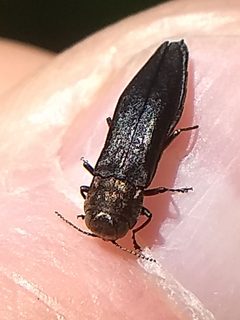
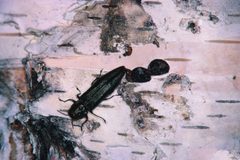
are metallic wood-boring beetles with bronze coloration typical of the Agrilus. Specific morphological details distinguishing A. anxius from require examination of male genitalia, as external features overlap with related .
Habitat
Associated with birch trees in various settings including natural forests, urban landscapes, and surface mine reforestation sites. Occurs in where birch grow, from to temperate zones.
Distribution
Native to North America, more numerous in warmer parts of the continent and rare in the north. Documented across Canada (Alberta, British Columbia, Manitoba, New Brunswick, Newfoundland, Nova Scotia, Ontario, Prince Edward Island, Quebec, Saskatchewan) and the United States (Alaska, Arkansas, California, Colorado, Connecticut, Delaware, District of Columbia, Florida, Georgia, Idaho, Illinois, Indiana, Iowa, Kansas, Kentucky, Maine, Maryland, Massachusetts, Michigan, Minnesota, Missouri, Montana, Nebraska, Nevada, New Hampshire, New Jersey, New Mexico, New York, North Dakota, Ohio, Oregon, Pennsylvania, South Dakota, Tennessee, Utah, Vermont, Washington, West Virginia, Wisconsin, Wyoming).
Seasonality
present on tree boles from mid-June through mid-August. Larvae present throughout the year, with fourth instars comprising 93.1% of the . occurs in spring. timing varies by latitude and is predicted by heat accumulation models.
Diet
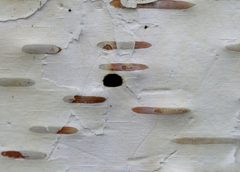
Larvae feed on vascular tissue and cambial layer of birch trees. Larval tunneling disrupts nutrient and water transport in trees.
Host Associations
- Betula nigra - river birch; most native North American
- Betula pendula - European white birch; highly susceptible, no resistance
- Betula papyrifera - paper birch; susceptible in urban landscapes
Life Cycle
laid in clusters of up to 14, commonly placed in crevices at branch origins on tree boles. Eggs concentrated on the northeast (shaded) side of trees. Larvae progress through four instars, with fourth instars . occurs primarily on the southwest aspect of tree boles. Vertical distribution of all stages is random relative to surface area, resulting in greater abundance on the lower half of trees.
Behavior
are found on foliage of larval . Larvae tunnel through cambial layer, causing tree decline and mortality. and first instars show preference for shaded (northeast) side of tree boles; fourth instars overwinter and pupate primarily on southwest aspect.
Ecological Role
Native North American pest that contributes to birch tree mortality, particularly affecting stressed trees. Potential threat to European and Asian birch forests if introduced.
Human Relevance
Significant economic pest in urban and ornamental landscapes, killing birch trees and limiting of European and Asian birch in eastern North America. Subject of biosurveillance programs using predatory (Cerceris fumipennis) as detection tools. Target of molecular detection assays (qPCR and LAMP) for early detection and monitoring. Included in forecast models by USA National Phenology Network to optimize pest management timing.
Similar Taxa
- Agrilus planipennisClosely related emerald ash borer; both are economically important trunk-boring Agrilus , but A. planipennis attacks ash (Fraxinus) rather than birch
- Poplar-feeding Agrilus speciesHistorically confused with A. anxius under the same name, but distinguished by male genitalia, number (20 vs. 22), and association (poplars vs. birches)
Misconceptions
Historical confusion of birch-feeding and poplar-feeding as a single ; resolved through combined morphological, chromosomal, and biological evidence demonstrating two distinct species.
More Details
Molecular Detection
Novel qPCR and LAMP assays have been developed for rapid, specific identification of A. anxius. qPCR detects at concentrations as low as 20 fg/μL, while LAMP detects at 3.2 pg/μL. Plant chemicals in leaf extracts do not inhibit assays, though vascular tissue reduces LAMP sensitivity.
Natural Enemies
and larval including Thysanus sp., Atanycolus charus, and Phasgonophora sulcata have been identified, but their role in control is unclear. Oobius agrili, a parasitoid used against emerald ash borer, can parasitize A. anxius eggs but is less effective when EAB eggs are present.
Sources and further reading
- BugGuide
- Wikipedia
- GBIF taxonomy match
- iNaturalist taxon
- NCBI Taxonomy
- Catalogue of Life
- Two new species of Agrilus from Mexico | Beetles In The Bush
- Predatory Wasps and Citizen Scientists are Taking on the Emerald Ash Borer
- Sanctuary for the Betulaceae | Beetles In The Bush
- National Phenology Network Aids Pest Management With Insect Forecast Maps
- Sanctuary for the Betulaceae | Beetles In The Bush
- Agrilus anxius . [Distribution map].
- Bronze Birch Borer, Agrilus anxius (L.)
- On the Identity of Agrilus anxius Gory and Some Allied Species (Coleoptera: Buprestidae)
- WITHIN-TREE DISTRIBUTIONS AND SEASONALITY OF IMMATURE STAGES OF THE BRONZE BIRCH BORER, AGRILUS ANXIUS (COLEOPTERA: BUPRESTIDAE)
- Developing a European Toolbox to manage potential invasion by emerald ash borer (Agrilus planipennis) and bronze birch borer (Agrilus anxius), important pests of ash and birch
- The Influence of Host Condition on Post First Instar Development of the Bronze Birch Borer, <i>Agrilus Anxius</i> (Coleoptera: Buprestidae)
- Tree girdling and host tree volatiles provides a useful trap for bronze birch borer Agrilus anxius Gory (Coleoptera: Buprestidae)†
- Development of novel LAMP and qPCR assays for rapid and specific identification of Bronze birch borer (Agrilus anxius)