
Oobius agrili
Zhang & Huang, 2005
Oob
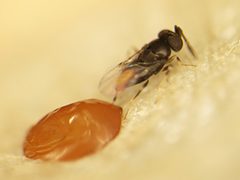
Oobius agrili is a tiny, solitary in the Encyrtidae, native to Northeast Asia. It is the only egg parasitoid released for of the emerald ash borer (Agrilus planipennis) in North America, where it has been introduced in over 31 US states. The is parthenogenic, produces multiple annually, and achieves partial phenological synchrony with its 's egg-laying period. Individual females can parasitize more than 60 host eggs, with field rates reaching 60% in optimal conditions.
Pronunciation
How to pronounce Oobius agrili: /ˈoʊbiʊs əˈɡraɪli/
These audio files are automatically generated. While they are not always 100% accurate, they are a good starting point.
Identification
Oobius agrili is extremely small (<1 mm in diameter), making direct field identification impractical without magnification. It is distinguished from other EAB biocontrol agents by its stage: it attacks , whereas Tetrastichus planipennisi and Spathius agrili attack larval stages. Visual surveys for parasitized EAB eggs or recovery of from sentinel egg deployments are used to confirm presence. The is non-stinging and lacks the metallic coloration typical of its buprestid host.
Images
Habitat
Associated with ash trees (Fraxinus spp.) in both natural forest stands and urban settings where emerald ash borer occurs. In its native range, found on ash trees in temperate regions of Northeast Asia. In North America, established in areas with EAB-infested ash, including green ash (Fraxinus pensylvanica) plantings and white fringe trees (Chionanthus virginicus) used in sentinel monitoring.
Distribution
Native to Northeast Asia (specifically recorded from Jilin province, China). Introduced and released across more than 31 US states for emerald ash borer biocontrol, with documented establishment in Michigan, Maryland, Connecticut, Massachusetts, New York, Indiana, Ohio, and other states. GBIF records confirm presence in Indiana, Maryland, Michigan, New York, and Ohio.
Seasonality
Multivoltine with at least two per year in temperate North America. Peak occurs during July and August, corresponding with peak emerald ash borer oviposition. F0 consistently occurs 2–5 days before EAB oviposition begins; F1 emergence is most synchronized with peak oviposition. F2 larvae typically enter within host to overwinter, emerging the following summer. June releases have shown favorable establishment outcomes in Maryland.
Host Associations
- Agrilus planipennis - solitary ; primary for biocontrol
- Fraxinus spp. - ash trees serving as plant for EAB and location of activity
- Fraxinus pensylvanica - green ash used in sentinel monitoring studies
- Chionanthus virginicus - white fringe tree used as alternative plant in monitoring studies
Life Cycle
Solitary with complex voltinism. Females deposit eggs within EAB eggs concealed in bark crevices. Development is temperature-dependent with multiple overlapping . Parthenogenic with female-biased sex ratio (14.5:1 female:male). occurs as diapausing larvae within parasitized eggs; induction and termination are modulated by and temperature. Critical day length for diapause induction varies spatially across the ' introduced range.
Behavior
Females actively search ash tree bark for concealed EAB and use an ovipositor to deposit eggs within them. Disperses at least 45 meters from release points based on sentinel egg studies. Shows strong preference for EAB eggs on ash compared to eggs of other Agrilus on their respective hosts. rates increase with longer exposure time (120-hour deployments yield higher parasitism than 48-hour). No significant preference detected between green ash and white fringe trees for sentinel egg parasitism in field studies.
Ecological Role
agent; functions as a -dependent mortality factor for emerald ash borer . Intended to suppress EAB populations below damaging levels in North American forests and urban areas. Part of program alongside larval Tetrastichus planipennisi and Spathius agrili.
Human Relevance
Released as a agent to mitigate economic and ecological damage from emerald ash borer, which has killed tens of millions of ash trees in North America. Over 2.5 million individuals released; over 56,000 released in Maryland alone between 2009–2015. Subject to extensive monitoring to assess establishment, spread, and efficacy. Mass-rearing protocols developed for continuous production, with storage methods established for (up to 30 days at low temperature with high humidity) and diapaused progeny (up to 270 days with moderate decline after 120 days).
Similar Taxa
- Tetrastichus planipennisialso introduced for EAB biocontrol, but attacks larval stage rather than ; endoparasitoid that develops inside larvae
- Spathius agrilialso introduced for EAB biocontrol, but attacks larval stage rather than ; ectoparasitoid that lays eggs on exterior of larvae
- other Oobius speciescongeneric may share morphological similarities but differ in associations; O. agrili distinguished by specific association with Agrilus planipennis
More Details
Biocontrol efficacy
Field rates vary considerably spatially and temporally, ranging from 1.5% to 51.2% (mean 21.4%) in Michigan and 2.6% to 29.2% (mean 16.1%) in northeastern states. Factors affecting variation remain under investigation.
Monitoring challenges
Detection is complicated by the cryptic nature of both and stages. Visual surveys of ash bark for EAB eggs are more time-efficient than bark sifting, with comparable detection rates.
Cold tolerance
Studies indicate differential cold hardiness among EAB ; this trait influences potential northern range limits for establishment.
Sources and further reading
- BugGuide
- Wikipedia
- GBIF taxonomy match
- iNaturalist taxon
- NCBI Taxonomy
- Catalogue of Life
- Pesticide use in home orchards - AgriLife Extension Entomology
- Managing Insect and Mite Pests of Texas Corn - AgriLife Extension Entomology
- Forage Sorghum Insects - AgriLife Extension Entomology
- Links - AgriLife Extension Entomology
- Social Media and Blogs - AgriLife Extension Entomology
- Parasitoids to the rescue - Emerald Ash Borer, Agrillus plenipennis, and its assassins Oobius agrili, Tetrastichus planipennisi, and Spathius agrili — Bug of the Week
- Cold tolerance of Chinese emerald ash borer parasitoids: Spathius agrili Yang (Hymenoptera: Braconidae), Tetrastichus planipennisi Yang (Hymenoptera: Eulophidae), and Oobius agrili Zhang and Huang (Hymenoptera: Encyrtidae)
- A Phenology Model for Simulating Oobius agrili (Hymenoptera: Encyrtidae) Seasonal Voltinism and Synchrony With Emerald Ash Borer Oviposition
- Monitoring the impact of introduced emerald ash borer parasitoids: factors affecting Oobius agrili dispersal and parasitization of sentinel host eggs
- Postrelease assessment of Oobius agrili (Hymenoptera: Encyrtidae) establishment and persistence in Michigan and the Northeastern United States
- Comparing Methods for Monitoring Establishment of the Emerald Ash Borer (Agrilus planipennis, Coleoptera: Buprestidae) Egg Parasitoid Oobius agrili (Hymenoptera: Encyrtidae) in Maryland, USA
- Photoperiodic modulation of diapause induction and termination in Oobius agrili Zhang and Huang (Hymenoptera: Encyrtidae), an egg parasitoid of the invasive emerald ash borer
- Long-term monitoring of the introduced emerald ash borer (Coleoptera: Buprestidae) egg parasitoid, Oobius agrili (Hymenoptera: Encyrtidae), in Michigan, USA and evaluation of a newly developed monitoring technique
- Effects of Temperature and Photoperiod on the Reproductive Biology and Diapause ofOobius agrili(Hymenoptera: Encyrtidae), an Egg Parasitoid of Emerald Ash Borer (Coleoptera: Buprestidae)
- Development of methods for the field evaluation of Oobius agrili (Hymenoptera: Encyrtidae) in North America, a newly introduced egg parasitoid of the emerald ash borer (Coleoptera: Buprestidae)
- Evaluating a New Method for Monitoring the Field Establishment and Parasitism ofOobius agrili(Hymenoptera: Encyrtidae), an Egg Parasitoid of Emerald Ash Borer (Coleoptera: Buprestidae)
- An improved method for monitoring parasitism and establishment of Oobius agrili (Hymenoptera: Encyrtidae), an egg parasitoid introduced for biological control of the emerald ash borer (Coleoptera: Buprestidae) in North America
- Comparison of two release methods for establishingOobius agrili(Hymenoptera: Encyrtidae), the introduced egg parasitoid ofAgrilus planipennis(Coleoptera: Buprestidae), in Michigan
- Effect of storage conditions on host egg suitability and the reproductive fitness of Oobius agrili (Hymenoptera: Encyrtidae), an egg parasitoid of the invasive emerald ash borer (Agrilus planipennis) (Coleoptera: Buprestidae)
- Effects of parental diapause status and release time on field reproductive biology of the introduced egg parasitoid, Oobius agrili (Hymenoptera: Encyrtidae) in the Mid-Atlantic: Implications for biocontrol of the emerald ash borer (Coleoptera: Buprestidae)