
Heterobostrychus aequalis
(Waterhouse, 1884)
oriental wood borer, lesser auger beetle, oriental bostrichid
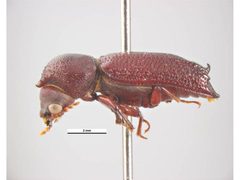
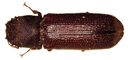
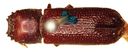
Heterobostrychus aequalis is a horned powder-post beetle ( Bostrichidae) and serious pest of seasoned hardwood timber. Native to tropical and subtropical Asia, it has been introduced to multiple continents including North America, Australia, Africa, and Oceania. The attacks starch-rich sapwood of timber and wood products, often remaining undetected until holes and appear. In Florida, it has been intercepted at ports and is now established in the wild. In Australia, its establishment status remains ambiguous despite multiple detections, with evidence suggesting at most a tenuous local in northern Queensland rather than widespread establishment.
Pronunciation
How to pronounce Heterobostrychus aequalis: /ˌhɛt.ə.roʊˈbɒs.trɪ.kəs iːˈkwɑː.lɪs/
These audio files are automatically generated. While they are not always 100% accurate, they are a good starting point.
Identification
Distinguished from similar Bostrichidae by combination of horned pronotum and association with seasoned hardwood timber. Specific diagnostic characters not detailed in available sources. Detection typically relies on holes (approximately 1.5–2 mm diameter) and fine rather than direct observation of .
Images
Appearance
Horned powder-post beetle with characteristic horn-like projections on the pronotum typical of the Bostrichidae. Specific morphological details not provided in available sources.
Habitat
Seasoned hardwood timber and stored wood products; attacks starch-rich sapwood of various timber . Associated with processed wood materials in trade and storage facilities. In naturalized , occupies dead wood and timber in tropical to subtropical climates.
Distribution
Native to tropical and subtropical Asia, particularly Southeast Asia through Oceania. Introduced and established in Florida, USA. Intercepted or reported in Africa (Comoros, Madagascar, Nigeria, Seychelles, South Africa), Australia (New South Wales, Northern Territory, Queensland—establishment status uncertain), Central America and Caribbean (Cuba), Europe (Germany), North America (Florida), Oceania (Guam, New Caledonia, Northern Mariana Islands, Papua New Guinea, Solomon Islands), and South America (Suriname). Distribution limits approximately 40° north and south of the equator.
Diet
Starch-rich sapwood of timber and wood from various plant . Documented include tea (Camellia sinensis), kapok (Ceiba pentandra), and forest trees. Feeding confined to sapwood; does not attack heartwood.
Host Associations
- Camellia sinensis - tea
- Ceiba pentandra - kapok
- forest trees - general category
Life Cycle
Complete with , larval, pupal, and stages. Larvae bore into and feed on starch-rich sapwood. Specific duration of developmental stages not documented in available sources.
Behavior
Larvae tunnel within wood, producing fine . emerge through round exit holes, leaving visible evidence of . Attacks often remain cryptic until . Adults are attracted to light. Repeatedly introduced to new areas through international trade in timber and wood products due to inadequate inspection.
Ecological Role
Major pest of seasoned hardwood causing economic damage to timber and wood products. Considered a potentially high-risk pest capable of establishing wild when climatic and conditions are favorable. In naturalized populations, functions as a decomposer of dead wood.
Human Relevance
Serious economic pest of lumber, timber, and stored wood products. Causes damage to structural timber, furniture, and other wood products. Subject to and regulatory attention in multiple countries. In Australia, ambiguous establishment status creates challenges for regulatory response to detections. Recommended response to detection includes or destruction of infested material, tracing enquiries, and limited surveys to immediate vicinity.
Similar Taxa
- other BostrichidaeSimilar horned pronotal ; distinguished by specific associations, geographic distribution, and subtle morphological characters not detailed in available sources
- Lyctus spp.Other powder-post beetles causing similar damage patterns; distinguished by lack of pronotal horns and different characteristics
Misconceptions
Early Australian records from the 1950s–1960s suggested established in northern Queensland, but subsequent decades of targeted surveillance found no confirmed breeding populations until detections in suburban Cairns in 2013 and 2015. The ' establishment status in Australia has been historically confused by interception records versus wild population establishment.
More Details
Invasion History
Frequently introduced to new areas through international timber trade due to cryptic larval habit and inadequate inspection. In Florida, intercepted at ports before becoming established in the wild. Represents a model case for challenges in distinguishing between repeated introductions and true establishment in invasion .
Detection Challenges
often remain undetected until due to internal larval feeding. Visual inspection of timber surfaces is insufficient for detection; emergence holes and are primary signs. This cryptic habit complicates regulatory surveillance and response.
Sources and further reading
- BugGuide
- Wikipedia
- GBIF taxonomy match
- iNaturalist taxon
- NCBI Taxonomy
- Catalogue of Life
- Bembicid Holdings | Entomology Research Museum
- Mantispidae | Beetles In The Bush
- July | 2024 | Beetles In The Bush
- Heterobostrychus aequalis . [Distribution map].
- World Distribution of Heterobostrychus aequalis Waterhouse (Coleoptera: Bostrychidae)
- Oriental Wood Borer, Heterobostrychus aequalis (Waterhouse) (Insecta: Coleoptera: Bostrichidae)
- Lesser auger beetle Heterobostrychus aequalis (Coleoptera: Bostrichidae) in Australia: absent or elusive?