
Bostrichidae
Latreille, 1802
auger beetles, false powderpost beetles, horned powderpost beetles
Subfamily Guides
5- Bostrichinae(horned powder-post beetles)
- Dinoderinae
- Lyctinae(Powderpost beetles)
- Polycaoninae(horned powder-post beetles)
- Psoinae
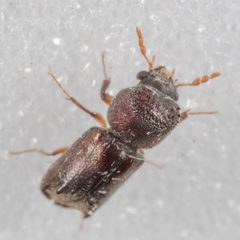
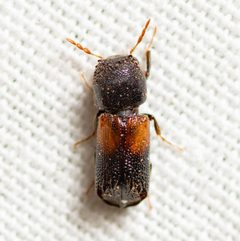
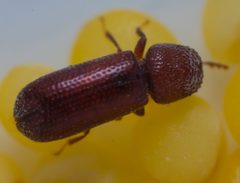
is a of beetles containing more than 700 described . Members are commonly known as auger beetles, false powderpost beetles, or horned powderpost beetles. The family includes significant stored product pests such as the lesser grain borer (Rhyzopertha dominica) and the larger grain borer (Prostephanus truncatus), as well as wood-boring species. The fossil record extends to the Cretaceous period.
Pronunciation
How to pronounce Bostrichidae: /bɒˈstrɪkɪdiː/
These audio files are automatically generated. While they are not always 100% accurate, they are a good starting point.
Identification
Most auger beetles have a downwardly directed that cannot be seen from above, as it is hidden by the . Exceptions occur in the powderpost beetle Lyctinae and the subfamily Psoinae, where the head is visible from above. Some , such as Bostrychoplites cornutus, possess large and distinctive thoracic horns.
Images
Habitat
The occupies diverse . Many are wood-borers in dead or declining wood of various tree species. Others are significant pests of stored grains and cereal products. Some species are associated with specific plants; for example, the Australian Loranthophila is associated with mistletoe.
Distribution
has a global distribution. occur across North America, Europe, Africa, Asia, Australia, and New Zealand. Specific distribution varies by species; for example, Bostrychoplites cornutus is native to parts of Africa and Arabia, while Prostephanus truncatus originated in Central America and Mexico but has been introduced to Africa.
Diet
Larvae of most are , feeding within dead wood. Some species have adapted to stored products; Rhyzopertha dominica and Prostephanus truncatus feed on stored grains, with the latter also adapted to dried cassava roots.
Ecological Role
Wood-boring contribute to decomposition of dead wood in forest . Stored product species function as significant agricultural pests, with Prostephanus truncatus capable of destroying up to 40 percent of stored grain in three months and causing 52-74 percent losses in stored cassava in Africa.
Human Relevance
Several are major pests of stored agricultural commodities. Rhyzopertha dominica (lesser grain borer) and Prostephanus truncatus (larger grain borer) cause substantial economic losses in grain storage facilities globally. Control measures include inspection, , traps, insect-proof containers, and . Some species are intercepted in international trade, such as Bostrychoplites cornutus larvae in African wooden bowls imported to Europe.
Similar Taxa
- LyctinaeLyctinae is a within , not a separate similar . Members differ from other Bostrichidae in having a visible from above rather than a downwardly directed head hidden by the .
- CerambycidaeBoth contain wood-boring beetles, but Cerambycidae (longhorned beetles) have extremely long , often longer than the body, and larvae typically produce clean tunnels rather than -filled tunnels.
- BuprestidaeBoth include wood-boring , but Buprestidae (jewel beetles) larvae produce tunnels filled with fine sawdust-like and often have a more flattened, metallic appearance.
Sources and further reading
- BugGuide
- Wikipedia
- GBIF taxonomy match
- iNaturalist taxon
- NCBI Taxonomy
- Catalogue of Life
- Christian Nansen: An Entomologist on the Move | Bug Squad
- The Silence of the Cicadas | Bug Squad
- Insecticide Netting Could Keep Beetles Out of Your Breakfast Cereal
- Larger Grain Borer: A Pesky Pest That Gets Peskier With Climate Change
- Calopterygidae | Beetles In The Bush
- Beetle Collecting 101: How to rear wood-boring beetles | Beetles In The Bush
- Lesser Grain Borer, Rhyzopertha dominica (Coleoptera, Bostrichidae)
- An investigation into application of azadirachtin as a grain protectant : biological and behavioural responses by Rhyzopertha dominica F. (Coleoptera: bostrichidae)
- Loranthophila, a new genus of Australian Lyctinae (Coleoptera: Bostrichidae) associated with Mistletoe
- Evaluating the Long-Term Efficacy of Four Active Ingredients Against Rhyzopertha dominica (F.) (Coleoptera: Bostrichidae) and Sitophilus oryzae (L.) (Coleoptera: Curculionidae) on Stored Sorghum in the United States.