
Lyctus
Fabricius, 1792
powderpost beetles, lyctid beetles
Species Guides
8- Lyctus africanus(African powderpost beetle)
- Lyctus brunneus(brown powderpost beetle)
- Lyctus carbonarius(southern lyctus beetle)
- Lyctus caribeanus
- Lyctus cavicollis(shiny powderpost beetle)
- Lyctus linearis(European lyctus beetle)
- Lyctus opaculus(powder-post beetle)
- Lyctus villosus
Lyctus is a of powderpost beetles in the Bostrichidae. These beetles are wood-boring pests with a distribution across all continents except Antarctica. The genus includes economically significant that infest hardwood products.
Pronunciation
How to pronounce Lyctus: /ˈlɪktəs/
These audio files are automatically generated. While they are not always 100% accurate, they are a good starting point.
Identification
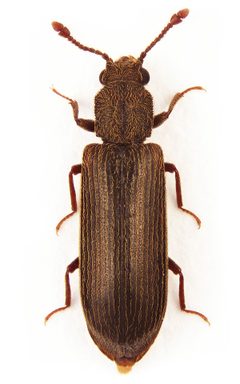
Distinguished from other Bostrichidae by the two-segmented antennal club (versus three segments in most related ). The pronotum has a distinct margin that is narrower than the elytral base. Separated from Anobiidae by the more slender body form and different antennal structure. Identification to level requires examination of genitalia and subtle differences in punctation patterns.
Images
Appearance
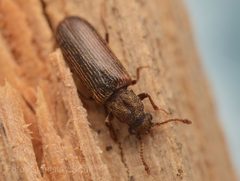
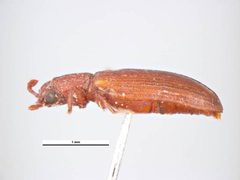
Small, slender beetles, typically 2–7 mm in length. Body is elongated and somewhat flattened. are clubbed with two-segmented clubs. Coloration ranges from reddish-brown to black. are often marked with fine punctures and may appear slightly hairy. The pronotum is narrower than the base of the elytra and has distinct lateral margins.
Habitat
Associated with hardwood timber and wood products. Found in seasoned wood, lumber, furniture, and structural timbers. Requires wood with sufficient starch content for larval development. Not found in living trees or softwoods.
Distribution
distribution; present on all continents except Antarctica. GBIF records confirm occurrence in Denmark, Norway, and Sweden.
Diet
Larvae feed on starch stored in hardwood vessels and rays. do not feed; they rely on fat reserves accumulated during larval development. Wood must contain starch content above approximately 3% for successful larval development.
Life Cycle
Complete with , larva, pupa, and stages. Eggs are deposited in wood pores or cracks. Larvae tunnel through wood, creating fine, powdery . Development time varies from several months to multiple years depending on temperature, humidity, and wood starch content. Adults emerge through round exit holes approximately 1–2 mm in diameter.
Behavior
are cryptic and primarily . They are attracted to light in some . Mating occurs on wood surfaces. Females seek cracks, checks, or pores in wood to deposit . Larvae remain within wood until , creating extensive tunnel networks that reduce wood to a fine powder.
Ecological Role
Decomposers of dead hardwood in natural settings. In native , they contribute to nutrient cycling by breaking down fallen branches and logs. In human-modified environments, they function as pests by degrading stored wood products.
Human Relevance
Significant economic pest of hardwood lumber, flooring, furniture, and structural timbers. are detected by the presence of fine, flour-like and small round exit holes. Control relies on reducing wood moisture content below 20% and using kiln-dried lumber. Some are pests of international concern.
Similar Taxa
- AnobiidaeSimilar powderpost beetles but distinguished by three-segmented antennal clubs and more rounded body form; Anobiidae also infest softwoods while Lyctus is restricted to hardwoods.
- BostrichusRelated in Bostrichidae with three-segmented antennal clubs and more robust body; Bostrichus are larger and attack both hardwoods and softwoods.
More Details
Taxonomic Note
Lyctus was historically placed in the separate Lyctidae, but modern classifications subsume Lyctinae within Bostrichidae based on phylogenetic evidence.
Economic Significance
Lyctus brunneus and L. planicollis are among the most destructive powderpost beetles globally, causing millions of dollars in damage to hardwood products annually.
Sources and further reading
- BugGuide
- GBIF taxonomy match
- iNaturalist taxon
- NCBI Taxonomy
- Catalogue of Life
- Biology of the Southern Lyctus Beetle, Lyctus Planicollis
- Lipid Biosynthesis in the Southern Lyctus Beetle, Lyctus Planicollis, Leconte (Coleoptera: Lyctidae): Distribution of Carbon From U-(Carbon-14 Labeled)-Glucose in the Principal Lipid Classes and Fatty Acids During Growth and Development.