
Dinoderus minutus
(Fabricius, 1775)
bamboo borer, bamboo powderpost beetle
Dinoderus minutus is a small wood-boring in the Bostrichidae, commonly known as the bamboo borer or bamboo powderpost beetle. Native to Asia, it has become a globally distributed pest of bamboo products through international trade. The is attracted to the internal starch content of bamboo and is considered one of the most damaging pests of the bamboo industry, capable of causing significant economic losses in storage and finished products. It has established across multiple continents including Europe, Africa, North America, South America, and Oceania.
Pronunciation
How to pronounce Dinoderus minutus: //ˌdaɪnoʊˈdɛrəs maɪˈnjuːtəs//
These audio files are automatically generated. While they are not always 100% accurate, they are a good starting point.
Identification
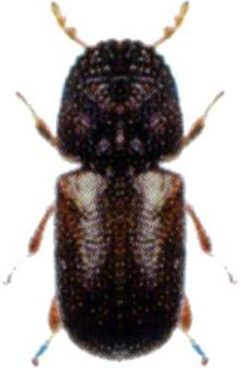
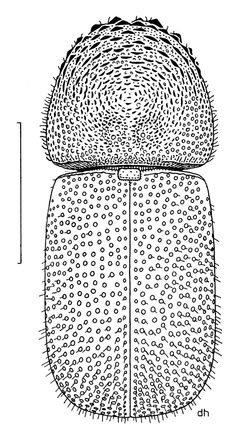
Distinguished from similar wood-boring beetles by the concealed (covered by prothorax dorsally), small size, and association with bamboo. The lamellated and dense elytral punctation with bristles are additional diagnostic features. Larvae are C-shaped with a round head, slightly expanded bearing three legs, and oval/round on thorax and ; tibia covered with dense hair.
Images
Appearance
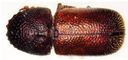
are small, elongated, columnar beetles measuring 2.5–3.5 mm in length and 1–1.5 mm in width. The body is reddish to dark brown with dense hair coverage, particularly on the . The elytra are densely punctured with small bristles. A distinctive feature is that the is dorsally covered by the prothorax and not visible from above. The are approximately 10-segmented and lamellated. The legs match the body color; the has five segments with the first and last segments equal in length.
Habitat
Associated with bamboo and bamboo-derived products; found in stored bamboo articles, finished bamboo products, and felled bamboo culms. Requires bamboo with sufficient starch content for development.
Distribution
Native to Asia: China (Beijing, Fujian, Guangdong, Sichuan, Hong Kong), India, Indonesia, Japan, Malaysia, Philippines, Sri Lanka. Introduced and established in Europe (Czechia, Germany, Italy, Norway, Sweden), Africa (Congo, Côte d'Ivoire, Ghana, Zimbabwe, Zambia), North America (USA: Florida, California; Cuba, Trinidad and Tobago), South America (Brazil, Chile, Colombia), and Oceania (Australia, Fiji, New Zealand, Papua New Guinea, Solomon Islands). Introduced to Greece (1991) and Israel (1999).
Seasonality
Oviposition most commonly observed in May and June; can last up to four months. Multiple per year (3–5) in tropical regions. Activity reduced by cold temperatures but no distinct period.
Diet
Specialized feeder on bamboo; larvae and feed on the internal starch-rich tissues of bamboo culms, shoots, trunks, and branches. Does not feed on bark, flowers, leaves, roots, or seeds.
Host Associations
- Bambusa textilis - preferred high starch content
- Bambusa pervariabilis - preferred high starch content
- Phyllostachys heterocycle - preferred high starch content
- Phyllostachys heteroclada - preferred high starch content
- Pleioblastus amarus - less preferred lower starch content
- Pseudosasa amabilis - less preferred lower starch content
- Phyllostachys bambusoides - madake bamboo used in laboratory studies
Life Cycle
are very small (0.84 mm), elongated-oval, milky white and almost transparent, laid in tunnels bored by . Larvae are C-shaped, 3–4 mm long, with round , expanded , three legs, oval/round , and dense tibial hair; larval period approximately 61 days. Pupa is spindle-shaped, 2.5–4 mm long, milky-white with black and , with finger-like appendages at the end of the sternum. Adults emerge and bore exit tunnels.
Behavior
bore tunnels 15–20 mm deep in bamboo for oviposition. Females create longer tunnels (mean 116.4 mm) and lay more (mean 253.1) than males tunnel. Tunneling activity detected by acoustic emission shows regular short pauses (~1 hour) at intervals of ~2 days, without clear in females; male tunneling is slower, non-directional, and synchronized with . Adults show strong starvation and resistance. No phototactic response to light.
Ecological Role
Decomposer of dead bamboo, returning carbon to soil. As a pest in commercial contexts, reduces bamboo volume in storage by up to 40% in 8–20 months. Limited natural ; Teretrius nigrescens and Denops albofasciata have been reported as of , larvae, pupae, and .
Human Relevance
Major economic pest of the bamboo industry worldwide. Causes direct loss of raw material and finished products through internal feeding damage. Spread globally through international trade of bamboo furniture and products. Subject to phytosanitary inspection and control measures including , heat treatment, and chemical preservatives.
Similar Taxa
- Dinoderus brevisSimilar size, , and bamboo-feeding habit; distinguished by subtle differences in antennal club and pronotal structure
- Other BostrichidaeShared wood-boring habit; D. minutus distinguished by small size, concealed , and specific association with bamboo products
Sources and further reading
- BugGuide
- Wikipedia
- GBIF taxonomy match
- iNaturalist taxon
- NCBI Taxonomy
- Different Jaws for Different Jobs | Beetles In The Bush
- sawfly | Blog
- distribution | Blog
- citizen science | Blog - Part 4
- BugGuide | Blog
- expansion | Blog
- Dinoderus minutus and D. breνis (Coleoptera: Bostrychidae): Two Exotic Wood Borers Introduced to Greece
- Behavioral characterization and alternative control methods of the Bamboo borer [Dinoderus minutus Fabricius (Coleoptera: Bostrichidae)]
- Studies on the chemical ecology of the wood-boring beetles >i<Euplatypus parallelus>/i< (Coleoptera: Curculionidae) and >i<Dinoderus minutus>/i< (Coleoptera: Bostrichidae)
- Effect of humidity on egg hatchability and reproductive biology of the bamboo borer (Dinoderus minutus Fabricius)
- Nondestructive evaluation of egg-to-adult development and feeding behavior of the bamboo powderpost beetle Dinoderus minutus using X-ray computed tomography
- Correction to: Nondestructive evaluation of egg-to-adult development and feeding behavior of the bamboo powderpost beetle Dinoderus minutus using X-ray computed tomography
- Nondestructive evaluation of oviposition behavior of the bamboo powderpost beetle, Dinoderus minutus, using X-ray computed tomography and acoustic emission