
Dinoderus
Stephens, 1830
bamboo powderpost beetles
Species Guides
2- Dinoderus japonicus(Japanese shot-hole borer)
- Dinoderus minutus(bamboo borer)
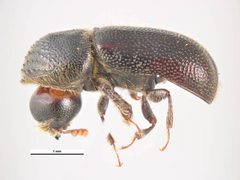
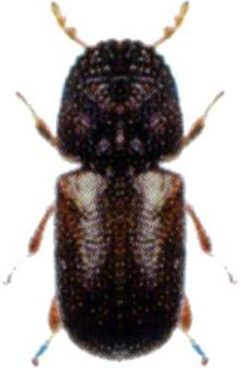
Dinoderus is a of small wood-boring beetles in the Bostrichidae, commonly known as bamboo powderpost beetles. range from 2.2 to 4.5 mm in length and are characterized by a hood-like pronotum that conceals the from above. The genus contains more than 20 described , several of which are significant economic pests of bamboo products, processed wood, and stored foodstuffs including yam and cassava chips. Species such as D. minutus, D. japonicus, D. ocellaris, and D. brevis attack harvested bamboo culms and finished products by tunneling through the material.
Pronunciation
How to pronounce Dinoderus: //daɪˈnɒdərəs//
These audio files are automatically generated. While they are not always 100% accurate, they are a good starting point.
Identification
The pronotum is hood-like and conceals the from above when viewed dorsally, a diagnostic feature of the Dinoderinae. The are never more than twice as long as the pronotum. The second antennal segment is less than half the length of the first segment. The pronotum bears posterolateral carinae, though these are weakly developed in some . Body length ranges from 2.2 to 4.5 mm.
Images
Habitat
Associated with bamboo culms and bamboo products; also found in stored wood products and processed foodstuffs such as yam chips and cassava chips. enter material through wounds or cut ends.
Distribution
Widespread distribution with native to various regions; D. minutus and D. brevis have been introduced to Greece via imported bamboo articles from Hong Kong and the Philippines respectively. D. distinctus has been studied in laboratory conditions in Port-Harcourt, Nigeria.
Life Cycle
For D. distinctus under laboratory conditions: incubation averages 6.04 days; four larval instars with capsule growth ratio of 1.32–1.40; prepupal stage lasts no more than 24 hours; pupal stage 4–6 days; total development from larva to averages 26.97 days. For D. minutus, egg hatchability and development are strongly influenced by relative humidity, with ranging from 4.63 days at 20% RH to 10.43 days at 85% RH at 30°C.
Behavior
enter bamboo culms through wounds or cut ends and construct horizontal tunnels for oviposition. Larvae bore longitudinally through culms, creating criss-crossing tunnel systems that compromise structural integrity.
Human Relevance
Several are major economic pests. D. japonicus, D. minutus, D. ocellaris, and D. brevis damage harvested bamboo culms and finished bamboo products. The also attacks wood and stored foods including yam chips and cassava chips. Management has historically relied on , which are costly and environmentally damaging.
Sources and further reading
- BugGuide
- Wikipedia
- iNaturalist taxon
- NCBI Taxonomy
- Catalogue of Life
- Dinoderus minutus and D. breνis (Coleoptera: Bostrychidae): Two Exotic Wood Borers Introduced to Greece
- Studies on the biology of Dinoderus distinctus Lesne (Coleoptera: Bostrychidae)
- Studies on the chemical ecology of the wood-boring beetles >i<Euplatypus parallelus>/i< (Coleoptera: Curculionidae) and >i<Dinoderus minutus>/i< (Coleoptera: Bostrichidae)
- Effect of humidity on egg hatchability and reproductive biology of the bamboo borer (Dinoderus minutus Fabricius)
- Effect of botanical powders and the assassin bug, Alloeocranum biannulipes Mont. and Sign. (Hemiptera: Reduviidae) against Dinoderus porcellus Lesne (Coleoptera: Bostrichidae) infesting yam chips.