
Pulvinaria
Targioni Tozzetti, 1866
cottony cushion scales, soft scales
Species Guides
4- Pulvinaria acericola(Cottony Maple Leaf Scale)
- Pulvinaria floccifera(Cottony Camellia Scale)
- Pulvinaria innumerabilis(Cottony Maple Scale)
- Pulvinaria vitis(Cottony Grape Scale)
Pulvinaria is a of soft scale insects ( Coccidae) characterized by females that produce conspicuous cottony or flocculent wax ovisacs to protect their . The genus includes economically significant agricultural and ornamental pests with broad ranges spanning numerous woody plant families. Several have potential and have established beyond their native ranges, including P. aurantii, P. psidii, and P. urbicola. The genus exhibits considerable morphological variability, complicating species identification.
Pronunciation
How to pronounce Pulvinaria: /pʊlvɪˈnɑːrɪə/
These audio files are automatically generated. While they are not always 100% accurate, they are a good starting point.
Identification
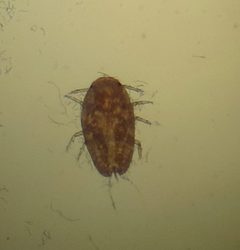
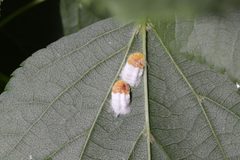
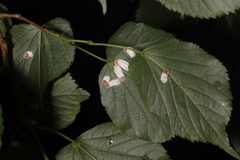
females are typically oval to oblong, often with a slightly convex dorsum. The most distinctive feature is the production of large, white, cottony or flocculent ovisacs that extend from beneath the end of the body, often longer than the body itself. This separates Pulvinaria from many other soft . -level identification requires examination of microscopic features including the arrangement of setae, presence and structure of tubular ducts, and characteristics of the marginal setae. P. aurantii closely resembles P. polygonata; P. urbicola shows variable and requires careful comparison with similar established species.
Images
Habitat
Found on woody plants including trees and shrubs in diverse environments from urban landscapes to agricultural orchards and natural forests. Specific associations vary by : P. regalis occurs in urban areas on street trees; P. pistaciae is associated with pistachio ; P. tenuivalvata is linked to sugarcane agriculture.
Distribution
distribution with native and introduced worldwide. Documented from Asia (China, India, Japan, Southeast Asia), Africa (widespread across sub-Saharan and North Africa), Europe (including recent records from Norway and Poland), North America (USA), Central America and Caribbean, South America, Australasia (Australia, New Zealand), and Pacific Islands. Individual show varying distributions: P. psidii is pantropical; P. aurantii is probably native to Japan but elsewhere; P. urbicola is invasive with records from Christmas Island, Galapagos, Hawaii, and now India.
Diet
Phloem-feeding sap-suckers. All feed on vascular plants, inserting stylets into phloem tissue to extract nutrient-rich sap.
Life Cycle
with , nymph, and stages. Females lay eggs within protective ovisacs. Eggs hatch into mobile first-instar nymphs () that disperse before settling permanently. Nymphs are initially flat and translucent, becoming increasingly convex through subsequent . Males develop through four instars, with winged adults emerging to seek females. Females remain after the second instar, continuing to feed and develop through three instars before maturity.
Behavior
Females are as , remaining permanently attached to plant leaves or stems. Males are winged and mobile, seeking females for mating. All produce honeydew, a sugar-rich that supports growth of fungi. Some species are attended by ants that harvest honeydew.
Ecological Role
Primary consumers that function as plant . Honeydew production creates trophic subsidies for ants and supports . Some serve as for hymenopteran in the Encyrtidae and Aphelinidae, which function as agents.
Human Relevance
Several are significant agricultural and horticultural pests. P. psidii (green shield ) attacks citrus, coffee, mango, guava, and numerous other crops. P. aurantii damages mango and other fruit trees. P. urbicola is a destructive pest with broad range. P. regalis affects urban street trees including maple, horse chestnut, and linden. Heavy reduce plant vigor, cause leaf yellowing and drop, and reduces and aesthetic value. Management includes , insecticidal soaps, and using .
Similar Taxa
- CoccusBoth are soft scales in Coccidae; Coccus females lack the prominent cottony ovisac characteristic of Pulvinaria, instead covering with a thinner wax layer.
- SaissetiaSimilar oval body shape and Coccidae placement; Saissetia typically have darker, more sclerotized and lack the flocculent ovisac of Pulvinaria.
- IceryaBoth produce conspicuous cottony wax masses; Icerya (monophlebid cottony cushion scales) have distinct morphological features including more elaborate wax filaments and different leg structure, and belong to a separate .
Sources and further reading
- BugGuide
- Wikipedia
- iNaturalist taxon
- NCBI Taxonomy
- Catalogue of Life
- Encyrtid Holdings | Entomology Research Museum
- Flocked hollies - Cottony camellia scale, Pulvinaria floccifera — Bug of the Week
- Pulvinaria tenuivalvata (Newstead). [Distribution map].
- First record of Pulvinaria urbicola Cockerell (Hemiptera: Coccidae) from India, with a key to the Indian species of Pulvinaria Targioni Tozzetti
- First record of Pulvinaria aurantii Cockerell (Hemiptera: Coccomorpha: Coccidae) from India, with a key to species of Pulvinaria Targioni Tozzetti in India
- Registro de Parasaissetia nigra, Pulvinaria psidii y Dysmicoccus brevipes (Hemiptera: Coccidae, Pseudococcidae) infestando mangle blanco Laguncularia racemosa
- Pulvinaria psidi . [Distribution map].
- Pulvinaria pistaciae . [Distribution map].
- First record of Pulvinaria regalis CANARD, 1968 (Hemiptera: Coccomorpha: Coccidae) in Poland
- Pulvinaria psidii . [Distribution map].
- Scale insects of the genus Pulvinaria Targioni-Tozzetti, 1866 (Hemiptera, Coccomorpha, Coccidae) in Norway
- The genus Pulvinaria (Hemiptera: Coccomorpha: Coccidae) in China, with description of a new species and a new record