
Pseudococcus longispinus
(Targioni Tozzetti, 1867)
long-tailed mealybug, longtailed mealybug
Pseudococcus longispinus is a mealybug pest in the Pseudococcidae. It is distinguished by two long, waxy filaments extending from the of females. The is a significant agricultural and horticultural pest, particularly damaging to grapevines, citrus, orchids, and tropical fruits. It is a known of Grapevine leafroll-associated virus 3 (GLRaV-3), transmitting the virus only during the first instar stage. The species has been observed to develop three annually in temperate regions, with complex patterns shifting from exposed foliage in early instars to protected bark and fruit clusters for .
Pronunciation
How to pronounce Pseudococcus longispinus: /ˌsjuːdoʊˈkɒkəs lɒnˈdʒɪspaɪnəs/
These audio files are automatically generated. While they are not always 100% accurate, they are a good starting point.
Identification
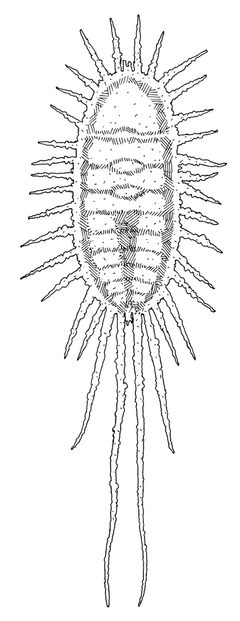
females are readily distinguished from most other mealybugs by the pair of exceptionally long, waxy caudal filaments. These filaments are longer relative to body size than in similar such as Pseudococcus calceolariae or Planococcus citri. When filaments are broken, identification requires slide-mounting of adult females for microscopic examination of morphological characters. Males and stages lack the distinctive long filaments and require expert identification. The species co-occurs with P. calceolariae on grapevines and other , but the two species do not hybridize and show strong mating isolation.
Images
Appearance
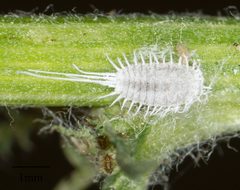
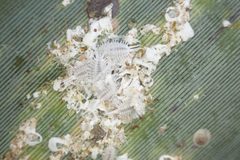
females are soft-bodied, oval-shaped, and covered with white, powdery, meal-like wax secretions. The most distinctive feature is two long, waxy filaments (tail-like appendages) protruding from the last abdominal segment, which give the its . These filaments may break off in older specimens or under disturbance. Body color beneath wax is typically pinkish or purplish. Males are smaller, winged, and have a more elongated form with reduced wax covering.
Habitat
Commercial greenhouses, interior plantscapes, vineyards, citrus orchards, and tropical and subtropical agricultural systems. Found on all above-ground plant parts including foliage, stems, fruit clusters, and under bark. First-instar occupy exposed positions on foliage; later instars and seek sheltered microhabitats including bark crevices, leaf axils, and fruit clusters.
Distribution
distribution spanning six continents. Present in Europe (including Mediterranean region, Azores, Balearic Islands, Canary Islands, Madeira), Africa (North, East, West, and Southern Africa), Asia (Middle East, South Asia, East Asia, Southeast Asia), Australasia (Australia, New Zealand, Papua New Guinea), Pacific Islands (Hawaii, New Caledonia, Solomon Islands), North America (USA, Canada), Central America and Caribbean, and South America (Argentina, Brazil, Chile, Peru, Uruguay).
Seasonality
In temperate regions such as New Zealand vineyards, three discrete per year have been documented. First generation begins with third-instar nymphs becoming active in spring, moving to foliage at bud burst. Two overlapping summer generations occur between mid-December and leaf fall. Third generation is born under bark in autumn and overwinters. declines substantially during winter, attributed to mortality rather than .
Diet
Phloem-feeding . Uses (stylets) to extract sap from plant phloem tissue. Feeding causes direct damage through nutrient removal and indirect damage via honeydew , which supports growth that reduces and aesthetic value.
Host Associations
- Vitis vinifera - primary Major agricultural ; of GLRaV-3
- Citrus spp. - primary Significant pest in citrus orchards
- Phalaenopsis orchids - primary Important greenhouse pest
- Persea americana - Avocado pest
- Diospyros kaki - Persimmon pest
- Ficus spp. - Ornamental and crop
- Zamia spp. - Coontie
- Coffea spp. - Coffee pest
- Theobroma cacao - Cocoa pest
- Cocos nucifera - Coconut pest
- Malus domestica - Apple pest
- Pyrus spp. - Pear pest
Life Cycle
Hemimetabolous development with three instars in females, four in males (including prepupal and pupal stages within cocoon). Females are , producing live young () rather than . Development rate is temperature-dependent, with optimal development around 28°C for males. In temperate vineyards, three occur annually with overlapping cohorts. First instars are the dispersive stage; later instars become increasingly sedentary and seek sheltered positions. Males are short-lived and do not feed as ; their sole adult function is mating.
Behavior
First-instar actively disperse across plant foliage and between plants. Older instars exhibit negative and thigmotaxis, seeking sheltered positions under bark, in leaf axils, or within fruit clusters. females are sedentary, remaining in protected locations to reproduce. Males emerge from cocoons and actively seek females using . Multiple mating occurs in both sexes. No has been observed. The does not hybridize with sympatric P. calceolariae despite co-occurrence on shared hosts.
Ecological Role
Agricultural pest causing direct damage through phloem feeding and indirect damage via honeydew and . Serves as prey for diverse natural enemies including encyrtid (e.g., Leptomastix spp.), predatory insects, and . Acts as for Grapevine leafroll-associated virus 3 (GLRaV-3), transmitting the virus only during the first instar stage. Hyperparasitoids may disrupt by attacking primary parasitoids.
Human Relevance
Significant economic pest of viticulture, citrus, orchids, avocado, and ornamental plants. of GLRaV-3, a major viral of grapevines affecting wine quality and vine longevity. Management relies on combining monitoring, , and selective applications targeting stages. Subject to biological control programs using and predatory beetles such as Cryptolaemus montrouzieri. Identification challenges complicate management, as slide-mounting is required for definitive identification.
Similar Taxa
- Pseudococcus calceolariaeCo-occurs on grapevines and other ; lacks the extremely long caudal filaments of P. longispinus; no hybridization possible between
- Planococcus citri citrus mealybug with similar range; lacks distinctive long tail filaments; differs in morphological details requiring slide-mounting to distinguish
- Pseudococcus viburni mealybug with overlapping distribution and ; similar reproductive but distinguishable by morphological characters and lack of long caudal filaments
More Details
Virus transmission specificity
P. longispinus transmits GLRaV-3 only during the first instar stage; third instars and do not transmit this virus. The virus is not retained through molting, indicating non-persistent or semi-persistent transmission. GLRaV-1 is not transmitted by this .
Insecticide susceptibility patterns
stages lack waxy covering and are most susceptible to contact . Short-persistence insecticides such as aminocarb and methomyl allow survival of natural enemies from protected stages, whereas persistent like maldison disrupt by killing and .
Reproductive constraints
Females must mate to produce viable offspring; no occurs. Both sexes mate multiply, but female reproductive output is not increased by multiple copulations. exposure does not affect male activity in this , unlike in P. viburni.
Sources and further reading
- BugGuide
- Wikipedia
- GBIF taxonomy match
- iNaturalist taxon
- NCBI Taxonomy
- Catalogue of Life
- Sustainable Entomology: How Insect Scientists Can Protect Our Planet
- New methods needed to boost success of Classical Biological Control to fight insect pests | Blog #
- Green Light: New ID Test Ready for Invasive Mealybug Pest
- Pseudococcus longispinus . [Distribution map].
- Longtailed Mealybug Pseudococcus longispinus (Targioni Tozzetti) (Insecta: Hemiptera: Pseudococcidae)
- Do hyperparasitoids disrupt the biological control of Pseudococcus longispinus in persimmon?
- Do hyperparasitoids disrupt the biological control of Pseudococcus longispinus in persimmon? [Dataset]
- Mating behavior ofPseudococcus calceolariaeandPseudococcus longispinus(Hemiptera: Pseudococcidae): are asexual reproduction and hybridization possible?
- Reproductive Biology of Three Cosmopolitan Mealybug (Hemiptera: Pseudococcidae) Species, Pseudococcus longispinus, Pseudococcus viburni, and Planococcus ficus
- Transmission of grapevine leafroll‐associated closteroviruses by Pseudococcus longispinus and P. calceolariae
- Stylet penetration behaviour of Pseudococcus longispinus in relation to acquisition of grapevine leafroll virus 3
- The Dispersal, Age-Structure and Natural Enemies of the Long-Tailed Mealybug, Pseudococcus Longispinus (Targioni-Tozzetti), in Relation to Sampling and Control.
- Chemical and integrated control of the long-tailed mealybug, Pseudococcus longispinus (Targioni-Tozzetti) (Hemiptera: Coccidae) in the Riverland of South Australia
- Distribution and life history of the longtailed mealy bug, Pseudococcus longispinus (Homoptera: Pseudococcidae), in Auckland vineyards
- Susceptibility of avocado varieties to the long-tailed mealybug,Pseudococcus longispinus (Targioni Tozzetti) (Homoptera: pseudococcidae), and a survey of its host plants in Israel
- Study on Fecundity, Reproductive Rate, Intrinsic Rate of Increase and Effects of Diets on Adult Longevity, of a Long-tailed Mealybug, Pseudococcus longispinus (Targioni-Tozzetti) Parasitoid, Leptomastix nr. epona (Walker)
- Effect of Different Temperatures and Host Plants on the Biology of the Long-Tailed Mealy Bug Pseudococcus longispinus (Targioni and Tozzetti) (Homoptera: Pseudococcidae)