
Cinara pinea
(Mordvilko, 1895)
Large Pine Aphid
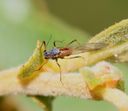
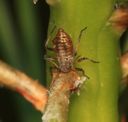
Cinara pinea, the Large Pine , is a specialized phloem-feeding insect that colonizes Pinus , particularly Scots pine (Pinus sylvestris). It exhibits distinctive seasonal , with spring peaks driven by plant availability, followed by summer declines during drought conditions and partial autumn recoveries after rainfall. The species overwinters as laid on current-year needles, with approximately 50% egg mortality between oviposition and hatching. Winged morphs (alatae) are produced only during June and early July, contingent on both crowding and active host shoot growth.
Pronunciation
How to pronounce Cinara pinea: //saɪˈnɑːrə ˈpɪniə//
These audio files are automatically generated. While they are not always 100% accurate, they are a good starting point.
Images
Habitat
Coniferous forests dominated by Pinus , particularly Scots pine (Pinus sylvestris). Colonizes woody stems and branches, specifically twigs bearing needles from both current and previous years. Distribution within the is influenced by phloem depth, with higher densities on thinner shoots where phloem is nearer the surface.
Distribution
Native to Europe; documented in Scotland and inferred across the range of Scots pine in Europe. Associated with Pinus sylvestris distribution.
Seasonality
Active peak in spring ( availability in phloem). virginoparae produced only during June and early July. Summer population decline during drought. Partial autumn recovery following rainfall. hatch in spring; broken by increasing daylength after December 22, with hatching rate controlled by temperature.
Diet
Phloem sap of Pinus , particularly Scots pine. Feeding depends on seasonal concentrations in phloem; high spring amino acid levels support growth, while reduced nitrogen availability and increased osmotic pressure in summer limit survival.
Host Associations
- Pinus sylvestris - obligatePrimary ; colonizes current and previous year shoots
- Pinus - obligate-level specificity
Life Cycle
Overwinters as on current-year needles of pine. Eggs sparsely distributed, rarely more than one or two eggs per needle. Egg mortality approximately 50% between oviposition and hatching. Hatching success increases with longer and lower temperatures; development rate after increases with temperature. Spring followed by parthenogenetic . morphs produced in early summer under specific conditions of crowding and active host shoot growth. and egg-laying occur in autumn.
Behavior
Nymphal distribution shows 'inertial' pattern: smallest instars feed near bud at shoot tips, while (apterae) feed primarily on second-year twigs. on shoots correlates with phloem accessibility rather than gregariousness. crashes occur during summer drought; rapid response to improved water status following autumn rainfall.
Ecological Role
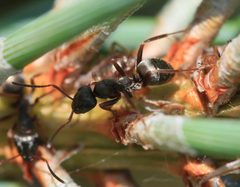
Produces honeydew that supports growth and attracts predatory including yellowjackets (Vespula pensylvanica). Serves as prey for various natural enemies. Acts as a nutrient sink, extracting phloem and excreting excess as honeydew.
Human Relevance
Potential forestry pest; heavy can reduce tree growth. Honeydew production creates sticky deposits on surfaces beneath infested trees. Subject of modeling studies to understand -plant interactions and develop management strategies.
Similar Taxa
- Cinara strobiAlso colonizes Pinus ; distinguished by preference for white pine and seasonal autumn activity peak
- Cinara conifer aphidsGeneral morphological similarity within ; C. pinea distinguished by specific association with Scots pine and distinctive seasonal
More Details
Population Regulation
Computer modeling indicates that nymphal is the primary limiting factor for size, sensitive to both and plant quality as reflected in growth rates. production, contrary to conventional belief, proved negligible in regulating population numbers due to insufficient production and brief seasonal occurrence.
Alate Induction
Winged morph production requires both crowding during nymphal development AND tree in active shoot growth stage. Mature shoots suppress formation regardless of crowding. and temperature do not directly influence alate production; maternal crowding experience does not affect nymphal response.
Sources and further reading
- BugGuide
- iNaturalist taxon
- NCBI Taxonomy
- Catalogue of Life
- Winning PBESA Images: A Damselfly, a Blowfly and a Monarch | Bug Squad
- A Posse for the Pieiris? | Bug Squad
- What's That Bug? | Bug Squad
- Aphids serve a tasty autumn treat: White pine aphid, Cinara strobi — Bug of the Week
- Unusual Galls Trigger National Survey of Adelgids and Their Predators in Bhutan Forests
- Bug Eric: Wasp Wednesday: Western Yellowjacket
- The population dynamics of the large pine aphid, Cinara pinea (Mordv.)
- Distribution, survival and hatching of overwintering eggs in the large pine aphid, Cinara pinea (Mordv.) (Hom., Lachnidae)
- The Role of the Host Plant in the Population Dynamics of the Large Pine Aphid, Cinara pinea
- Host plant and crowding effects in the induction of alatae in the large pine aphid, Cinara pinea
- The distribution of the large pine aphid, Cinara pinea (Mordv.) within the canopy of Scots pine, Pinus sylvestris L.