
Cinara strobi
(Fitch, 1851)
White Pine Aphid
Cinara strobi, the white pine , is a large aphid specialized on white pine (Pinus strobus). It is notable for exceptionally high autumn that produce copious honeydew, attracting stinging and creating nuisance conditions. The species exhibits parthenogenetic during the growing season, with live birth of nymphs accelerating population growth. Uniquely among Cinara aphids, C. strobi harbors three bacterial endosymbionts—Buchnera aphidicola, Sodalis sp., and Serratia symbiotica—representing an intermediate stage of replacement where the latter has become metabolically incompetent yet persists.

Pronunciation
How to pronounce Cinara strobi: //ˈsɪnərə ˈstroʊbaɪ//
These audio files are automatically generated. While they are not always 100% accurate, they are a good starting point.
Identification
Images
Appearance
Habitat
White pine (Pinus strobus) trees in forested and urban settings. Found on branches and needles where phloem feeding occurs.
Distribution
North America, associated with the range of its plant white pine (Pinus strobus). Documented in eastern North America including the DMV (DC-Maryland-Virginia) region.
Seasonality
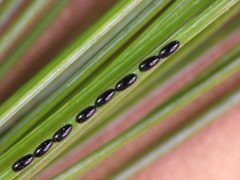
Peak in autumn (September-October). Overwinters as on pine needles. Parthenogenetic during growing season transitions to producing eggs as cold weather approaches.
Diet
Phloem sap from white pine (Pinus strobus). Excess excreted as honeydew.
Host Associations
- Pinus strobus - obligate White pine; sole plant for feeding and
Life Cycle
Complex with seasonal shift in reproductive mode. During growing season: parthenogenetic females give live birth to daughters (viviparity), with embryos of next carried before birth, compressing generation time. In autumn: winged sexual males and females produced, mate, and females deposit on pine needles. Eggs survive winter cold, hatch in spring.
Behavior
Forms dense on pine branches. Produces large quantities of honeydew that falls from trees, attracting yellowjackets, bald-faced hornets, European hornets, and paper wasps. Parthenogenetic allows rapid increase from few individuals to thousands.
Ecological Role
Phloem feeder that transfers nutrients from plant to via honeydew. Honeydew supports in autumn and provides substrate for growth, which blackens plant surfaces. Serves as model organism for studying bacterial endosymbiont replacement and erosion.
Human Relevance
Nuisance pest when abundant due to sticky honeydew falling on sidewalks, vehicles, and people. Attracted create safety concerns in urban areas. Not a direct agricultural pest but can reduce aesthetic value of ornamental white pines.
Similar Taxa
- Other Cinara speciesOther Cinara aphids feed on different conifer (spruce, fir, cedar, larch); C. strobi distinguished by white pine specificity and exceptionally long rostrum
- Longistigma caryaeGiant bark aphid also produces copious honeydew and attracts , but feeds on hardwood trees (oak, hickory) rather than conifers
More Details
Endosymbiont biology
Cinara strobi uniquely harbors three fixed bacterial endosymbionts: Buchnera aphidicola (provides ), Sodalis sp. (co-primary , contributes to nutrition), and Serratia symbiotica (highly eroded , pseudogenized, no longer contributes to nutrition). This represents an intermediate stage of symbiont replacement where a once-competent symbiont is retained despite providing no apparent benefit.
Sources and further reading
- BugGuide
- GBIF taxonomy match
- iNaturalist taxon
- NCBI Taxonomy
- Archive — Bug of the Week
- Aphids serve a tasty autumn treat: White pine aphid, Cinara strobi — Bug of the Week
- Clubmoss along the Ozark Trail | Beetles In The Bush
- I don’t think you’re ready for these Jellies: A brief dive into the world of Jellyfish - Buglife Blog - Buglife
- Bug Eric: Wasp Wednesday: Western Yellowjacket
- What do insects do in winter, Part 2? Tolerating the big chill: Banded woolly bears, Pyrrharctia isabella, field crickets, Gryllus spp., baldfaced hornets, Dolichovespula maculata, and others — Bug of the Week
- A Freeloader?: The Highly Eroded Yet large Genome of the Serratia symbiotica symbiont of Cinara strobi