
Longistigma caryae
(Harris, 1841)
Giant Bark Aphid
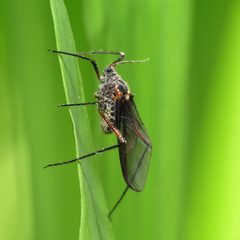
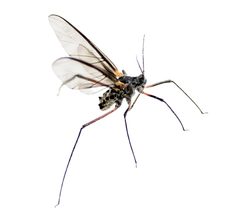
Longistigma caryae, commonly known as the giant bark aphid, is the largest native to the United States. First described in 1841 from pignut hickory in Massachusetts, this species was later placed in its own due to its distinctive extremely long, slender stigma that extends around the end of the wing. It feeds on the bark of hickory trees and has been documented across eastern and central North America.
Pronunciation
How to pronounce Longistigma caryae: /lɔŋˈgɪstɪɡmə ˈkɛəriˌi/
These audio files are automatically generated. While they are not always 100% accurate, they are a good starting point.
Identification
Distinguished from all other North American aphids by its exceptional size and the extraordinarily elongated stigma that curves around the wing tip, a feature unique to the Longistigma. The combination of large body size and bark-feeding habit on hickory trees further separates it from superficially similar .
Images
Habitat
Associated with hickory trees (Carya spp.), particularly on bark surfaces. Specific microhabitat details such as preferred tree age, forest type, or elevation range are not documented in available sources.
Distribution
Eastern and central United States; recorded from Massachusetts, Illinois, and likely throughout the range of its hickory . Fossil records indicate historical presence in Iceland.
Diet
Feeds on bark of hickory trees, specifically documented from pignut hickory (Carya glabra).
Host Associations
- Carya glabra - primary pignut hickory, original collection site in Massachusetts
Human Relevance
May occasionally attract attention due to its large size when observed on hickory trees in residential or park settings. No documented economic importance or pest status.
Similar Taxa
- Tuberolachnus salignusSimilar large body size and 'giant willow aphid'; distinguished by association (willow vs. hickory) and wing venation features
- Other Lachninae aphidsShare bark-feeding habits but distinguished by the unique elongated stigma structure and larger size of Longistigma caryae
Sources and further reading
- BugGuide
- Wikipedia
- GBIF taxonomy match
- iNaturalist taxon
- NCBI Taxonomy
- Catalogue of Life
- Archive — Bug of the Week
- Gall darn it! Gall insects on hickory, oak, and elm, Phylloxera caryaecaulis, Andricus palustris, Colopha ulmicola — Bug of the Week
- When is a locust borer not a locust borer? | Beetles In The Bush
- Bug Eric: February 2009
- Pseudoscorpiones | Beetles In The Bush
- Megacyllene comanchei revisited | Beetles In The Bush
- Giant Bark Aphid, Longistigma caryae (Harris) (Insecta: Hemiptera: Aphididae)