
Tuberolachnus salignus
(Gmelin, 1790)
Giant Willow Aphid
Tuberolachnus salignus, the giant willow aphid, is one of the largest in the world, reaching up to 5.8 mm in body length. It is an obligate parthenogenetic species, reproducing without males and producing genetically identical female offspring. Native to Asia, it has become , spreading to all continents except Antarctica. The species feeds primarily on willow phloem sap and is considered an pest in regions including New Zealand, where it impacts willow-based industries and apiculture through copious honeydew production.
Pronunciation
How to pronounce Tuberolachnus salignus: /tuː.bə.roʊˈlæknəs səˈlɪgnəs/
These audio files are automatically generated. While they are not always 100% accurate, they are a good starting point.
Identification
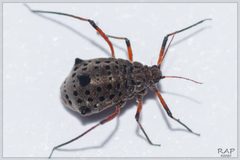
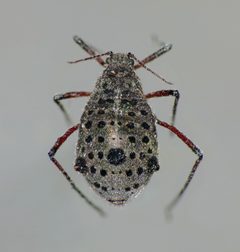
Distinguished from other aphids by its exceptional size (largest known ), the prominent single , and rows of black dots along the body. The combination of large size, dark coloration with grayish-gold abdominal hairs, and the characteristic thorn-like tubercle separates it from other Lachninae aphids. Winged and wingless forms occur; winged forms have clear wings with dark brown forewing edges.
Images
Habitat
Almost entirely dependent on willow trees (Salix spp.), living on bark and feeding on phloem sap. Found on stems and branches, with seasonal movement to shoot tips for feeding. Survives year-round on trees, with spring retreating behind bark or into soil during harsh conditions. In New Zealand, also recorded on apple, pear, and poplar trees near infested willows.
Distribution
distribution; originated in Asia (likely Japan/Korea region) and now present on all continents except Antarctica. Established in Europe, North America, South America (Patagonia), Australia, and New Zealand (first detected December 2013 in Auckland, now widespread). In New Zealand, present wherever willow occur. Also recorded in India (Kashmir) on apple.
Seasonality
Most active in late summer and early autumn when peak. time of 2-3 weeks depending on temperature. Year-round activity with reduced in colder months. In spring, colonies often not visible as aphids retreat to protected locations. In some regions, late September appearance on willow shoots with population buildup through late February.
Diet
Obligate phloem feeder on willow (Salix) , including white willow (Salix alba), common sallow (Salix cinerea), and Indian willow (Salix tetrasperma). Also recorded on poplar (Populus spp.), apple (Malus domestica), pear (Pyrus spp.), and quince (Cydonia oblonga). Feeds during warmer daylight hours, preferring shoot tips where plant tissue is softer. Ingests large volumes of sucrose-rich, -poor sap, excreting excess sugar as honeydew.
Host Associations
- Salix alba - primary white willow
- Salix cinerea - primary common sallow
- Salix tetrasperma - primary Indian willow
- Salix fragilis - crack willow
- Populus spp. - secondary poplars
- Malus domestica - secondary apple; recorded in New Zealand and India
- Pyrus spp. - secondary pear
- Cydonia oblonga - secondary quince
Life Cycle
Obligate with no sexual phase; all individuals are female. via viviparity (live birth of nymphs) during favorable conditions. Four nymphal instars before adulthood; development from nymph to takes approximately two weeks at optimal temperatures (17.5-22.5°C). Adults live approximately five weeks. of 35-71 offspring per female. In autumn, females switch to oviparity, laying thousands of black on branches as the stage. Eggs hatch in spring when trees become sappy.
Behavior
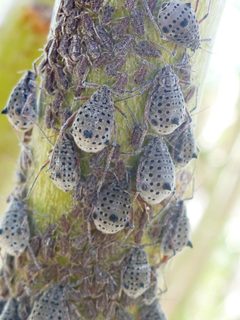
Feeds preferentially during daylight and warmer hours, climbing to shoot tips to access softer plant tissue. Uses paired stylets to pierce phloem: one injects saliva, the other ingests sap-saliva mixture. Forms dense colonies on stems. Exhibits temperature-dependent feeding rates to compensate for nutritionally dilute phloem sap. Produces copious honeydew (estimated 1517 kg/ha/season in some regions), which attracts ants, , bees, and other insects that feed on the excreted sugars but not the aphids themselves.
Ecological Role
Significant honeydew producer, creating localized sugar resource that supports diverse insect including ants, , bees, and flies. Honeydew deposition alters soil biota and biochemical properties beneath trees, increasing microbial , respiration, and mesofauna abundance. Serves as prey for lady beetles, lacewings, hover fly larvae, and parasitic wasps. In range, disrupts native and supports invasive social wasp (Vespula spp.) through subsidy.
Human Relevance
pest of willow plantations used for production, land stabilization, and soil erosion control. In New Zealand, threatens willow-based apiculture: honeydew foraged by honeybees causes honey crystallization in combs and reduces health and honey quality. of apple orchards near willow trees causes tree decline, yellowing leaves, stunted growth, reduced fruit production, and growth. Subject of efforts using introduced Pauesia nigrovaria in New Zealand.
Similar Taxa
- Longistigma caryaeAlso called 'giant bark aphid' and among largest North American aphids; distinguished by occurrence on oak, hickory, walnut, and beech rather than willow, and lacking the prominent characteristic of T. salignus
- Lachnus spp.Related aphids in same tribe Lachnini; distinguished by smaller size, different associations, and lack of the distinctive large
More Details
Genetic diversity
genetics studies reveal extremely low clonal diversity: only 16 found in 660 specimens from 27 populations across five countries. Two genotypes comprise more than half of all specimens, with wide geographic distribution. Dense colonies can contain multiple genotypes, suggesting of colonizing individuals.
Honeydew chemistry
Honeydew contains high levels of melezitose, a trisaccharide that causes honey to crystallize. Melezitose content varies by willow cultivar and plant age, though not as significantly as sucrose, fructose, and glucose levels. This chemical signature creates management challenges for apiculture industries.
Temperature response
Ideal temperature range is 17.5-22.5°C. increase rapidly following heavy rainfall events. decreases in colder months but colonies remain active; spring populations retreat behind bark or into soil.
Sources and further reading
- BugGuide
- Wikipedia
- GBIF taxonomy match
- iNaturalist taxon
- NCBI Taxonomy
- Catalogue of Life
- ‘Twas two weeks before Christmas – Giant bark aphids, Longistigma caryae and giant willow aphids, Tuberolachnus salignus — Bug of the Week
- ‘Twas the week before Christmas: Giant bark aphids, Longistigma caryae, and giant willow aphids, Tuberolachnus salignus — Bug of the Week
- Archive — Bug of the Week
- ‘Twas the week before Christmas: Giant bark aphids, Longistigma caryae, and giant willow aphids, Tuberolachnus salignus — Bug of the Week
- Studies On the Feeding and Nutrition of Tuberolachnus Salignus (Gmelin) (Homoptera, Aphididae)
- Population genetics of Tuberolachnus salignus , an obligate parthenogenetic aphid
- Tuberolachnus salignus (Gmelin, 1790) (Hemiptera, Aphididae) on Apple (Malus domestica Borkh) in Kashmir, India
- Studies On the Feeding and Nutrition ofTuberolachnus Salignus(Gmelin) (Homoptera, Aphididae)
- Monitoring giant willow aphid (<i>Tuberolachnus salignus</i>) on apple trees in close proximity to infested willows
- Honeydew Deposition by the Giant Willow Aphid (Tuberolachnus salignus) Affects Soil Biota and Soil Biochemical Properties
- Direct and Indirect Impacts of the Tuberolachnus salignus (Hemiptera: Aphididae) Invasion in New Zealand and Management Alternatives
- Seasonal abundance of Tuberolachnus salignus and its effect on flowering of host willows of varying susceptibility
- The potential of harlequin ladybird beetle Harmonia axyridis as a predator of the giant willow aphid Tuberolachnus salignus: voracity, life history and prey preference
- Effect of willow cultivar and plant age on the melezitose content of giant willow aphid ( Tuberolachnus salignus ) honeydew
- Host selection and performance of the giant willow aphid, Tuberolachnus salignus Gmelin – implications for pest management
- Host specificity testing of Pauesia nigrovaria (Hymenoptera: Braconidae: Aphidiinae) for classical biological control of Tuberolachnus salignus (Hemiptera: Aphididae: Lachninae) in New Zealand
- Honeydew production by the giant willow aphid (Tuberolachnus salignus, Hemiptera: Aphididae) and its effect on foraging yellowjackets (Hymenoptera: Vespidae)