
Cinara
Curtis, 1835
giant conifer aphids, conifer aphids
Species Guides
10- Cinara costata(Mealy Spruce Aphid)
- Cinara curvipes(Bow-legged Fir Aphid)
- Cinara fornacula(Large Green Spruce Aphid)
- Cinara hottesi(Blue-black Spruce Aphid)
- Cinara laricifex(Black Larch Aphid)
- Cinara obscura(Dark Spruce Stem Aphid)
- Cinara pergandei(Globose Pine Aphid)
- Cinara pilicornis(spruce shoot aphid)
- Cinara pinea(Large Pine Aphid)
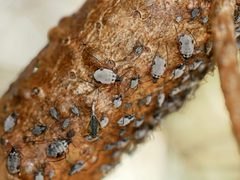
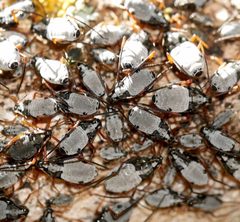
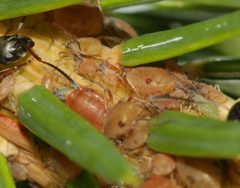
Cinara is a of aphids comprising approximately 200-243 , commonly known as giant conifer aphids. These insects are specialized feeders on conifers in the Pinaceae and Cupressaceae, including pines, firs, spruces, cedars, and cypresses. Molecular studies indicate their tribe Eulachnini represents the basal group for other aphids. Several species are significant pests of cultivated Christmas trees, particularly Fraser fir production in the southeastern United States.
Pronunciation
How to pronounce Cinara: //ˈsɪnərə//
These audio files are automatically generated. While they are not always 100% accurate, they are a good starting point.
Identification
Cinara are distinguished from other by their association with coniferous plants; species identification traditionally relies on host plant patterns. They are among the larger aphids, hence the "giant conifer aphids." Specific morphological characters for distinguishing species within the genus require specialized taxonomic expertise and examination of specimens.
Images
Habitat
Coniferous forests and plantations; specifically colonizes lignified parts including branches, trunks, roots, and leaves of Pinaceae (Pinus, Cedrus, Abies, Picea) and Cupressaceae trees. Found on both native stands and cultivated ornamental or Christmas tree plantations.
Distribution
Widespread in the Northern Hemisphere. Approximately 200 globally distributed, with documented presence across North America, Europe, and Asia. In Turkey, 30 species have been recorded; distribution records confirmed from Denmark, Norway, and Sweden.
Seasonality
Autumn represents a period of high activity when can increase dramatically due to parthenogenetic and live birth. occurs as deposited on pine needles. Some have been documented with overwintering strategies involving cryoprotectant compounds.
Diet
Phloem-feeding on coniferous trees. Uses a long piercing-sucking beak to tap into -rich phloem sap. Excess carbohydrates are excreted as honeydew, a sugary waste product that attracts other insects including social .
Host Associations
- Pinus spp. - Primary ; multiple Cinara specialized on pines
- Cedrus spp. - for multiple including Cinara cedri
- Abies spp. - Includes Fraser fir (Abies fraseri), significant for Christmas tree industry
- Picea spp. - Spruce as
- Juniperus spp. - Cupressaceae
- Cupressus spp. - Cupressaceae
- Platycladus spp. - Cupressaceae
- Abies nordmanniana - Specific record from Turkey
Life Cycle
includes both parthenogenetic and sexual phases. During growing seasons, consist entirely of females reproducing parthenogenetically via live birth (viviparity), with embryos of the next already present within newborn females. As winter approaches, winged males and females are produced, mating occurs, and females deposit on plant needles. Cinara cedri has been documented hosting three : Buchnera aphidicola, a secondary symbiont, and bacteria.
Behavior
Forms dense colonies on plant branches. Produces substantial quantities of honeydew that accumulates on surfaces below, attracting ants, , and other insects. Some demonstrate specific microhabitat preferences within host plants (branches, trunks, roots, or leaves).
Ecological Role
Herbivore of coniferous trees; honeydew production supports by providing resources for other insects including yellowjackets, paper wasps, and ants. Serves as for specialized in the Pauesia. can impact forest health and Christmas tree aesthetics.
Human Relevance
Several are economically significant pests of Christmas tree production, particularly in the southeastern United States where Fraser fir (Abies fraseri) dominates the market. Heavy reduce tree aesthetic quality through honeydew accumulation and growth. Management requires approaches combining cultural, chemical, and methods. Cinara cupressi is among species attacking cultivated Christmas trees.
Similar Taxa
- Mindarus pinicola (balsam twig aphid)Also feeds on conifers and is a pest of Christmas trees; distinguished by feeding location on new growth and causing different damage (twig distortion vs. honeydew accumulation)
- Adelges piceae (balsam woolly adelgid)Another conifer-feeding Hemipteran pest of firs; distinguished by woolly wax secretions and gouting damage at twig ends rather than -like honeydew production
More Details
Symbionts
Cinara cedri has been demonstrated to three : the primary endosymbiont Buchnera aphidicola, a secondary symbiont, and bacteria in the .
Natural enemies
in the Pauesia are specific to Cinara, representing specialized agents.
Cryoprotection
Research on Cinara tujafilina indicates adaptations for including accumulation of cryoprotectant compounds, similar to strategies documented in other freeze-tolerant insects.
Sources and further reading
- BugGuide
- Wikipedia
- GBIF taxonomy match
- iNaturalist taxon
- NCBI Taxonomy
- Catalogue of Life
- Aphids serve a tasty autumn treat: White pine aphid, Cinara strobi — Bug of the Week
- Cinara aphids Archives - Entomology Today
- Bug Eric: Wasp Wednesday: Western Yellowjacket
- What do insects do in winter, Part 2? Tolerating the big chill: Banded woolly bears, Pyrrharctia isabella, field crickets, Gryllus spp., baldfaced hornets, Dolichovespula maculata, and others — Bug of the Week
- The Pest Management Methods That Deliver Picture-Perfect Christmas Trees
- Bug Eric: October 2011
- Cinara (Hemiptera: Aphidoidea) species distributed in Turkey and their host plants Türkiye'de dağılım gösteren Cinara (Hemiptera: Aphidoidea) türleri ve konak bitkileri