
Cinara curvipes
(Patch, 1912)
Bow-legged Fir Aphid
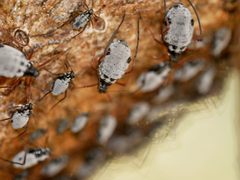
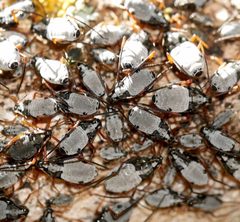
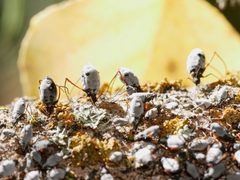
Cinara curvipes is a large, black bark native to North America that has become in Central Europe since 2000. measure 4.5–5.3 mm. The exhibits remarkable flexibility, with capable of both holocyclic (sexual) and anholocyclic (parthenogenetic) . In its invaded range, it can form exceptionally large colonies of thousands of individuals by May—a phenomenon not observed in native European Cinara species. The aphid secretes copious honeydew throughout most of the year, supporting diverse insect .
Pronunciation
How to pronounce Cinara curvipes: /ˈkɪnərə ˈkɜrvaɪˌpiz/
These audio files are automatically generated. While they are not always 100% accurate, they are a good starting point.
Identification
Large (4.5–5.3 mm), black-colored bark . Distinguished from other Cinara by its status in Europe and association with Abies . The specific epithet 'curvipes' (curved foot) may refer to leg , though this is not explicitly described in available sources.
Images
Habitat
Bark of fir trees (Abies spp.); specifically trunk surfaces, undersides of branches, and branch bases. In Central Europe, found on ornamental and plantation firs in both natural and urban settings.
Distribution
Native to USA, Canada, and Mexico. in Central Europe: Germany (Brandenburg/Eberswalde area, Bavaria, Berlin, Mecklenburg-Western Pomerania, Lower Saxony), with records also from Serbia.
Seasonality
Active year-round in mild conditions. In Central Europe, honeydew secretion occurs from March through November/December. occurs as (holocyclic cycle) or as larval/ morphs of the V6 (anholocyclic cycle). Peak colony development by May.
Diet
Phloem sap from fir trees, obtained by piercing bark tissues with sucking mouthparts.
Host Associations
- Abies grandis - primary Observed in Germany since 2000
- Abies concolor - primary Observed in Germany since 2000
- Abies koreana - Also recorded as
- Abies veitchii - Also recorded as
Life Cycle
cycle with two possible . Holocyclic: fundatrices emerge from winter , followed by 5 ; the last generation is bisexual and produces winter eggs. Anholocyclic: 6 parthenogenetic generations, with the V6 generation (born November) and reproducing in March. The V3 generation in both cycles produces both V4 and sexuparae, causing overlap of holocyclic and anholocyclic cycles on the same tree.
Behavior
Forms dense colonies on bark surfaces. Secretes large quantities of honeydew from March through November/December, before . In Central Europe, colonies can reach thousands of individuals by May—unprecedented among native Cinara .
Ecological Role
Significant producer of honeydew, serving as an important food source for Formicidae (ants) and Vespidae () from early spring through late autumn. May have local significance for . Notable absence of predatory insects observed in European .
Human Relevance
Pest of ornamental and plantation fir trees (Abies spp.) in Europe. Potential economic impact on Christmas tree production and forestry. Subject of invasion research regarding climate change .
Similar Taxa
- Native European Cinara speciesC. curvipes distinguished by much larger colony sizes (thousands vs. hundreds), year-round activity, and dual reproductive strategies not observed in native
- Other Cinara aphids on AbiesRequires morphological examination; C. curvipes specifically associated with A. grandis and A. concolor in European invasions
Sources and further reading
- BugGuide
- GBIF taxonomy match
- iNaturalist taxon
- NCBI Taxonomy
- Aphids serve a tasty autumn treat: White pine aphid, Cinara strobi — Bug of the Week
- Cinara aphids Archives - Entomology Today
- Bug Eric: Wasp Wednesday: Western Yellowjacket
- What do insects do in winter, Part 2? Tolerating the big chill: Banded woolly bears, Pyrrharctia isabella, field crickets, Gryllus spp., baldfaced hornets, Dolichovespula maculata, and others — Bug of the Week
- The Pest Management Methods That Deliver Picture-Perfect Christmas Trees
- Bug Eric: October 2011
- Cinara curvipes (Patch) (Sternorrhyncha, Lachnidae) - eine invasive Rindenlaus in Mitteleuropa.
- Adapting to change: exploring the distribution dynamics of the alien and potentially invasive aphid species Cinara curvipes (Hemiptera: Aphididae) in the context of global warming