
Adelges piceae
(Ratzeburg, 1844)
Balsam Woolly Adelgid, Balsam Woolly Aphid
Adelges piceae is a small, wingless, sap-sucking insect native to Europe that has become a destructive pest of fir trees (Abies spp.) in North America. Introduced to the United States around 1900, it has killed millions of trees across the continent. The produces distinctive white, woolly wax secretions that protect and . It is particularly damaging to balsam fir and Fraser fir, causing gouting, reduced growth, and tree mortality.
Pronunciation
How to pronounce Adelges piceae: //əˈdɛldʒiːz ˈpɪsi.aɪ//
These audio files are automatically generated. While they are not always 100% accurate, they are a good starting point.
Identification
Distinguished from other adelgids by its exclusive association with Abies (fir) rather than Tsuga (hemlock) or Picea (spruce). The white woolly wax masses on bark and twigs are distinctive, though similar in appearance to the hemlock woolly adelgid (Adelges tsugae), which occurs on hemlock trees. Microscopic examination reveals characteristic wax plate with crater-like pits. Gouting and swelling at twig tips is a diagnostic of on trees.
Images
Appearance
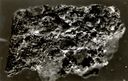
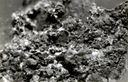
females are small (approximately 1 mm), oval, dark purple to black, and wingless. The body is covered by dense, white, woolly wax secretions that form ribbon-like bands extending from tergal , with characteristic wax plates bearing crater-like pits visible under magnification. First-instar nymphs are tiny, flattened, and settle in bark crevices. Longitudinal grooves in wax ribbons indicate secretions from rows of that fuse together.
Habitat
Coniferous forests dominated by fir ; occurs on bark and twigs of living Abies trees. concentrate in bark crevices, particularly under bud at nodes, at the base of seasonal growth, and among staminate flower buds or flower bracts. Over 95% of feeding individuals occur in branch crevices, with highest densities within the 3-year growth of branches.
Distribution
Native to Europe (widespread across continental Europe, UK, Ireland, Scandinavia, and Turkey). in North America: established in Canada (British Columbia, New Brunswick, Newfoundland, Nova Scotia, Ontario, Prince Edward Island, Quebec) and USA (California, Idaho, Maine, New York, North Carolina, Oregon, Tennessee, Virginia, Washington, West Virginia). Also introduced to Chile in South America. First detected in North America around 1900.
Seasonality
In temperate regions, first-instar nymphs settle and establish on trees in spring and summer. first-instar stage persists through summer and autumn. Development resumes in late autumn to mid-winter. present in mid-winter, with -laying occurring in late winter. Second develops between March and June. Two generations per year in most .
Diet
Phloem-feeding on parenchyma of xylem rays in trees. Insert hypodermic-like mouthparts through bark to access stored nutrients in specialized vascular tissues.
Host Associations
- Abies balsamea - primary Balsam fir; major in eastern North America
- Abies fraseri - primary Fraser fir; economically important Christmas tree in southeastern USA
- Abies amabilis - Pacific silver fir; studied in nitrogen experiments
- Abies lasiocarpa - Subalpine fir
- Abies grandis - Grand fir
Life Cycle
Complex with cyclical . deposited in late winter within woolly wax ovisacs. First-instar nymphs () disperse and settle in bark crevices, primarily in 3-year branch growth. first-instar stage over summer and autumn. Development resumes late autumn; mature mid-winter. Second completes development March-June. Two generations annually. All stages feed on tree vascular tissues.
Behavior
Sedentary sap-feeding once settled; nymphs remain fixed in bark crevices. Initial settling of larvae is inhibited by nitrogen-fertilized trees. Complex distribution within tree crowns: over 95% of individuals occur in crevices on branches, with 9-13 distinct strata identified within the 3-year tip of branches. Produces copious white wax secretions for protection. No active stage in ; spread occurs through and human-mediated transport of infested plant material.
Ecological Role
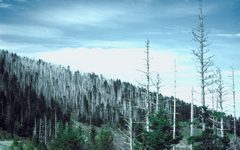
Significant forest pest that alters stand composition and structure through fir mortality. Creates gaps and reduces biodiversity in affected . Serves as prey for introduced and native in programs. can transform forest composition by eliminating fir .
Human Relevance
Major economic pest of Christmas tree production, particularly Fraser fir in North Carolina where over 4 million trees are produced annually. Causes catastrophic damage to native forest , especially in the Appalachian Mountains. Subject of extensive efforts involving importation of European including Pullus impexus, Laricobius erichsonii, Aphidecta obliterata, and Cremifania nigrocellulata. Management relies on combining cultural, chemical, and biological control methods.
Similar Taxa
- Adelges tsugaeHemlock woolly adelgid; similar white woolly wax masses but restricted to Tsuga (hemlock) rather than Abies (fir); causes similar gouting and tree mortality
- Pineus strobiPine bark adelgid; occurs on Pinus ; shares woolly wax covering but on different
Misconceptions
More Details
Biological Control History
Subject of one of the longest-running programs in North America, initiated in 1933. Multiple European introduced to eastern Canada and USA, with varying degrees of establishment and success.
Morphological Variation
North American show significant morphological divergence between eastern and western populations, with three distinct groups identified: 'Maritime,' 'British Columbia,' and 'intermediate' groups from North Carolina, Oregon, and Washington. This variation reflects history and has implications for control strategies.
Wax Chemistry
Wax secretions have been studied for potential control using analogs. The ribbon-like wax structure with longitudinal grooves represents secretions from rows of wax-producing .
Sources and further reading
- BugGuide
- GBIF taxonomy match
- iNaturalist taxon
- NCBI Taxonomy
- Catalogue of Life
- The Pest Management Methods That Deliver Picture-Perfect Christmas Trees
- Unusual Galls Trigger National Survey of Adelgids and Their Predators in Bhutan Forests
- Field Tour Offers Close-Up Look at Invasive Species Security
- Iral Ragenovich: A Career Devoted to Caring for the Land and Serving People
- Flocked hemlocks - hemlock woolly adelgid, Adelges tsugae — Bug of the Week
- The scourge of the hemlock - hemlock wolly adelgid, Adelges tsugae — Bug of the Week
- Adelges piceae . [Distribution map].
- SAMPLING POPULATIONS OF ADELGES PICEAE (HOMOPTERA: PHYLLOXERIDAE) ON BALSAM FIR, ABIES BALSAMEA
- NITROGEN FERTILIZATION OF THE HOST TREE AND POPULATION GROWTH OF THE BALSAM WOOLLY APHID, ADELGES PICEAE (HOMOPTERA: ADELGIDAE)
- DISTRIBUTION OF FIRST INSTAR NYMPHS OF ADELGES PICEAE (HOMOPTERA: PHYLLOXERIDAE) ON BRANCHES OF BALSAM FIR, ABIES BALSAMEA, AFTER COLONIZATION
- DISTRIBUTION, ABUNDANCE, AND SURVIVAL OF THE BALSAM WOOLLY APHID, ADELGES PICEAE (HOMOPTERA: PHYLLOXERIDAE), ON BRANCHES OF BALSAM FIR, ABIES BALSAMEA
- Pullus impexus(Muls.) (Coleoptera, Coccinellidae), a Predator ofAdelges piceae(Ratz.) (Hemiptera, Adelgidae), with notes on its Parasites
- SCANNING ELECTRON MICROSCOPIC STUDY OF WAX DISTRIBUTION ON THE BALSAM WOOLLY APHID, ADELGES PICEAE (HOMOPTERA: ADELGIDAE)
- Development, Feeding Habits, and Predator-Prey Relations of Insect Predators of the Balsam Woolly Aphid, Adelges piceae (Ratz.) (Homoptera: Adelgidae), Recently Introduced into Canada
- Morphometric variation between populations of the balsam woolly aphid, Adelges piceae (Ratzeburg) (Homoptera: Adelgidae), in North America
- Studies of Predators of the Balsam Woolly Aphid Adelges piceae (Ratz.) (Homoptera: Adelgidae): IX. Pullus impexus (Muls.) (Coleoptera: Coccinellidae), An Introduced Predator in Eastern Canada,
- Studies of Predators of the Balsam Woolly Aphid, Adelges piceae (Ratz.) (Homoptera: Adelgidae): V. Laricobius erichsonii Rosen. (Coleoptera: Derodontidae), an Introduced Predator in Eastern Canada,
- Studies of Predators of the Balsam Woolly Aphid,Adelges piceae(Ratz.) (Homoptera: Adelgidae): III. Field Identification and some Notes on the Biology ofNeoleucopis pinicolaMall. (Diptera: Chamaemyiidae)