
Adelges
Vallot, 1836
Species Guides
5- Adelges abietis(Pineapple-gall Adelgid)
- Adelges cooleyi(Cooley spruce gall adelgid)
- Adelges laricis(Larch Woolly Aphid)
- Adelges piceae(Balsam Woolly Adelgid)
- Adelges tsugae(Hemlock Woolly Adelgid)
Adelges is a of conifer-feeding insects in the Adelgidae, closely related to aphids. Members of this genus are small, sap-sucking insects that infest various fir (Abies) and hemlock (Tsuga) . Several species are significant forest pests, notably Adelges tsugae (hemlock woolly adelgid), which has caused extensive mortality of eastern hemlock forests in North America, and Adelges piceae (balsam woolly adelgid), a pest of balsam and Fraser firs. The genus exhibits complex often involving parthenogenetic and alternating between winged and wingless forms.
Pronunciation
How to pronounce Adelges: /əˈdɛldʒiːz/
These audio files are automatically generated. While they are not always 100% accurate, they are a good starting point.
Identification
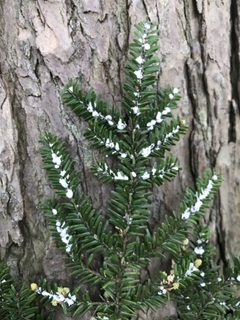
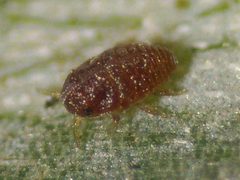
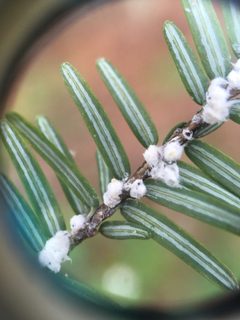
Adelges are typically recognized by the distinctive white, woolly wax secretions produced by mature individuals, which form protective coverings over their bodies and . The insects themselves are minute (1-2 mm), soft-bodied, and often once settled on tissue. Nymphs may appear dark and uncoated before wax production begins. Winged forms, when present, are rarely observed and have reduced mouthparts.
Images
Habitat
in this are exclusively associated with coniferous , primarily in the genera Abies (firs) and Tsuga (hemlocks). They inhabit the bark of twigs and branches, typically near the base of needles, where they insert mouthparts to feed on vascular tissues. Heavy occur on host trees in both forested and urban environments.
Distribution
The has a broad distribution spanning North America, Europe, and Asia. Individual ranges vary: Adelges tsugae is native to Asia and western North America but in eastern North America; Adelges piceae occurs in North America and Europe; other species are restricted to specific regions. Distribution is closely tied to tree ranges.
Seasonality
Activity patterns vary by and region. Adelges tsugae exhibits an unusual reverse seasonality, with peak activity in winter and dormancy () during summer months. typically complete development in late winter through spring, with -laying occurring in late winter.
Diet
Phloem-feeding on conifer . Mouthparts are inserted into parenchyma of xylem rays to extract stored nutrients, depriving host trees of vital reserves.
Host Associations
- Tsuga canadensis - primary eastern hemlock; major for A. tsugae in eastern North America
- Tsuga caroliniana - primary Carolina hemlock; for A. tsugae
- Abies balsamea - primary balsam fir; for A. piceae
- Abies fraseri - primary Fraser fir; for A. piceae
- Abies nordmanniana - primary Nordmann fir; original for D. nordmannianae
- Abies alba - primary European silver fir; secondary for D. nordmannianae in Europe
- Pseudotsuga menziesii - primary Douglas-fir; for A. cooleyi
Life Cycle
Complex typically involve two per year. Development proceeds through , (mobile first-instar nymph), and four nymphal stages before adulthood. Eastern North American of A. tsugae reproduce through ( without ). Spring generations may produce winged females that cannot reproduce, while wingless lay eggs. Winter generations are entirely wingless and reproductive.
Behavior
stages are the only mobile phase, dispersing to locate feeding sites on trees. Once settled, individuals become and feed in place. Some exhibit (summer dormancy) as an adaptive response to avoid and adverse conditions. Wax secretion provides protection from desiccation and predators.
Ecological Role
As herbivores, Adelges can exert profound top-down effects on forest . Heavy cause tree decline and mortality, leading to shifts in forest composition and associated biodiversity losses. Infestation induces host plant defense responses (salicylic acid , increased phenolics and terpenoids) that can mediate interactions with other herbivores. In their native ranges, natural enemy including predatory beetles (Laricobius spp.) and fungi provide .
Human Relevance
Several are economically and ecologically significant pests. Adelges tsugae threatens eastern hemlock forests from Maine to Georgia, with estimated costs exceeding $214 million in control expenditures and lost property values. Management approaches include application (primarily for ornamental trees), using introduced predatory beetles, and development of varieties. Spread occurs through human transport of infested nursery stock and natural by wildlife.
Similar Taxa
- PineusAnother in Adelgidae; distinguished by associations with pines (Pinus) rather than firs or hemlocks, and differences in wax secretion patterns and complexity.
- Aphidoidea (aphids)Superficially similar in and feeding habits; distinguished by the presence of cornicles (siphuncles) in aphids, which are absent in adelgids, and differences in alternation patterns.
More Details
Notable species
The includes several of management concern: Adelges tsugae (hemlock woolly adelgid), Adelges piceae (balsam woolly adelgid), and Adelges cooleyi (Cooley spruce gall adelgid). Some taxonomic treatments place certain species in segregate genera (e.g., Dreyfusia for A. nordmannianae).
Sampling challenges
Detection is difficult due to small size and habit. Specialized techniques include visual inspection, Velcro-covered ball sampling for high detection, and beat sheet methods for predatory surveys.
Sources and further reading
- BugGuide
- GBIF taxonomy match
- iNaturalist taxon
- NCBI Taxonomy
- Catalogue of Life
- Flocked hemlocks - hemlock woolly adelgid, Adelges tsugae — Bug of the Week
- The scourge of the hemlock - hemlock wolly adelgid, Adelges tsugae — Bug of the Week
- Upside and downside of a warming world for the despoiler of hemlocks: Hemlock woolly adelgid, Adelges tsugae — Bug of the Week
- ‘Tis the season to inspect your hemlocks for hemlock wooly adelgid, Adelges tsugae — Bug of the Week
- Biological Control for Hemlock Woolly Adelgid: Where Do We Stand?
- Little, Fuzzy, But Not So Cute: The Hemlock Woolly Adelgid
- Adelges piceae . [Distribution map].
- Dreyfusia nordmannianae (silver fir adelges).
- A Native Lepidopteran is Impacted by Host Defenses Induced by Hemlock Woolly Adelgid (Adelges tsugae)
- Impact of host defenses induced by hemlock woolly adelgid (Adelges tsugae) feeding on a native lepidopteran
- Biology, ecology and efficacy of Lecanicillium muscarium as a potential fungal biocontrol of the invasive hemlock woolly adelgid (Adelges tsugae) on eastern hemlock (Tsuga canadensis)
- Insecticidal Control of Adelges cooleyi on Douglas-Fir in Ohio, with Notes on Biology12
- SAMPLING POPULATIONS OF ADELGES PICEAE (HOMOPTERA: PHYLLOXERIDAE) ON BALSAM FIR, ABIES BALSAMEA
- Methods for collecting and rearing three sympatric biocontrol agents of Adelges tsugae (Hemiptera: Adelgidae) in eastern North America.