
Adelges cooleyi
(Gillette, 1907)
Cooley spruce gall adelgid, Douglas fir adelgid, gall adelgid
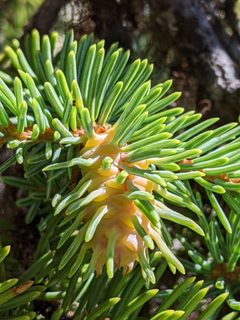
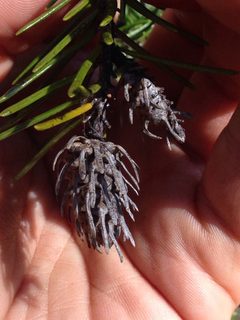
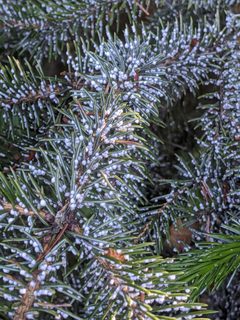
Adelges cooleyi is a gall-forming adelgid native to western North America, specifically the Rocky Mountains and Cascade Mountains. It is a -alternating with a complex involving two primary hosts: spruce (Picea) species as primary hosts and Douglas fir (Pseudotsuga menziesii) as the secondary host. On spruce, the adelgid induces the formation of distinctive pineapple-shaped galls at branch terminals. On Douglas fir, it produces white, cottony wax masses containing but causes less conspicuous injury. The species has two per year and exhibits morphological dimorphism: progredientes migrate to current-year needles while sistentes settle on older needles.
Pronunciation
How to pronounce Adelges cooleyi: /ə.ˈdɛl.dʒɪz ˈkoʊ.li.aɪ/
These audio files are automatically generated. While they are not always 100% accurate, they are a good starting point.
Identification
Distinguished from other adelgids by its -alternating and gall formation on spruce. On Douglas fir, identified by white, cottony wax masses containing at needle bases. On spruce, the pineapple-shaped terminal galls are diagnostic. The two morphs—progredientes (winged or wingless, on current-year needles) and sistentes (wingless, on older needles)—represent different developmental on the same host. Distinguished from Adelges tsugae (hemlock woolly adelgid) by host association: A. cooleyi occurs on spruce and Douglas fir, never on hemlock.
Images
Habitat
Forests, shelter-belt plantings, and shade-tree settings. On spruce: forms galls at branch terminals. On Douglas fir: occurs on bark near needle bases, producing waxy masses. Found in montane and foothill environments of western North America; introduced occur in eastern North America and Europe where trees have been planted.
Distribution
Native to western North America: Rocky Mountains and Cascade Mountains. Documented in Alberta, British Columbia, and throughout the western United States. Introduced to eastern North America (Ohio and beyond) and Europe (Austria, Belgium, Serbia) through movement of ornamental trees.
Seasonality
Two annually. First generation: nymphs hatch from in spring, develop on spruce or Douglas fir, with producing eggs by late summer. Second generation: eggs hatch and nymphs develop through autumn, entering during summer dormancy. On Douglas fir, progredientes migrate to current-year needles in late May to early June; sistentes appear later and settle on older needles.
Diet
Phloem sap obtained by inserting long, hypodermic-like stylets through bark into parenchyma of xylem rays.
Host Associations
- Picea glauca - primary White spruce; gall formation occurs on this
- Picea engelmannii - primary Engelmann spruce; gall formation occurs on this
- Picea pungens - primary Colorado blue spruce; gall formation, though less severe than on other spruces
- Pseudotsuga menziesii - secondary Douglas fir; less conspicuous injury, white cottony wax masses produced
- Picea sitchensis - primary Sitka spruce; occasionally attacked
Life Cycle
Complex -alternating or heteroecous cycle. On spruce: fundatrices induce gall formation at branch terminals; within galls, nymphs develop in chambers. Galls open to release winged migrants that fly to Douglas fir. On Douglas fir: two morphs develop—progredientes (early-emerging, colonize current-year needles, may be winged or wingless) and sistentes (later-emerging, colonize older needles, wingless). Progredientes produce sexuparae that return to spruce; sistentes produce the . Alternatively, some may complete the cycle without host alternation.
Behavior
Exhibits -dependent settling : sistentes redistribute to exploit needle cortex with less competition, preferring the groove on upper needle surfaces. Probing behavior differs by needle age: sistentes probing is inhibited on young current-year needles, explaining their preference for older foliage. Progredientes show no such inhibition. The two morphs represent an unusual case of conspecifics preferring different-aged foliage on the same .
Ecological Role
Herbivore and gall-former; modifies plant architecture through gall induction on spruce. Serves as prey for predatory beetles, particularly Aphidecta obliterata (a coccinellid), though this performs better on alternative prey (Elatobium abietinum). are strongly regulated by mortality, which acts as the key factor controlling changes.
Human Relevance
Pest of ornamental spruce and Douglas fir in nurseries, Christmas tree plantations, and landscapes. Economic damage includes disfigurement of spruce trees through gall formation and tree decline under heavy . Subject to insecticidal control programs and research. sequenced (270.2 Mb) as a resource for understanding adelgid evolution and developing management strategies.
Similar Taxa
- Adelges tsugaeBoth are woolly adelgids with similar appearance (white waxy secretions), but A. tsugae occurs exclusively on hemlock (Tsuga) and does not form galls; A. cooleyi occurs on spruce and Douglas fir and forms pineapple-shaped galls on spruce.
- Adelges piceaeBoth are spruce-feeding adelgids, but A. piceae (balsam woolly adelgid) does not alternate and forms dense woolly masses on twigs rather than terminal galls; it also lacks the progrediens/sistentes dimorphism.
- Pineus spp.Pine adelgids that form woolly masses on pine needles; distinguished by (Pinus vs. Picea/Pseudotsuga) and lack of complex gall formation or host alternation.
Sources and further reading
- BugGuide
- GBIF taxonomy match
- iNaturalist taxon
- NCBI Taxonomy
- Catalogue of Life
- Cooley spruce gall adelgids, Adelges cooleyi — Bug of the Week
- Archive — Bug of the Week
- Flocked hemlocks - hemlock woolly adelgid, Adelges tsugae — Bug of the Week
- The scourge of the hemlock - hemlock wolly adelgid, Adelges tsugae — Bug of the Week
- Upside and downside of a warming world for the despoiler of hemlocks: Hemlock woolly adelgid, Adelges tsugae — Bug of the Week
- ‘Tis the season to inspect your hemlocks for hemlock wooly adelgid, Adelges tsugae — Bug of the Week
- The Biology of Adelges cooleyi (Gill.) (Homoptera: Phylloxeridae)
- Insecticidal Control of Adelges cooleyi on Douglas-Fir in Ohio, with Notes on Biology12
- The settling behaviour of Adelges cooleyi sistentes on mature needles of Douglas fir
- Sampling plan for Adelges cooleyi (Hemiptera: Adelgidae) in spruce seed orchards
- Studies on the factors affecting the population levels of Adelges cooleyi (Gillette) on Douglas fir
- Studies on the factors affecting the population levels of Adelges cooleyi (Gillette) on Douglas fir
- Effects of host needle age on the settling behaviour of two morphs of Adelges cooleyi (Gill.)
- Phylogeography of a specialist insect, Adelges cooleyi: historical and contemporary processes shape the distribution of population genetic variation
- A comparison of Aphidecta obliteratae (L.) (Col., Coccinellidae) populations feeding on Elatobium abietinum (Walker) and on Adelges cooleyi (Gillette)
- Whole-genome sequence of the Cooley spruce gall adelgid, Adelges cooleyi (Hemiptera: Sternorrhyncha: Adelgidae)